How to Verify Spanish Supplier Bank Accounts: VoP, NIF, and the Registro Mercantil
Spain is an unusual market for supplier verification. Since October 2025 every Spanish bank must run a Verification of Payee check before a euro transfer leaves the account — and Spain also has a second, older mechanism that most of Europe does not: a national service that matches an IBAN to the account holder's tax number. Between them, the account layer in Spain is stronger than in almost any other euro-area country. The company layer behind it is a different story, spread across a provincial registry network, a tax census, and a beneficial ownership register that is not open to the public. This guide covers both, and where the gap between them sits.
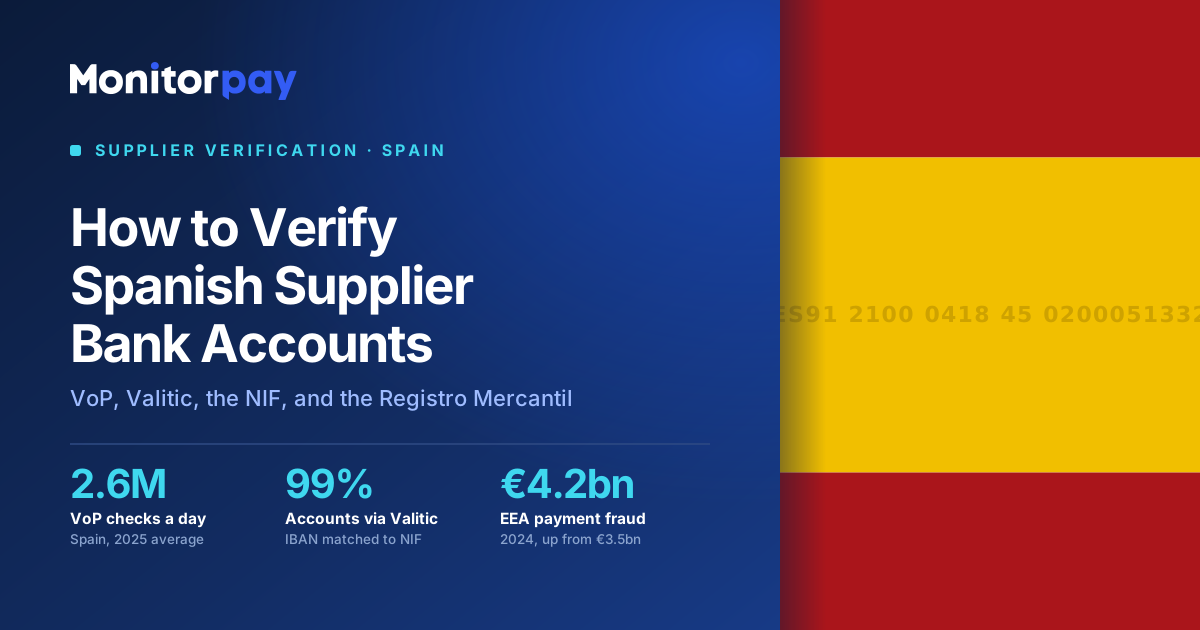
Sources: Iberpay 2025 activity data; EBA and ECB joint Payment Fraud Report, December 2025.
The account layer, part one: Verification of Payee
Verification of Payee became mandatory across the euro area under the Instant Payments Regulation, Regulation (EU) 2024/886, which required all payment service providers in euro-using EEA countries to offer the check from 9 October 2025. In Spain the service went live on 5 October 2025, built and operated centrally by Iberpay, the operator of the Spanish national payment system, on behalf of the banking community. More than 120 Spanish and international banks and PSPs signed up, and the service now handles an average of 2.6 million verifications a day.
The mechanics are the same as elsewhere in the EU. Before a SEPA credit transfer or instant transfer is sent, the payer's bank asks the payee's bank whether the name being paid matches the account holder on the destination IBAN. The answer comes back as one of four outcomes.
| Result | What it means | What to do |
|---|---|---|
| Match | The name you entered matches the registered account holder. | Proceed. This is the expected result for a correctly onboarded supplier. |
| Close match | Near-identical, usually a legal-form suffix, an accent, or a trading name. The bank normally returns the registered name for you to confirm. | Check the returned name against your supplier record before releasing. |
| No match | The name does not correspond to the account holder. | Stop. Re-verify through a channel you already trust, not one supplied in the payment request. |
| Verification not possible | The payee's PSP could not answer — out of scope, unreachable, or a technical failure. | Treat as unverified, not as a pass. |
One point is easy to lose. As the Banco de España sets out in its guidance for bank customers, the IBAN remains the account's unique identifier. If the result is a no match or a close match and the payer chooses to continue anyway, the money still goes to the IBAN entered — and may not reach the intended payee. VoP informs the decision; it does not block the payment.
The account layer, part two: Valitic
This is the part of the Spanish setup that has no direct equivalent in most of Europe. Alongside VoP, Iberpay operates Valitic, a national account ownership service that answers a different question: does this IBAN belong to the holder of this tax identification number?
Where VoP compares a name to an account, Valitic compares a NIF, CIF or NIE to an account. It returns a binary result — OK if the identifier and the account correspond, KO if they do not — in around one second. The service reaches 93 participating institutions and can confirm ownership on roughly 88 million accounts, about 99% of all Spanish bank accounts.
The distinction matters for supplier payments. Company names are messy: trading names, abbreviations, legal-form suffixes, regional-language variants and accented characters all produce close matches that a human then has to adjudicate. A tax identifier is exact. For a business counterparty, matching an IBAN to a NIF removes almost all of the ambiguity that makes name matching operationally expensive.
| VoP | Valitic | |
|---|---|---|
| Question answered | Does the name match the account? | Does the tax ID match the account? |
| Input | Payee name + IBAN | NIF / CIF / NIE + IBAN |
| Result | Match, close match, no match, not possible | OK or KO |
| Trigger | Automatic, before a SEPA transfer | On request, any time |
| Legal basis | Mandatory under Regulation (EU) 2024/886 | Commercial service, not mandated |
| How companies access it | Through their own bank's payment flow | Through a participating bank or PSP |
Valitic is not self-serve. Banks, payment institutions and e-money providers can join directly if they hold their own IBANs and are authorised by the Banco de España; companies and public bodies reach the service through a participating institution. If you pay Spanish suppliers at volume, it is worth asking your Spanish banking partner whether they offer it — many corporates are entitled to it and have never been told.
For a Spanish business supplier, matching the IBAN to the company's NIF is a cleaner control than matching it to the company's name. Use the name check as the regulatory baseline and the tax-ID check as the operational one.
Reading a Spanish IBAN
Spanish IBANs are 24 characters. Unlike most SEPA countries, the domestic account structure is still visible inside the IBAN: the old CCC format — bank, branch, two check digits, account number — sits directly after the country and IBAN check digits.
Format validation is worth doing first because it is free and it catches transcription errors, but it is the weakest check available. It confirms the string is well-formed and identifies the issuing bank. It says nothing about whether the account is open, or whose it is.
The company layer: reading the NIF
Every Spanish company has a NIF (Número de Identificación Fiscal). You will still see it called a CIF, and for practical purposes the two are the same thing — Royal Decree 1065/2007 folded the old Código de Identificación Fiscal into the general NIF system with effect from 2008, and the number itself did not change. A company whose CIF was B66254202 has the NIF B66254202 today.
The useful part is the first character. For a Spanish legal entity it encodes the legal form, which means you can tell what kind of organisation you are dealing with before you look anything up.
Two of these are worth flagging in a supplier context. An N prefix means a non-resident foreign entity with Spanish tax obligations, and a W prefix means the Spanish permanent establishment of a foreign company. Both are entirely legitimate, but many validation tools hard-code the domestic A-to-J range and reject them. If your onboarding rejects an N or W NIF automatically, you are turning away real suppliers.
A related trap: if the supplier is a sole trader (an autónomo) rather than a company, the NIF is their personal DNI and starts with a digit, or is a NIE starting with X, Y or Z. There is no company to look up in the commercial registry, and no annual accounts to check. The verification path is different, and thinner.
The company layer: the Registro Mercantil
Spain's commercial registry is not a single database. It is a network of provincial registries — one per province — coordinated by the Colegio de Registradores under the supervision of the Ministry of Justice, plus the Registro Mercantil Central (RMC) in Madrid.
The division matters when you are looking something up. The RMC maintains the national index and handles company name reservations, but the authoritative file on any given company sits with the provincial registry for its domicilio social — its registered office. A Madrid-registered S.L. is on file in Madrid, not centrally. In practice you confirm the province through the central index and then order the document from the provincial registry through the registrars' shared electronic portal.
Three outputs are relevant to supplier verification:
- The nota simple (also called a nota informativa) — the standard extract. It gives the registered name, NIF, registered office, share capital, directors and attorneys-in-fact, the list of registered acts, and which annual accounts have been deposited. This is the workhorse document for onboarding.
- The cuentas anuales — the deposited annual accounts, including balance sheet and profit and loss.
- The BORME (Boletín Oficial del Registro Mercantil) — the official commercial gazette, published daily and freely searchable. Incorporations, capital changes, director appointments and dissolutions all appear here.
The signal most buyers miss: cierre registral
Spanish companies must file annual accounts, and the sanction for not doing so is unusually informative for anyone assessing a supplier.
The sequence is fixed by law. Under article 253 of the Ley de Sociedades de Capital, directors must draw up the accounts within three months of the financial year end. The shareholders' meeting approves them, and they must be deposited with the provincial registry within one month of approval. If a full year passes from the financial year end without approved accounts on file, article 282 triggers cierre registral — the registrar closes the company's registry sheet.
A closed sheet means no new entries can be registered — no new director appointments, no capital changes, no new powers of attorney — with a short list of exceptions covering resignations, revocation of powers, dissolution and court-ordered entries. Separately, the tax authority can trigger its own registry closure by provisionally striking an entity from the Index of Legal Entities for tax non-compliance. And beyond the closure itself, the accounting regulator can impose fines from €1,200 to €60,000, rising to €300,000 where turnover exceeds €6 million.
For a buyer, this is a gift. A supplier whose registry sheet is closed is telling you, on the public record and with a date attached, that it has not filed accounts for over a year. That is not proof of fraud — plenty of small S.L.s file late through disorganisation rather than intent. But it is a hard, checkable signal that belongs in an onboarding decision, and it is invisible to any account-level check.
Insolvency: the Registro Público Concursal
The commercial registry will eventually reflect a formal insolvency, but it is not the fastest source. Spain runs a separate national register for insolvency proceedings — the Registro Público Concursal, operating under the consolidated Insolvency Law (Royal Legislative Decree 1/2020), managed under the Ministry of Justice and operated by the Colegio de Registradores.
It publishes the court resolutions issued in Spanish insolvency proceedings across three sections: insolvency notices, registry entries of insolvency resolutions, and out-of-court settlement arrangements. Access is free, online and permanent, and — unlike the beneficial ownership register — requires no demonstration of legitimate interest. That makes it one of the cheapest checks on this list to add to an onboarding flow.
One caveat is worth carrying. The register depends on courts, notaries, insolvency administrators and registrars filing correctly, and the operator states plainly that it cannot guarantee the completeness of what is published. Treat a hit as significant and a miss as inconclusive rather than as a clean bill of health.
VIES, the ROI, and why good suppliers fail VAT checks
This one causes more false rejections than any other Spanish check, so it is worth being precise about.
A Spanish company has a NIF from the moment it registers with the tax authority. It does not automatically appear in VIES, the EU VAT information exchange system. To be listed, the company must separately apply to join the Registro de Operadores Intracomunitarios (ROI) by filing form 036 and ticking box 582. Only then is it assigned an intra-community VAT number with the ES prefix and entered in the VIES census. The tax authority has three months to decide, and silence counts as refusal.
A perfectly legitimate Spanish supplier that trades only domestically will have a valid NIF and will return "not found" in VIES, because it never had a reason to join the ROI. A VIES miss is a reason to check the NIF against the tax census — not a reason to treat the company as fake.
The inverse also holds: a VIES hit confirms the company is authorised for intra-EU trade on the date you checked. It does not confirm the company is solvent, active in any meaningful sense, or connected to the bank account in front of you.
Beneficial ownership: the RCTIR
Spain created a single national beneficial ownership register, the Registro Central de Titularidades Reales (RCTIR), under Royal Decree 609/2023. It went live on 19 September 2023 and is run by the Ministry of Justice through the Directorate-General for Legal Certainty and Public Faith. It covers all Spanish legal persons, plus trusts and analogous arrangements operating in Spain.
The threshold follows Law 10/2010: a beneficial owner is a natural person who directly or indirectly holds or controls more than 25% of the capital or voting rights, or who otherwise exercises effective control.
Access is the constraint. Following the Court of Justice ruling that struck down unrestricted public access to EU beneficial ownership registers, the RCTIR is open to competent authorities, to obliged entities under the anti-money-laundering law, and to any person or organisation that can demonstrate a legitimate interest — with a qualifying electronic identity and an application process. It is not a page you can search. Separately, the commercial registries can issue a beneficial ownership certificate for a company.
The practical position is the same as in several other markets: the data exists, the register is real, and confirming ownership on a routine supplier still depends either on what the supplier discloses or on registry-sourced data assembled from company filings. A recently incorporated company, a sole shareholder, or an ownership chain that runs somewhere unexpected all remain worth weighing before a first payment.
Why verification is not optional in Spain: you can inherit the debt
In most markets the argument for verifying a supplier is fraud prevention. Spain has a second argument, and for a finance director it is the stronger one. Two separate statutes make a buyer answerable for its supplier's unpaid obligations, and in both cases the way out is a certificate somebody has to remember to ask for.
Tax: article 43.1.f of the Ley General Tributaria
If you contract or subcontract the execution of works or the provision of services corresponding to your main economic activity, you become subsidiarily liable for the contractor's tax debts on that work — specifically taxes that should have been passed on, such as VAT, and amounts that should have been withheld from workers, professionals or other businesses.
The exemption is narrow and specific. The liability is not enforceable where the contractor has given you a certificado específico confirming it is current on its tax obligations, issued by the tax authority for that purpose, within the 12 months before you pay each invoice. The contractor requests it, and the tax authority must issue or refuse it within three days.
Read that timing again. Not once at onboarding — within the twelve months before payment of each invoice. It is a rolling control attached to your payment run, not a document you file once and forget.
Social security and wages: article 42 of the Estatuto de los Trabajadores
The parallel regime is wider in scope. A company contracting works or services corresponding to its own activity must check that the contractor is current on social security contributions, by requesting in writing a certificación negativa por descubiertos from the Tesorería General de la Seguridad Social.
The TGSS has 30 non-extendable days to issue it. If it fails to answer in that window, the company that asked is exonerated — the written request is itself the protection. If you never ask, you have no defence to fall back on.
Where liability does attach, it is joint and several rather than subsidiary. The principal answers for social security obligations the contractor incurred during the engagement for three years after it ends, and for wage obligations for one year. The Supreme Court has confirmed one useful limit: the principal is not liable for debts the contractor ran up before the contract began.
| Tax — art. 43.1.f LGT | Social security and wages — art. 42 ET | |
|---|---|---|
| Type of liability | Subsidiary | Joint and several |
| What is covered | Taxes to be passed on and amounts to be withheld | Social security contributions, and wages |
| Your protection | Contractor supplies a specific tax-authority certificate | You request a TGSS negative certificate in writing |
| Timing | Issued within 12 months before payment of each invoice | TGSS must answer within 30 days; silence exonerates you |
| Exposure window | The contracted works or services | Three years after the engagement ends; one year for wages |
| What triggers it | Work in your main economic activity | Work in your own activity |
Both protections expire. A supplier checked once at onboarding and then paid monthly for three years is covered for the first invoice and exposed for every one after it. This is the statutory argument for monitoring a supplier base continuously rather than verifying it once — in Spain the exposure is written into the tax code and the labour code, not just the fraud statistics.
Both regimes turn on the same idea — work corresponding to your own activity — and both are triggered by the ordinary act of paying a supplier invoice. Neither has anything whatsoever to do with the bank account.
What an account match will not catch
Spain's account layer is genuinely strong. Between VoP and Valitic, you can establish that an account exists, that the name on it matches, and that it belongs to the holder of a specific tax number. That is more than most European buyers can establish anywhere else.
None of it tells you anything about the business, and none of it touches the liabilities above. A verified account can belong to a company whose registry sheet has been closed for eighteen months, whose sole director was appointed last quarter, whose accounts have never been deposited, or whose ownership changed hands between your last two purchase orders. There are several company red flags a bank account match alone will not catch, and in Spain they sit in a registry that the payment rails never touch.
The two layers answer different questions. A matched account is a necessary condition for paying safely. It is not a sufficient one.
The company layer, verified from registry data
MonitorPay confirms the company behind a Spanish payment using registry-sourced data: registered legal name and NIF, current status, incorporation date, registered address, directors and officers, shareholders and beneficial ownership, and full group structure — with continuous monitoring so a change in status or ownership is flagged rather than discovered later. It sits alongside the Spanish account checks rather than replacing them: MonitorPay's payee verification confirms whether the name matches the account number, and the account confirmation itself runs through banking infrastructure. MonitorPay does not initiate or hold funds.
Why this matters now
The EBA and ECB joint payment fraud report published in December 2025 put total payment fraud across the European Economic Area at €4.2 billion in 2024, up from €3.5 billion the year before. The composition is the part that should concern anyone running accounts payable: for credit transfers, payment service users bore roughly 85% of total fraud losses, overwhelmingly through scams in which they were manipulated into initiating the transfer themselves.
That is the defining characteristic of the attack. Strong customer authentication works — the report confirms it — because it stops an attacker transacting as you. It does nothing when you authorise the payment yourself, believing the instruction is genuine. Vendor email compromise and bank-detail change requests are built precisely around that gap.
Spain's exposure is growing with its instant payment volumes. Iberpay processed 1,556.3 million instant transfers in 2025, up 31.1% on the previous year, with the rise in total value driven substantially by corporate B2B payments rather than consumer transfers. Faster settlement means a shorter window to catch a misdirected payment, and less chance of recall.
A request to change an existing supplier's bank details is where most business payment fraud in Spain succeeds. Treat every change request as a re-verification event: confirm the new account through your bank's VoP or Valitic check, and re-confirm the company in the registry, before the change is approved in your ERP.
A practical verification workflow
For a new Spanish supplier, or a change to an existing one, a defensible sequence looks like this:
- Validate the IBAN. Confirm the 24-character structure and identify the issuing bank. Free, instant, and it catches transcription errors before anything else.
- Match the account to the company. Run the payee name check through your bank's VoP flow, and where you have access, match the IBAN to the supplier's NIF through Valitic. The tax-ID match is the stronger of the two for a business counterparty.
- Confirm the NIF. Check the entity letter is consistent with the legal form the supplier claims, and validate the number against the tax census rather than a format regex — particularly for N and W prefixes.
- Confirm the company. Pull the nota simple from the provincial Registro Mercantil. Check the registered name, status, registered office, and current directors against what the supplier has told you.
- Check the accounts are filed. Look at which annual accounts have been deposited and whether the registry sheet is closed. A gap of more than a year is a material finding, not an administrative detail.
- Check for insolvency. Search the Registro Público Concursal. It is free, needs no justification, and takes seconds.
- Check ownership. Review shareholders and beneficial owners, and note recent incorporation, a single owner, or a recent change of control.
- Collect the liability certificates, where they apply. If the supplier is performing works or services within your own main activity, obtain the specific tax certificate before paying invoices and request the TGSS negative certificate in writing. Diarise both — the tax certificate has to be current within 12 months of each payment.
- Monitor. Re-verify on every bank-detail change request, and monitor status and ownership across the existing supplier base rather than treating onboarding as a one-time event.
- How to verify Italian supplier bank accounts: VoP and the Registro Imprese →
- How to verify French supplier bank accounts: VoP, SIREN, and the Kbis →
- How to verify German supplier bank accounts: VoP and the Handelsregister →
- How to verify Dutch supplier bank accounts: VoP, IBAN-Name Check, and KVK →
- 10 company red flags a bank account match won't catch →
- Top bank account verification providers in 2026 (9 vendors compared) →
Bulk, API, or the online platform
Company verification and ownership data on Spanish and international suppliers is available through whichever access method fits your team: bulk file checks for onboarding runs and supplier-base reviews, the REST API for verification inside your existing workflow, or the online platform for one-off checks with full audit logs.
Frequently asked questions
How do I verify a Spanish supplier's bank account?
Use both layers. At the account layer, your bank's Verification of Payee check confirms whether the payee name matches the IBAN, and Iberpay's Valitic service — available through participating banks and PSPs — confirms whether the IBAN belongs to the holder of a specific NIF, CIF or NIE.
At the company layer, check the supplier in the Registro Mercantil for its registered name, NIF, status, directors and deposited annual accounts. Both layers are needed: an account can be correctly matched and the company behind it can still be dormant, unfiled or recently sold.
Is Verification of Payee mandatory in Spain?
Yes. Under the EU Instant Payments Regulation, Regulation (EU) 2024/886, all payment service providers in euro-area EEA countries have had to offer Verification of Payee since 9 October 2025, at no extra cost to the customer. Spain went live on 5 October 2025 through a centralised service built by Iberpay for the Spanish banking community, with more than 120 banks and PSPs participating.
The check applies to both standard SEPA credit transfers and SEPA instant transfers, and returns one of four results: match, close match, no match, or verification not possible.
What is Valitic, and how is it different from VoP?
Valitic is Iberpay's Spanish account ownership service. It answers a different question from VoP: instead of comparing a name to an account, it confirms whether an IBAN belongs to the holder of a given tax identification number — a NIF, CIF or NIE — and returns OK or KO in about one second.
It covers roughly 88 million accounts, around 99% of all Spanish bank accounts, across 93 participating institutions. Because a tax number is exact where a company name is ambiguous, it is often the more reliable check for a business supplier. Companies access it through a participating bank or payment institution rather than directly.
What does a Spanish IBAN look like?
A Spanish IBAN is 24 characters: the country code ES, two IBAN check digits, a four-digit bank code, a four-digit branch code, two control digits, and a ten-digit account number. For example, ES91 2100 0418 45 0200051332.
The domestic account structure is still visible inside the IBAN, which is not the case in every SEPA country. Validating the format confirms the string is well-formed and identifies the issuing bank, but it does not confirm the account is open or who holds it.
What does the first letter of a Spanish NIF mean?
For a Spanish legal entity, the first character of the NIF encodes the legal form. A is a Sociedad Anónima, B a Sociedad Limitada, C a Sociedad Colectiva, D a Sociedad Comanditaria, E a Comunidad de Bienes, F a cooperative, G an association or foundation, H a commonhold association, and J a civil society.
N marks a non-resident foreign entity and W a permanent establishment of a foreign company in Spain — both valid, though many validators wrongly reject them. A NIF beginning with a digit belongs to a Spanish individual, and one beginning X, Y or Z is a NIE held by a foreign individual.
Is a CIF the same as a NIF?
In practice, yes. The CIF (Código de Identificación Fiscal) was the tax identifier for Spanish legal entities until Royal Decree 1065/2007 merged it into the general NIF system with effect from 2008. The number itself did not change, so a company whose CIF was B12345678 now has the NIF B12345678.
The term CIF is still widely used in Spanish commercial documents and in some banking interfaces, including Valitic. If a supplier gives you a "CIF", treat it as the company's NIF.
How do I check whether a Spanish company is registered and active?
Check the Registro Mercantil. Spain has one provincial registry per province plus the Registro Mercantil Central in Madrid, which holds the national index. The authoritative file sits with the provincial registry for the company's registered office, so confirm the province centrally and then order the document from that provincial registry.
The standard extract is the nota simple, which shows the registered name, NIF, registered office, share capital, directors, registered acts and which annual accounts have been deposited. Corporate events are also published daily in the BORME, the official commercial gazette, which is freely searchable.
Why does a legitimate Spanish company show as not found in VIES?
Because a Spanish NIF and an intra-community VAT number are not the same thing. A company only appears in VIES if it has separately registered in the Registro de Operadores Intracomunitarios (ROI) by filing form 036 and ticking box 582. The tax authority then assigns an ES-prefixed VAT number and adds the company to the VIES census.
A Spanish supplier that trades only domestically will have a valid NIF and will still return no result in VIES, because it never needed to join the ROI. Treat a VIES miss as a prompt to verify the NIF against the tax census, not as evidence the company is not real.
What is cierre registral and why does it matter when paying a supplier?
Cierre registral is the closure of a company's sheet at the commercial registry. Spanish directors must draw up annual accounts within three months of the financial year end and deposit the approved accounts within a month of approval. If a year passes from the year end with no approved accounts filed, article 282 of the Ley de Sociedades de Capital requires the registrar to close the registry sheet, blocking new entries apart from a narrow list of exceptions.
For a buyer, a closed sheet is a dated public record that the supplier has not filed accounts for over a year. It is not proof of wrongdoing, but it is a hard, checkable risk signal that no account-level verification will surface.
Can I be liable for a Spanish supplier's unpaid taxes or social security?
Yes, in defined circumstances. Under article 43.1.f of the Ley General Tributaria, a company that contracts or subcontracts works or services corresponding to its main economic activity is subsidiarily liable for the contractor's tax debts on that work. The liability falls away if the contractor supplies a specific tax-authority certificate confirming it is up to date, issued within the 12 months before payment of each invoice.
Article 42 of the Estatuto de los Trabajadores creates a parallel exposure for social security contributions and wages, and it is joint and several rather than subsidiary. The buyer must request a negative certificate from the Tesorería General de la Seguridad Social in writing; if the TGSS does not answer within 30 days, the buyer is exonerated. Liability runs for three years after the engagement ends for social security, and one year for wages.
Does a VoP match mean a Spanish supplier is legitimate?
No. A match confirms that the name you entered corresponds to the holder of that account number. It says nothing about the business: the company could have a closed registry sheet, unfiled accounts, a director appointed last month, or ownership that changed since you onboarded it.
It is also worth remembering that the IBAN remains the unique identifier for the payment. As the Banco de España notes, if the result is a no match or a close match and the payer proceeds anyway, the funds still go to the IBAN entered. Account verification and company verification answer different questions, and paying safely needs both.