How Long Does an ACH Transfer Take? 2026 Timing Guide
The honest answer is that an ACH transfer takes anywhere from a few hours to three business days, and which one you get has almost nothing to do with your bank being slow. It depends on the settlement window you hit, whether the day you sent it was a banking day, and whether anything downstream decided to hold the payment and look at it. This guide sets out the actual Nacha clock — the cut-offs, the settlement times, and the funds availability deadlines — then explains the nine things that add days to it, and the one control that removes most of them.
Same Day ACH settles in hours: a payment submitted to the ACH Operator by 10:30 a.m. ET settles at 1:00 p.m. ET, and the receiving bank must make the funds available by 1:30 p.m. its local time. There are three same-day windows, the last closing at 4:45 p.m. ET.
Standard ACH settles overnight. A file submitted by the 2:15 a.m. ET deadline settles at 8:30 a.m. ET, and funds from a credit must be available by 9:00 a.m. at the receiving bank's local time on the settlement date.
So why do people say one to three business days? Because for ACH debits — pulling money in — the money is settled long before it is safe. The receiving bank has two banking days to return most entries, so the bank or processor holding your funds usually waits out that window before releasing them. Add weekends, federal holidays, a missed cut-off, or a bad account number, and three days is easy to reach.
The short answer, by transfer type
Same Day ACH: hours, not days
Since 2016 the ACH Network has offered same-day settlement, and it now runs three same-day windows every banking day alongside the traditional overnight window. Almost everything is eligible — credits and debits, consumer and business — with two exceptions: international ACH transactions (IATs), and any single entry above the per-transaction dollar limit.
Same Day ACH is not a separate product you have to buy. It is triggered by the Effective Entry Date in the file. If the current processing date is in that field and the file arrives inside a same-day window, the ACH Operator settles it that day. If it arrives after the last window, it settles the next banking day instead.
Standard ACH: overnight
The traditional path is still the default for most payroll and supplier runs. Files transmitted to the ACH Operator by the 2:15 a.m. ET deadline settle at 8:30 a.m. ET the same banking day, and the receiving bank must make funds from a credit available to its customer by 9:00 a.m. local time on that settlement date. In practice, this is what people mean by "next-day ACH": you submit on Monday afternoon, your bank transmits overnight, and the money is in the recipient's account on Tuesday morning.
Under the Nacha Rules a credit entry may be dated up to two banking days in the future and a debit entry one banking day. So a "standard ACH" credit can legitimately be scheduled to settle two days out — that is the originator choosing a later date, not the network being slow.
Why "one to three business days" is still the honest answer for debits
If you are pulling funds — a subscription charge, an invoice collection, a customer-initiated payment — settlement is only half the story. The receiving bank can return most entries up to two banking days after settlement. Until that window closes, the money in your account is provisional. Most banks and payment processors therefore hold debit proceeds for one to three banking days before releasing them, sized to the return risk of your business.
This is the single most common reason a payment "takes three days" when the network settled it in one. Nothing is stuck. Someone is waiting out the return window on your behalf.
The four settlement windows: the actual clock
These are the deadlines that govern every ACH payment in the United States. The times below are the ACH Operator schedule and the Nacha funds availability requirements — they are the outer boundary, and your own bank will sit inside them.
| Processing window | Bank's deadline to the operator | Settlement | Funds available from a credit |
|---|---|---|---|
| Next Day ACH | 2:15 a.m. ET | 8:30 a.m. ET | 9:00 a.m. receiving bank's local time, on the settlement date |
| Same Day, window 1 | 10:30 a.m. ET | 1:00 p.m. ET | 1:30 p.m. receiving bank's local time |
| Same Day, window 2 | 2:45 p.m. ET | 5:00 p.m. ET | 5:00 p.m. receiving bank's local time |
| Same Day, window 3 | 4:45 p.m. ET | 6:00 p.m. ET | End of the receiving bank's processing day |
Source: Nacha, ACH Schedules and Funds Availability. Operator schedules are set by the ACH Operators, not by the Nacha Operating Rules.
Your bank's cut-off is not the network's cut-off
Whether it is written "cut-off" or "cutoff", this trips up more finance teams than any other detail. The 2:45 p.m. ET deadline belongs to your bank, not to you.
Your bank needs time to assemble, screen, and transmit the file, so its internal cut-off for receiving your instruction will be earlier — often by an hour or more, and earlier still if the payment needs a limit check or a second approval. If you are building a payment calendar, use your bank's published cutoff times and treat the operator schedule as the theoretical ceiling — the ACH timeframe you can commit to is the one your bank sets, not the one the network allows.
External transfers between your own accounts
Moving money between accounts you hold at two different banks — what most banks call an external transfer — runs on the same ACH rails and the same clock. So why does an external bank transfer feel slower than the timeframes above?
Because the sending bank usually debits your account immediately, then originates the ACH entry on its own schedule, and frequently applies a hold before the funds land on the other side. The money is out of one account and not yet in the other, which reads as a delay even though the network is behaving exactly as described. If speed matters, check whether both institutions support instant transfers over RTP or FedNow before defaulting to the external transfer feature.
What time of day does an ACH deposit post?
Settlement time and posting time are two different things, and the gap between them is where most of the confusion about ACH timing lives. Nacha sets a deadline by which a receiving bank must make funds available. It does not tell the bank when to post, and most banks post earlier than the deadline.
For a standard next-day credit, the operator distributes files to receiving banks overnight, with the last file going out at 6:00 a.m. ET. Most banks then post in an early-morning batch, which is why direct deposits so often appear between midnight and 6:00 a.m. local time even though the formal deadline is 9:00 a.m. For same-day credits, posting follows the 1:00 p.m., 5:00 p.m. or 6:00 p.m. ET settlement, against deadlines of 1:30 p.m., 5:00 p.m. and end of processing day respectively.
Two things vary by institution. Batch schedules differ — some banks run one posting batch, some run several through the day, and a payment that misses one waits for the next. And some banks offer early availability, crediting a customer when the file arrives rather than on the settlement date, which can put a payroll deposit in an account a day or two "early". That is a bank product decision, not a network rule, and it is not something you can rely on when you promise a supplier a date.
Tell a payee the deadline, not the typical posting time. Say "by 9:00 a.m. on Tuesday" rather than "overnight Monday". The deadline is the number Nacha enforces; the posting time is your recipient's bank's discretion.
Why does ACH take so long, when the network settles in hours?
It is a batch system, not a messaging system
A wire is a message about a single payment, sent and settled individually. ACH is a file of thousands of payments that gets swept up at a scheduled time, sorted by the operator, distributed to receiving banks, and settled as a block. Nothing happens continuously. Your payment sits in a queue until the next sweep, which is why a payment submitted at 11:00 a.m. and one submitted at 2:00 p.m. arrive at exactly the same moment.
Banking days, not calendar days
ACH settles only on days the Federal Reserve is open. There is no settlement on Saturdays, Sundays, or federal holidays. A same-day payment submitted at 3:00 p.m. on a Friday still has a window available; the same payment submitted at 5:00 p.m. on a Friday settles Monday. If Monday is a holiday, it settles Tuesday. Nothing has gone wrong — the clock simply does not run.
| Remaining 2026 Federal Reserve holidays | Date | Practical effect |
|---|---|---|
| Labor Day | Monday 7 September | Friday files settle Tuesday 8th |
| Columbus Day | Monday 12 October | Banks closed; markets trade |
| Veterans Day | Wednesday 11 November | Mid-week break in settlement |
| Thanksgiving Day | Thursday 26 November | Friday 27th is a normal banking day |
| Christmas Day | Friday 25 December | Four-day gap into Monday 28th |
Source: Federal Reserve Board, Holidays Observed by the Federal Reserve System (K.8). New Year's Day 2027 falls on Friday 1 January.
Your own bank may be holding the file
An often-missed source of delay sits on your side of the transaction. When your bank originates a credit for you, it takes on settlement risk until your account is funded, so it applies an origination exposure limit.
A file that breaches that limit — a larger-than-usual payroll, a month-end supplier run, a first payment after onboarding — can be held for pre-funding or manual review before it is transmitted, missing the window entirely. New originators and businesses with rising volumes hit this most often, and the payment shows as "sent" in your accounting system while the file has not left the bank.
Ask your treasury contact for three things: your origination limit, your pre-funding requirement, and what happens when a file exceeds either.
The return window is priced into your funds availability
Most administrative and commercial returns — insufficient funds (R01), account closed (R02), no account found (R03), invalid account number (R04) — must reach the originating bank by the opening of the second banking day after settlement. That two-day window is why debit proceeds get held. It is also why a payment that failed because of a wrong account number does not fail immediately: you find out about it two banking days later, by which time your recipient has been waiting for most of a week.
ACH vs wire, RTP and FedNow: which rail actually moves fastest
If you are asking how long an ACH transfer takes, the real question underneath is usually whether ACH is the right rail at all. The United States now has four ways to move money between bank accounts, and they trade speed against cost and against your ability to get the money back.
| Rail | Speed to final funds | Availability | Per-payment limit | Can it be recalled? |
|---|---|---|---|---|
| FedNow | Seconds | 24/7/365 | $10m network cap; $100,000 default per bank, adjustable | No. Credit-push and final on receipt |
| RTP network | Seconds | 24/7/365 | $10m since 9 February 2025 | No. Credit-push and final on receipt |
| Fedwire | Minutes | 22 hours a day, business days only | No network dollar limit | No. Settled individually and irrevocably |
| Same Day ACH | Same banking day | Three windows, banking days only | $1m, rising to $10m on 17 September 2027 | Only via a return or a permitted reversal |
| Standard ACH | Next banking day | Overnight window, banking days only | No network dollar limit | Only via a return or a permitted reversal |
The Fedwire Funds Service settles each payment individually and immediately, and it is open 22 hours a day — from 9:00 p.m. ET on the preceding calendar day to 7:00 p.m. ET, with earlier cut-offs for particular payment types. What it is not is always-on: Fedwire follows the same banking calendar as ACH, so a Saturday wire is not a thing. The Federal Reserve has approved adding a Sunday operating day, moving the service to a 22x6 schedule, but that is an end-of-decade change.
The two instant rails are the genuine step change. The RTP network, run by The Clearing House since 2017, and FedNow, launched by the Federal Reserve in 2023, both run 24 hours a day, every day of the year, and both settle in seconds. Both now carry a $10 million ceiling — RTP since February 2025, FedNow's network limit since November 2025, though individual banks set their own lower limits and FedNow's default is $100,000.
Instant rails are credit-push and final on receipt. There is no two-day return window, no reversal, no recall. The control that ACH gives you by accident — a couple of days in which a wrong payment can sometimes be pulled back — does not exist on RTP, FedNow or a wire. Moving to a faster rail does not remove the need to verify the destination. It removes your last chance to fix it afterwards.
International ACH: the slowest ACH of all
International ACH Transactions (IATs) are explicitly excluded from Same Day ACH, along with high-value entries above the per-transaction limit. An IAT settles domestically on the normal ACH schedule and then enters the receiving country's own clearing system, on that country's banking calendar. In practice you are tracking two holiday schedules and two sets of cut-offs, and a payment that clears the US leg on a Thursday can sit until the following week if it lands in a market with a public holiday.
This is also where account data quality bites hardest. A domestic ACH return tells you what went wrong in two banking days with a standard reason code. A cross-border payment that fails on the far leg can take considerably longer to come back, often with a less useful explanation, and sometimes with a deducted fee. Validating the account before the file is built matters more as the corridor gets longer, not less.
Check the account before the file goes out, not two days after
MonitorPay verifies a bank account and the company behind it in a single API call — whether the account is valid and active, whether the payee name matches the legal account holder, and what the registry says about the business receiving the money. It is a verification layer, not a payment processor: it does not initiate, hold, or settle funds. It tells you whether the destination is worth sending to, in under a second, before the entry is originated. Coverage spans US accounts and 49 countries in total, so the same check works on a domestic ACH run and a cross-border payment file.
Whether a particular validation method satisfies your originating bank's requirements is a conversation to have with your bank — we will happily join it.
New in 2026: your bank is now required to look before it lands
There is a source of delay in 2026 that did not exist in 2025, and most timing guides have not caught up with it. Nacha's risk management rule amendments introduced mandatory fraud monitoring across the network, in two phases.
Phase 1 took effect on 20 March 2026 and applied to all originating banks, to originators and third parties with 2023 volume above 6 million entries, and to receiving banks with 2023 receipt volume above 10 million entries. Phase 2, effective 19 June 2026 — practically Monday 22 June, since the 19th was a federal holiday — removed the volume threshold entirely. Every non-consumer originator, third-party sender, third-party service provider, and receiving bank in the country is now inside the rule.
The rules also introduced a defined term, False Pretenses: inducing a payment by misrepresenting your identity, your authority to act for someone else, or the ownership of the account to be credited. That definition is aimed squarely at business email compromise, vendor impersonation, and payroll diversion — the frauds where the payment is technically authorised because a real employee approved it.
Receiving banks now have to monitor incoming credits for these patterns. Nacha's own guidance points to the signals they should look for: a corporate entry code arriving at a consumer account, an unusually high-dollar credit for that account, several similar payroll-type credits in a short period, or any of those landing in a new or dormant account. Where a bank flags an entry, it may use the voluntary exemption from the funds availability requirements to hold the credit while it investigates — and if it concludes the payment is wrong, it can return it under reason code R17.
In other words, the 9:00 a.m. and 1:30 p.m. funds availability deadlines have an escape hatch, and in 2026 more banks are using it. If a supplier tells you a payment has not arrived despite settling on time, this is now a live possibility — particularly for a first payment to a newly opened account, which is exactly the profile the monitoring is designed to catch.
The same rules landed a second change on 20 March 2026: standardised Company Entry Descriptions. Payroll credits sent as PPD entries must carry PAYROLL in that field, and consumer e-commerce WEB debits must carry PURCHASE. Both exist to make receiving-bank monitoring more accurate. If your payroll file still says WAGES or your company name, you are giving the receiving bank less to work with, and increasing the odds your payment is the one that gets a second look.
Same Day ACH in 2026: limits, fees, and what changes in 2027
The per-transaction limit is $1 million, raised from $100,000 on 18 March 2022. An entry above the limit submitted into a same-day window is not rejected — it is simply processed for next-day settlement in the next available window. Splitting a large payment into smaller same-day entries to get under the cap is explicitly prohibited, though paying several separate invoices that each fall under $1 million is fine.
In April 2026 Nacha's membership approved raising that cap to $10 million, effective 17 September 2027. For treasury teams running invoice, tax, insurance claim, or cash concentration payments, that removes the main structural reason to reach for a wire.
There is also a network fee: the originating bank pays the receiving bank 5.2 cents for every same-day entry, collected by the ACH Operators through monthly billing. Your own bank may or may not pass a same-day charge through to you, and it is usually far more than 5.2 cents — worth checking before you default every payment to same-day.
ACH returns: the failure that arrives late
An ACH return is the network's way of telling you a payment did not work. The frustrating part is the lag: unlike a card decline, you find out days later. Understanding which code carries which deadline tells you how long your exposure actually runs.
| Code | Meaning | Return deadline | Preventable in advance? |
|---|---|---|---|
| R01 | Insufficient funds | 2 banking days | No — a balance problem, not a data problem |
| R02 | Account closed | 2 banking days | Yes — account status check |
| R03 | No account or unable to locate | 2 banking days | Yes — account validation |
| R04 | Invalid account number structure | 2 banking days | Yes — format and structure check |
| R05, R07, R10, R11 | Unauthorised or revoked consumer debit | Up to 60 calendar days | Partly — authorisation quality and validation |
| R17 | Entry the receiving bank questions | 2 banking days | Indirectly — clean, well-described entries draw less scrutiny |
Return rates are not just an operational nuisance — they are a compliance ceiling. Nacha sets an unauthorised return rate threshold of 0.5% (codes R05, R07, R10, R11, R29 and R51), measured over the preceding 60 days or two calendar months. Breaching it is a rules violation.
Two further levels trigger an inquiry rather than an automatic violation: 3% for administrative returns (R02, R03 and R04) and 15% overall. Originating banks are required to monitor these on your behalf, and a sustained breach can end in corrective action or loss of origination privileges.
Note which codes sit in the administrative bucket. R02, R03 and R04 are all failures of account data, and all three are preventable before the file is ever built.
How long does an ACH reversal take?
A return is the receiving bank pushing a payment back. A reversal is the opposite: it is your tool, as the originator, for pulling back an entry you sent in error — a duplicate file, the wrong amount, or the wrong account.
The Nacha Rules allow a reversal to be initiated within five banking days of the settlement date of the erroneous entry, and require the originator to make a reasonable attempt to notify the receiver of the reversal and the reason for it no later than the settlement date of the reversing entry.
The reversal itself moves on the normal ACH schedule, so it settles same-day or next-day depending on the window it makes. But the timeline is not the constraint people think it is. A reversal is a request against an account, not a clawback: if the money has already been spent or moved, the reversal simply returns unpaid.
Reversals also carry their own risk — an improper one can be returned against you, under R11 for a consumer account with a 60-day window, or R17 for a non-consumer account within two banking days.
A reversal almost never recovers a payment sent to a fraudulent account. Funds arriving in a mule account are typically moved within hours, well inside the five banking days the rules give you. The reversal window exists for operational errors, not for fraud. For fraud, the only control that works is the one that runs before the file is transmitted.
Your ACH payment is late today: how to diagnose it
Work through these in order. In most cases the answer is in the first three, and the payment is not actually late.
- Check the calendar. Was there a weekend or a federal holiday between submission and the expected date? This is the single most common explanation.
- Check which window it made. Not the network cut-off — your bank's. A file handed over at 2:30 p.m. rarely makes the 2:45 p.m. ET window.
- Check the effective entry date on the file. A credit can be dated up to two banking days forward and a debit one. If someone dated it, the network is doing exactly what it was told.
- Ask whether it is a debit or a credit. If you are collecting, the money may have settled days ago and simply not been released to you yet while the return window runs.
- Check for a return or a Notification of Change. Most returns land within two banking days. An NOC means the entry went through but the account details need correcting within six banking days.
- Ask your bank whether it transmitted the file. Origination limits and pre-funding requirements hold files on the sending side, and your accounting system will still show the payment as sent.
- Ask whether the receiving bank is holding the credit. Since June 2026 every receiving bank must monitor incoming credits, and may delay availability to investigate. Your bank can reach the receiving bank's ACH contact through Nacha's Risk Management Portal and ACH Contact Registry — that is the correct escalation path, not your supplier calling their branch.
- Check operator status. The ACH Operators publish processing status. A genuine network-wide delay is rare and is usually resolved within a window, but it does happen and it is worth ruling out before you rebuild a file.
- If none of the above fit, stop and verify. A payment that settled, was not returned, and has not arrived is not necessarily late. Confirm the account on file against the supplier through a channel you established independently — never by replying to the email that supplied the details.
Why Chase, Wells Fargo and Bank of America all give you different answers
The network schedule is identical for every bank in the country. The 10:30 a.m., 2:45 p.m. and 4:45 p.m. ET deadlines do not vary by institution. What varies is everything sitting on top of it, which is why searching for one bank's ACH timing returns contradictory numbers.
Four things differ between institutions, and all four are worth getting in writing from your treasury contact rather than from a help page:
- Internal cut-offs for each window, including the later deadline for payments needing a second approval.
- Posting batch schedule — how many times a day incoming credits are posted, and whether early availability is offered.
- Funds availability policy on debits — how many days proceeds are held before release, and whether that changes as your history builds.
- Same-day eligibility and surcharge — whether same-day origination is enabled on your account at all, and what it costs per entry.
A number you found in a forum is a number for someone else's account profile at that bank. Treat it as a rumour.
ACH verification: the step that removes most of the delay
What ACH verification actually means
ACH verification, sometimes called account validation, is the process of confirming — before you send a payment — that a routing and account number pair is real, is open, can accept the entry, and belongs to the party you think it does. It answers a question the ACH file itself cannot: the network will happily carry a payment to an account that does not exist and tell you about it 48 hours later.
There is a regulatory floor here too. Since 19 March 2021, the Nacha Rules have required originators of WEB debits — consumer debits authorised online — to validate first-use account information as part of a fraudulent transaction detection system. Nacha is deliberately neutral about how you do it, listing an ACH prenotification, a micro-entry, or a commercially available validation service as acceptable routes.
Three ways to validate, and what each costs you in days
Prenotification. A zero-dollar entry sent ahead of the real one. It is optional under the rules, but if you use one you must wait three banking days after its settlement date before initiating the live entry. It is reliable and free, and it is the slowest possible way to answer the question. It is also useful for re-validating an existing account, since the rules no longer limit prenotes to first use.
Micro-deposits. Two small credits the account holder has to locate and confirm back to you. It proves access, which is more than a prenote does, but it introduces one to two banking days of settlement plus an unbounded amount of time waiting for a human to check their statement. In onboarding flows the abandonment rate is usually a bigger problem than the delay.
A validation service. An API call that returns an answer before you build the file. No entry is sent, nothing is asked of the payee, and a failed check costs you a second rather than a week. This is the only option that does not extend the payment timeline at all.
If you are choosing between vendors, our comparison of the top bank account verification providers in 2026 sets out what each covers, and our note on open banking versus registry-based verification explains where each approach wins.
What account validation does not tell you
Here is the part that gets skipped. Validating an account answers a narrow question: does this account exist, is it open, and does the name on it match the name you typed. That is exactly the right question for preventing R02, R03 and R04 returns, and it is worth doing on that basis alone.
It is not the same question as "should I be sending money to this company at all."
An account can be real, open, correctly named, and freshly opened last month by a business that exists only to receive one payment. The 2025 FBI Internet Crime Report recorded $3.05 billion in business email compromise losses across 24,768 complaints — the second-largest category by value, out of $20.9 billion in total reported losses. In almost every one of those cases, the destination account was a real, valid, correctly matched account. It just belonged to the wrong company.
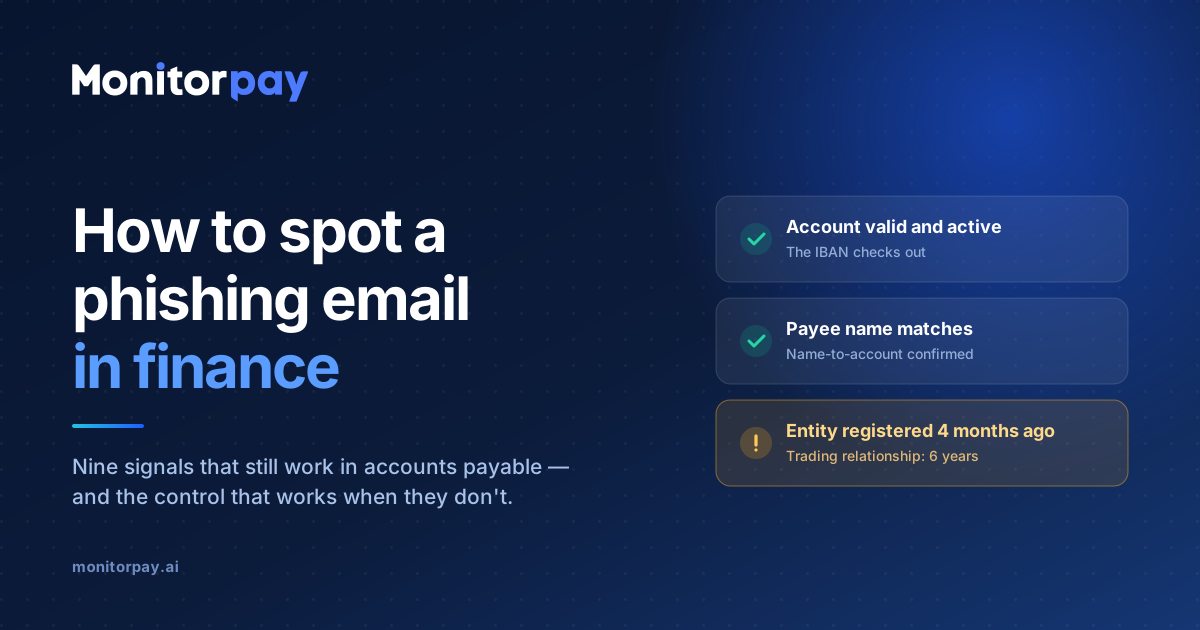
Four green ticks: the routing number is valid, the account is open and can accept credits, the account holder name matches the invoice, and the payment settles first time.
Five amber signals sitting behind them: the company was incorporated seven weeks ago; it has one director and one beneficial owner; its registered address is a mail-forwarding service shared with two hundred other entities; the bank account is at an institution in a different country from the trading address on the invoice; and the request to use it arrived as a change to an existing supplier's details rather than at onboarding.
No account check in existence catches any of the five. They are company facts, not account facts, and they only surface if someone looks at the entity rather than the account number.
This is why bank-detail change requests deserve their own control. A change request is not an administrative update — it is a new payment relationship being created inside an old one, and it is where most business payment fraud lands. Treat every change as a re-verification event: re-check the account, and re-check the company.
There are several company red flags a bank account match will not catch, and they are precisely the ones that separate a real supplier from a convincing front. If your team is starting to automate this work, the same logic applies to AI agents that move money — speed without verification simply moves the wrong payment faster.
A practical checklist for getting ACH payments to arrive on time
- Work backwards from your bank's cut-off, not the network's. Ask your bank for its internal deadlines for each window, in writing, including the deadline for payments that need a second approval.
- Validate every new account before the file is built. R02, R03 and R04 are entirely avoidable, and each one costs two banking days plus a re-run.
- Check the calendar before you promise a date. Federal holidays and weekends are the most common cause of a payment "arriving late" when it arrived exactly on schedule.
- Use the right Company Entry Description.
PAYROLLon PPD wage credits andPURCHASEon consumer e-commerce WEB debits have been mandatory since 20 March 2026. Correct labelling reduces the chance a receiving bank stops to look at your file. - Keep same-day for what needs it. Same-day entries carry an interbank fee and often a bank surcharge. Anything above $1 million will settle next day regardless.
- Document your fraud monitoring. Since 22 June 2026 every non-consumer originator needs risk-based processes, reviewed at least annually. A written risk assessment and a defined exception path is the minimum.
- Treat bank-detail changes as a separate workflow. Re-verify the account and the company, and confirm through a channel that was not the one the request arrived on.
- Monitor your return rates monthly. 0.5% unauthorised, 3% administrative, 15% overall. Rising administrative returns are almost always a data quality problem upstream.
- Re-verify long-dormant payees. Accounts close. Prenotes may now be used to re-validate accounts you have paid before, and a validation service does it without sending anything at all.
Bulk, API, or the online platform
Account verification, payee name matching, and registry-sourced company data are available through whichever access method fits your team: bulk file checks to clean a vendor master or pre-flight a payment run, the REST API for in-workflow verification before an entry is originated, or the online platform for one-off checks with full audit logs.
Key takeaways
- Same Day ACH settles in hours, standard ACH overnight. Three same-day windows close at 10:30 a.m., 2:45 p.m. and 4:45 p.m. ET; the overnight deadline is 2:15 a.m. ET.
- Your bank's cut-off is the one that binds you, not the network's. Get it in writing, including the deadline for payments needing a second approval.
- "One to three days" is a debit answer. The money settles fast; your processor holds it while the two-banking-day return window runs.
- Weekends and federal holidays stop the clock entirely. Five Federal Reserve holidays remain in 2026.
- Since June 2026, receiving banks must monitor incoming credits and may hold a settled credit to investigate it. First payments into new accounts attract the most scrutiny.
- R02, R03 and R04 are avoidable. They are account-data failures, and each costs two banking days before you even learn about it.
- Validation method decides the delay. A prenote costs three banking days, micro-deposits one to two plus a wait on the customer, an API check costs seconds.
- Faster rails remove your safety net. RTP, FedNow and wires are final on receipt — there is no return window to fix a wrong payment afterwards.
- A clean payment does not mean a clean supplier. Account validation and company verification answer different questions.
Frequently asked questions
How long does an ACH transfer take?
Between a few hours and three business days. Same Day ACH settles the same banking day, with funds available as early as 1:30 p.m. local time if the payment made the 10:30 a.m. ET window. Standard ACH settles overnight, with funds from a credit available by 9:00 a.m. local time on the settlement date. ACH debits often take one to three business days to be usable, because the bank or processor holding the money waits out the two-banking-day return window first.
What are the ACH cut-off times?
There are four deadlines for banks to submit files to the ACH Operator: 2:15 a.m. ET for next-day settlement at 8:30 a.m., then three same-day windows at 10:30 a.m., 2:45 p.m. and 4:45 p.m. ET, settling at 1:00 p.m., 5:00 p.m. and 6:00 p.m. ET respectively. Your own bank's cut-off for accepting your instruction is always earlier than these, often by an hour or more.
Why does ACH take so long?
Three reasons. It is a batch system, so payments wait for the next scheduled sweep rather than moving individually. It settles only on banking days, so weekends and federal holidays stop the clock entirely. And for debits, the receiving bank has two banking days to return most entries, so the money is settled well before it is safe to release — which is why your processor holds it.
Do ACH transfers process on weekends or holidays?
No. ACH settles only on Federal Reserve banking days. A payment submitted after the last window on a Friday settles on Monday. If Monday is a federal holiday it settles Tuesday. The remaining 2026 holidays are Labor Day (7 September), Columbus Day (12 October), Veterans Day (11 November), Thanksgiving (26 November) and Christmas Day (25 December).
What is ACH verification?
ACH verification, or account validation, confirms before a payment is sent that a routing and account number pair is real, the account is open and able to accept the entry, and that it belongs to the party being paid. It prevents R02 (account closed), R03 (no account found) and R04 (invalid account number) returns, each of which would otherwise take two banking days to surface.
It is also a rule in one case. Since 19 March 2021 originators of WEB debits — consumer debits authorised online — have been required to validate first-use account information as part of a fraudulent transaction detection system. Nacha does not mandate a method, listing an ACH prenotification, a micro-entry, or a commercially available validation service as options. A prenote costs you three banking days, micro-deposits one to two plus an open-ended wait on the customer, and a validation service returns an answer in seconds.
What time of day do ACH payments post?
Settlement time and posting time are different. Nacha sets the deadline by which funds must be available — 9:00 a.m. local time for a next-day credit — but most banks post earlier. Files are distributed to receiving banks overnight, with the last one going out at 6:00 a.m. ET, so direct deposits commonly appear between midnight and 6:00 a.m. local time. Same-day credits post after the 1:00 p.m., 5:00 p.m. or 6:00 p.m. ET settlement. Batch schedules vary by bank, and some offer early availability as a product feature rather than a network guarantee.
Is a wire transfer faster than ACH?
Yes, but only within banking hours. Fedwire settles each payment individually in minutes and is open 22 hours a day, from 9:00 p.m. ET the preceding calendar day to 7:00 p.m. ET — but only on business days, so a Saturday wire is not possible. The genuinely faster options are the instant rails: the RTP network and FedNow both settle in seconds, 24 hours a day, every day of the year, with a $10 million ceiling on each. All three are final on receipt, with no return window, so there is no way to pull the payment back afterwards.
How long does an ACH reversal take?
A reversal must be initiated within five banking days of the settlement date of the erroneous entry, and you must make a reasonable attempt to notify the receiver no later than the settlement date of the reversing entry. The reversal itself moves on the normal ACH schedule, settling same-day or next-day. But a reversal is a request against an account, not a clawback — if the money has been moved, it returns unpaid, which is why reversals rarely recover funds sent to a fraudulent account.
Can my bank hold an ACH credit even after it settles?
Yes, and this is more common in 2026 than before. Nacha's fraud monitoring rules — fully in force for all receiving banks since 22 June 2026 — require them to monitor incoming credits for entries that may be unauthorised or authorised under false pretenses. Where a bank flags one, it may use the voluntary exemption from the funds availability requirements to hold the credit while it investigates, and can return it under reason code R17. First payments into newly opened accounts are the profile most likely to attract that scrutiny.
Does a successful ACH payment mean the supplier is legitimate?
No. A payment that clears first time only proves the account details were correct. It says nothing about whether the company behind the account is the company you contracted with. Business email compromise accounted for $3.05 billion in reported losses in 2025 according to the FBI's Internet Crime Report, and in most of those cases the destination account was entirely valid — it simply belonged to someone else. Account validation and company verification answer different questions, and a bank-detail change request is the moment you need both. Get in touch to set this up for your payment workflow.