How to Verify Italian Supplier Bank Accounts: VoP and the Registro Imprese
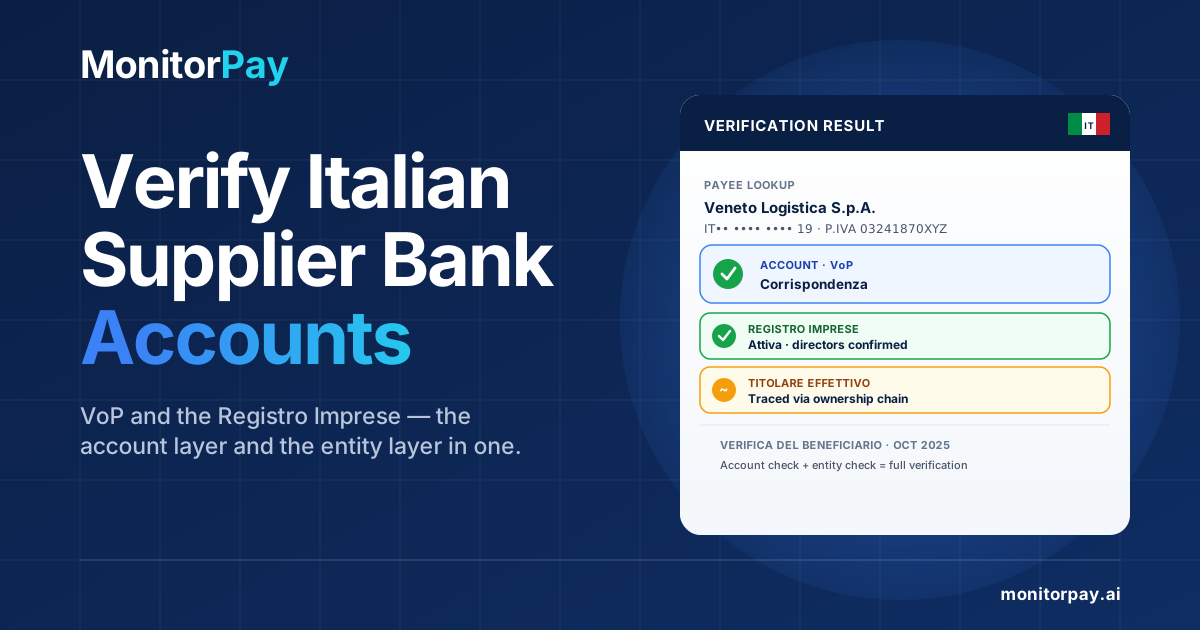
Italy made account-name verification mandatory in October 2025 — la Verifica del Beneficiario, the Italian face of the EU's VoP scheme. Italian banks were ahead of it: the CBI consortium had built its own Name Check before the mandate landed. But VoP only checks the name on the account. The harder questions — is this company real, who is the titolare effettivo — live in the Registro Imprese and a UBO register that, as of 2026, is frozen by the courts. Italy has solid company data and one of Europe's most unusable beneficial-ownership registers.
On 9 October 2025, every payment service provider in the eurozone had to start offering Verification of Payee under the EU Instant Payments Regulation. In Italy it's called la Verifica del Beneficiario, and Italian banks rolled it out across home banking, apps, branches, and call centres. Before you authorise a bonifico, your bank checks whether the name you entered matches the account holder behind the IBAN, and returns a result in real time. The Banca d'Italia — which is itself bound by the rule as the payment provider for public administrations — describes four possible outcomes: a match, a no-match, a partial match, or verification not possible.
Italy didn't arrive at this unprepared. The CBI consortium — the interbank body behind much of Italy's payment infrastructure — built its own Verification of Payee service, CBI Name Check, ahead of the regulatory deadline, and partnered with cross-border providers to make Italy-to-France and other corridors interoperable. So for Italian payments, VoP arrived as the formalisation of infrastructure the banks had already been building, not a standing start.
The numbers explain the urgency. According to the Banca d'Italia's report on fraudulent payment operations, the value of fraudulent transfers (bonifici) ordered through Italian PSPs reached around €50 million in 2024 — a 67% jump year-on-year. The more important figure for any business is the pattern behind it: roughly 74% of that fraud value came from "manipulation of the payer" (manipolazione del pagatore) — scams where the victim is tricked into authorising the payment themselves. And because the payer authorised it, this category generally does not trigger the automatic reimbursement that applies to unauthorised fraud, which makes the money far harder to recover. When you authorise the transfer, you largely own the loss — which is precisely why verification has to happen before the money moves.
But VoP is only the account layer. It confirms the name matches the IBAN. It doesn't tell you whether the Italian company behind that account genuinely exists and is solvent, or who ultimately controls it. Those questions live in the Registro Imprese and the Registro dei Titolari Effettivi — and Italy's entity layer has a particular problem: the company register is solid, but the beneficial-ownership register has been suspended by legal challenge since shortly after it launched. This article covers both layers, and the workflow a business paying Italian suppliers needs in 2026.
The Italian verification landscape in 2026
Three pillars define bank account verification for Italian suppliers: the EU-mandated VoP at the account layer, the Registro Imprese for entity verification, and the (currently frozen) Registro dei Titolari Effettivi for beneficial ownership. A brief refresh on each.
- VoP (Verifica del Beneficiario) became mandatory on 9 October 2025. Under the EU Instant Payments Regulation (Regulation (EU) 2024/886), every PSP in the eurozone must offer a free beneficiary-verification service before a SEPA credit transfer is authorised. It applies to both standard transfers (bonifici ordinari) and instant transfers (bonifici istantanei), issued one at a time or in batch.
- The check is real-time and free for consumers. Per the Banca d'Italia, the service compares the IBAN against the registered account holder (nome e cognome for an individual, ragione sociale for a company) and returns a result before you confirm. It's free for consumers and private users; for businesses and microenterprises, opt-out options exist for batch transfers (distinte multiple).
- CBI Name Check was the Italian forerunner. The CBI consortium pioneered its own VoP-compliant service ahead of the mandate and built interoperability for cross-border corridors — meaning Italian banks largely implemented VoP on top of infrastructure already in motion.
- The Registro Imprese is the entity-verification backbone. Managed by InfoCamere on behalf of Italy's network of Chambers of Commerce (Camere di Commercio), it records every registered Italian business. The standard extract is the visura camerale.
- The UBO register exists but is suspended. Italy launched the Registro dei Titolari Effettivi in October 2023, but public consultation was suspended after legal challenges over privacy, and the matter was referred to the Court of Justice of the European Union. As of 2026, filing obligations are in force — companies must lodge beneficial-ownership data with InfoCamere — but the public cannot consult the register. This is the single biggest complication in Italian KYB.
The practical takeaway: in Italy, the account-name check is now solved and was partly built ahead of time. What differentiates a robust supplier-payment workflow is the entity layer — and Italy's entity layer combines a workable company register with a beneficial-ownership register that practitioners simply cannot use right now.
VoP: what it does and how it reads
La Verifica del Beneficiario compares the payee name you enter against the name registered to the destination IBAN at the receiving bank. You get a result before you authorise the bonifico. It applies to all euro SEPA credit transfers — standard and instant — regardless of whether the beneficiary's IBAN is Italian or foreign, as long as it's within the SEPA area.
The Banca d'Italia describes four possible outcomes:
- Corrispondenza (Match) — the name and IBAN agree. Safe to proceed.
- Corrispondenza parziale (Partial match) — close but not identical (for example, a trading name vs the full ragione sociale). The registered name is typically returned so you can decide.
- Mancata corrispondenza (No match) — the name doesn't match the account holder. The full name isn't disclosed, for data-protection reasons. Contact the supplier through an independent channel before proceeding.
- Impossibilità di verifica (Not possible) — the check can't be performed: the receiving bank isn't reachable, the account type isn't covered, or the destination is outside the scheme. Proceed with extra caution.
As everywhere in SEPA, VoP informs rather than blocks. A mancata corrispondenza is a warning, not a hard stop — the ordinante (the payer) keeps the final say, and keeps the liability if they confirm anyway. That's the key point for Italian finance teams writing internal policy: VoP secures the name-IBAN match, but the decision and the consequence remain with the payer.
The four responses — and what each should trigger
The CBI proposing-bank rule
One Italian-specific operational detail: within the CBI service, the verification must be performed by the "proposing bank" (Banca Proponente — the one providing the electronic-banking channel), not the "passive bank" (the account-holding bank), regardless of which debit account is chosen for the payment. For corporates using multi-bank CBI channels, this matters: the VoP result you see comes from the channel provider, and the check perimeter covers all affected SEPA orders whether the beneficiary IBAN is Italian or foreign.
What VoP does NOT cover
VoP covers euro SEPA credit transfers. It does not cover payments to banks outside the eurozone, non-euro payments, or non-payment accounts. For an Italian business paying a supplier in the UK, Switzerland, or the US, VoP provides no coverage — a separate verification method is needed for each of those corridors.
Where VoP falls short for Italian B2B payments
VoP is the right first-line check. But three gaps matter for businesses paying Italian suppliers, and all three sit at the entity layer.
1. A "Corrispondenza" doesn't tell you the company is real or solvent
VoP confirms the account belongs to whoever registered it. It doesn't tell you whether the company is genuinely trading, or whether it's in liquidation or subject to insolvency proceedings. A company can have a valid Partita IVA and still have ceased real activity. A fraudster who registers a company, opens an account in its name, and submits an invoice passes VoP cleanly — the account name matches. The fraud is in the entity. Closing that gap requires the visura camerale and an insolvency check, not a name match. See KYB verification for marketplaces for how entity verification complements account verification.
2. For an S.p.A., VoP tells you nothing about who owns the company
This is Italy's distinctive KYB gap. For a S.r.l. (the most common Italian limited company), the shareholders and their stakes are visible in the visura camerale — you can see ownership directly from the Chamber of Commerce record. But for a S.p.A. (a joint-stock company), the visura gives you directors and capital structure, not the shareholders. And because the Registro dei Titolari Effettivi is suspended, the one register that was meant to close this gap is unavailable. For an S.p.A., establishing current ownership now requires reconstructing it from other sources — the visura storica, CONSOB disclosure filings for listed entities, and cross-jurisdiction tracing where the parent is foreign. The legal form of your Italian supplier determines how hard its ownership is to verify.
3. VoP doesn't catch a compromised supplier (IBAN swap)
The most common attack on Italian businesses isn't a fake company — it's the IBAN swap: a real supplier whose email has been compromised, sending a convincing request to change the IBAN to a new account. The supplier is real, their visura is clean, and the new account passes VoP because it's registered correctly to a money mule. The fraud lives in the change request, not the account details. Italian banks explicitly cite business email compromise and IBAN swap as the scenarios VoP is meant to mitigate — but VoP alone can't catch them, because the name on the fraudulent account genuinely matches. For the operational picture, see vendor email compromise vs business email compromise.
A concrete scenario: the IBAN swap
A composite, anonymised Italian scenario showing how the IBAN-swap attack defeats VoP.
The setup. “Milano Software S.r.l.” has paid “Veneto Logistica S.p.A.” monthly for two years — around €17,000 per invoice. Veneto Logistica banks with an Italian bank; the registered account name matches its visura. Every bonifico has cleared cleanly through la Verifica del Beneficiario.
The attack. On a Wednesday, Milano Software’s amministrazione team receives an email from their usual Veneto Logistica contact — the familiar address. It says the supplier has changed banks and asks them to update the IBAN for this month’s invoice. It cites the correct invoice number and reads exactly like the contact’s normal style. This is a textbook IBAN swap.
What the process catches — and misses. Milano Software runs VoP on the new account, entering “Veneto Logistica S.p.A.” The result: corrispondenza. The receiving bank confirms the account is registered to Veneto Logistica S.p.A. The analyst updates the IBAN in the supplier master file and sends the €17,000.
What actually happened. The Veneto Logistica contact’s email was compromised weeks earlier. The “new account” was opened in the supplier’s legal name using fraudulent documentation that passed the receiving bank’s onboarding. The VoP match was technically correct — the registered name really did read “Veneto Logistica S.p.A.” The fraud lived in the IBAN-change request, not the account details.
What would have caught it. A callback to Veneto Logistica on a number from Milano Software’s records or its Registro Imprese contact — not the email signature — would have exposed the fraud in under a minute. So would a pre-payment check flagging the destination account as recently opened. Both are mature, available controls. Neither is part of a “VoP-first” policy, because VoP secures the name match, not the change-request channel — which is exactly where the IBAN swap operates.
How MonitorPay helps
VoP, the Registro Imprese, and continuous monitoring in one API.
MonitorPay covers the full Italian verification stack: account-name verification through the EU VoP scheme, registry-sourced KYB from the Registro Imprese and 200+ government registries worldwide, and continuous monitoring on the suppliers and accounts you've already verified — account layer and entity layer in one API call, even where the UBO register is frozen.
Italian Stack
- ✓EU VoP (account name)
- ✓Registro Imprese KYB
- ✓Shareholder + UBO tracing
- ✓Sanctions + PEP screen
Beyond IT
- ✓EU VoP across SEPA
- ✓49+ country bank rails
- ✓200+ government registries
- ✓Webhook-driven monitoring
The entity layer: the Registro Imprese and the frozen UBO register
Italy's company-data system is workable but bureaucratically layered, and its beneficial-ownership register is, for now, effectively unusable. Understanding both is the key to Italian KYB.
The Registro Imprese and the visura camerale
The Registro Imprese is the Italian business register, established in 1993 and managed by InfoCamere — a technology consortium acting for the network of local Camere di Commercio (Chambers of Commerce). Every registered Italian business appears in it. The free public search at registroimprese.it (with an English-language mirror at italianbusinessregister.it) returns a basic identification profile — enough to confirm an entity exists and check its registered address, but not enough for a real KYB workflow.
For that you need the visura camerale, the official extract, purchased through the Telemaco platform. The visura ordinaria shows the current legal form, directors, registered address, share capital, and ATECO activity code; the visura storica shows the company's full history including past shareholding changes. A company's status should read Attiva (active) — anything else warrants scrutiny. Italian companies are identified by two numbers you'll verify together: the Codice Fiscale (fiscal code) and the Partita IVA (VAT number).
One 2026 wrinkle worth knowing: Italy migrated its activity-classification system from ATECO 2007 to ATECO 2025 in early 2026, so a supplier's activity code may have changed value even though its actual business hasn't. Don't read a changed ATECO code as a change of business on its own.
The S.r.l. vs S.p.A. shareholder split
Italy's most useful KYB distinction is by legal form. For an S.r.l. (società a responsabilità limitata — the standard limited company), shareholder names and their stakes are recorded in the Registro Imprese and visible in the visura. You can establish ownership directly from the Chamber of Commerce record. For an S.p.A. (società per azioni — a joint-stock company), the visura gives you directors and capital structure but not the shareholders. So for an S.r.l. you have a route to ownership through the register; for an S.p.A. you do not. This single distinction determines how hard your Italian supplier's ownership will be to verify.
Who can you see? It depends on the company form
The frozen UBO register
Italy's beneficial-ownership picture is the most complicated in the EU core. Italy launched its Registro dei Titolari Effettivi in October 2023, intending to make UBO data consultable. But the register was challenged in court over privacy concerns — in the wake of the 2022 European Court of Justice ruling that struck down unrestricted public access to EU UBO registers — and public consultation was suspended. The matter was referred to the CJEU. As of 2026, the situation is split: filing obligations remain in force (Italian companies must lodge their beneficial-ownership data with InfoCamere), but public consultation is suspended. KYB practitioners cannot rely on the register for ownership transparency; the Italian government has signalled it's awaiting further CJEU clarification, likely before reopening access under a legitimate-interest model rather than the original open-access design.
The Italian definition of beneficial owner (titolare effettivo) comes from Article 20 of Legislative Decree 231/2007 and Ministerial Decree 55/2022, following a cascading logic: first, any natural person holding more than 25% of capital (directly or indirectly through the ownership chain); failing that, control through votes or contractual arrangements; and as a last resort, senior management. With the register frozen, establishing the titolare effettivo means reconstructing the ownership chain from the visura (for an S.r.l.), CONSOB filings (for listed entities), and parent-registry lookups (for foreign-owned structures) — exactly the kind of cross-source ownership tracing that registry-aggregating verification platforms automate. See beneficial ownership verification in B2B payments for the deeper case.
Mandatory to file. Impossible to read.
The full Italian supplier verification workflow
What a working verification workflow looks like for a business paying Italian suppliers in 2026 — across onboarding, before each material payment, and continuously thereafter.
At supplier onboarding
- Verify the entity in the Registro Imprese. Search by name, Codice Fiscale, or Partita IVA; confirm the status is Attiva. Order the visura camerale for the legal form, directors, registered address, and share capital.
- Check the financials (bilancio) and insolvency status. Review the most recent filed accounts for financial-health signals, and check for insolvency or pre-insolvency proceedings. A valid Partita IVA doesn't guarantee a solvent, trading company.
- Validate the Codice Fiscale and Partita IVA. Cross-check the Partita IVA against the EU VIES system for VAT validity.
- Run a VoP / IBAN-name check on the supplied account. A corrispondenza, or a corrispondenza parziale with an explainable trading-name reason, is acceptable. A mancata corrispondenza requires independent contact with the supplier.
- Establish beneficial ownership by legal form. For an S.r.l., read the shareholders from the visura. For an S.p.A. or any structure that doesn't resolve, reconstruct ownership from the visura storica, CONSOB filings, and parent-registry tracing — because the UBO register is frozen.
- Screen the entity and its beneficial owners against sanctions and PEP lists. Required under Italian AML law (D.Lgs. 231/2007) for obliged entities; advisable for any business paying higher-risk suppliers.
Before each IBAN change
The highest-risk event in the workflow. The IBAN swap is the single most common B2B payment fraud — and on instant rails, a successful one is irreversible in seconds.
- Treat every IBAN change request as suspicious by default. The question isn't "does this look like fraud" — it's "have we verified this through an independent channel."
- Call back on a known number. Not the number in the email requesting the change — a number from your existing records or the company's official Registro Imprese contact.
- Run VoP on the new account before saving it. Verify first, update the master file second.
- Confirm the new account's registered name matches the supplier's ragione sociale. A supplier whose entity is one company should not suddenly bank under a different name without a documented reason.
Continuous monitoring between payments
Italian companies change constantly — director changes, share transfers, insolvency proceedings, status changes. Continuous monitoring catches these before the next payment cycle.
- Monitor Registro Imprese status changes. Insolvency proceedings, changes of legal representative, and a status moving away from Attiva are early warning signs.
- Monitor ownership changes where visible. For an S.r.l., share transfers appear in the register; a supplier that cleared screening at onboarding can come under sanctioned or high-risk ownership through a transfer.
- Re-screen against sanctions and PEP lists on a defined cadence. Designations change frequently; a supplier clean at onboarding may have been designated since.
For the full case on why one-time verification isn't enough — and why continuous monitoring is now the operational standard — see why one-time verification fails.
How Italian verification methods compare
Businesses paying Italian suppliers have several verification options. They differ in what they confirm and where they fit.
| Method | What it confirms | What it doesn't | Best for |
|---|---|---|---|
| VoP / Verifica del Beneficiario | Account holder name matches expected name | Entity solvency, ownership, IBAN-swap fraud, non-euro payments | Default first-line check on every bonifico and IBAN change |
| Visura camerale (Registro Imprese) | Entity exists, legal form, directors, share capital; S.r.l. shareholders | The bank account belongs to the entity; S.p.A. shareholders | Onboarding (paired with VoP) and continuous monitoring |
| Free Registro Imprese search | Existence, registered address, basic identification | Directors, ownership, financials (needs the paid visura) | A quick existence check before ordering a full visura |
| Bilancio (financial statements) | Financial health, filing currency | Ownership, account match, real-time status | Assessing whether a supplier is financially sound |
| Registro dei Titolari Effettivi (UBO) | Would show declared beneficial owners (25%+) | Public consultation suspended since launch — currently unusable | Not available for KYB until the CJEU matter resolves |
| Manual callback verification | The supplier confirms an IBAN change via an independently-sourced number | Speed, scale, audit-trail consistency | IBAN changes regardless of VoP outcome — a backstop, not a substitute |
The pattern: no single method is sufficient for Italian B2B verification. VoP is the right first-line account check, but it works alongside the visura camerale at onboarding, a bilancio and insolvency check, ownership tracing (harder for an S.p.A., and without the frozen UBO register), callback verification for IBAN changes, and continuous monitoring between payments. For how these methods interact with their non-Italian equivalents, see our 7 verification methods compared article.
Paying Italian suppliers from outside Italy
If you pay Italian suppliers from another country, VoP coverage depends on where your PSP sits. Since 9 October 2025, all eurozone PSPs must offer VoP, so payments from euro-area countries to Italian accounts get the name check — and notably, the CBI consortium built cross-border interoperability (including an Italy–France corridor) ahead of the deadline. Non-euro EU countries have until 9 July 2027 to comply; outside the EU — the UK, US, Switzerland — there's no automatic VoP coverage.
The entity layer is the harder cross-border problem. The Registro Imprese is accessible to foreign buyers through the English-language portal, but it requires an account and per-document payment, and the frozen UBO register means beneficial ownership has to be reconstructed from other sources. For a business outside Italy verifying Italian suppliers at scale, the practical answer is a verification provider that covers the VoP scheme directly and aggregates Registro Imprese and ownership data. See cross-border bank account verification for the country-by-country picture.
What's coming next: the 2026-2027 horizon
The October 2025 VoP mandate was the first major step. Several near-term changes will reshape Italian verification further — and the entity layer, in particular, is waiting on a court.
The CJEU ruling that could un-freeze the UBO register
The single biggest open question in Italian KYB is when — and how — the Registro dei Titolari Effettivi reopens to consultation. The suspension is tied to a legal challenge referred to the Court of Justice of the European Union, in the wake of the 2022 ruling that struck down unrestricted public access to EU beneficial-ownership registers. When the CJEU rules, Italy is widely expected to reopen the register under a legitimate-interest access model rather than the original open-access design. Businesses building Italian verification workflows now should plan for a UBO register that comes back as access-controlled, not freely browsable — and for the period until then, should rely on the visura-and-tracing approach described above.
The EU AML Regulation (AMLR) standardises access from 2027
The structural fix is the EU Anti-Money Laundering Regulation, directly applicable from 2027. Because a regulation applies uniformly across the bloc — unlike a directive each state implements differently — AMLR is expected to harmonise UBO-register access and beneficial-ownership requirements across all member states. For Italy, that should eventually standardise the access model and reduce the gap between its frozen register and the more workable registers elsewhere. The direction of travel across the EU is toward consistent, legitimate-interest-based UBO access.
ATECO 2025 reclassification
Italy migrated its activity-classification system from ATECO 2007 to ATECO 2025 in early 2026. For anyone monitoring Italian suppliers, this means a counterparty's activity code may have changed value even though its underlying business hasn't. Build the migration into your monitoring logic so a reclassification doesn't read as a false-positive change of business.
Non-euro SEPA countries join VoP by July 2027
VoP is mandatory for eurozone PSPs now, but non-euro EU members — Sweden, Poland, Denmark, the Czech Republic, Hungary, Romania, Bulgaria — have until 9 July 2027 to comply. For Italian businesses paying suppliers in or receiving payments from those countries, full VoP coverage across the EU is still some way off, and a verification provider that covers those corridors directly fills the gap until then.
Verifying Italian suppliers at scale?
Verify 50 bank accounts for free. No credit card required.
Try MonitorPay Free →Frequently Asked Questions
Is bank account verification mandatory in Italy?
Yes. Since 9 October 2025, all eurozone payment service providers — including Italian banks — must offer a free Verification of Payee service, known in Italy as la Verifica del Beneficiario, under the EU Instant Payments Regulation. It applies to all euro SEPA credit transfers, both standard (bonifici ordinari) and instant (bonifici istantanei). For a natural person it checks first and last name; for a company it checks the ragione sociale. The Banca d'Italia is itself bound by the rule as the payment provider for public administrations.
What is the difference between Codice Fiscale and Partita IVA?
The Codice Fiscale is the fiscal identification code of an Italian entity (or person); the Partita IVA is the VAT number, used for tax purposes and validated across the EU through the VIES system. A company has both, and you verify both: the Codice Fiscale identifies the entity in the Registro Imprese, and the Partita IVA confirms its VAT registration. For cross-border B2B, the Partita IVA is the number you check against VIES.
How do I verify an Italian company before paying it?
Search the Registro Imprese (registroimprese.it, or the English mirror italianbusinessregister.it) by name, Codice Fiscale, or Partita IVA, and confirm the status is Attiva. Order the visura camerale for the legal form, directors, share capital, and — for an S.r.l. — the shareholders. Review the bilancio (financial statements) for solvency, and check for insolvency proceedings. Entity verification and account verification (VoP) are separate, complementary checks — you need both.
What is a visura camerale?
The visura camerale is the official extract from the Italian Registro Imprese, purchased through the Telemaco platform. The visura ordinaria shows current details — legal form, directors, registered address, share capital, ATECO activity code — while the visura storica shows the company's full history, including past shareholding changes. It's the core document for Italian KYB. The free public search returns only a basic identification profile, not the detail a real verification workflow needs.
Can I access the Italian UBO register?
Not currently. Italy launched its Registro dei Titolari Effettivi (beneficial-ownership register) in October 2023, but public consultation was suspended after legal challenges over privacy, following the 2022 European Court of Justice ruling, and the matter was referred to the CJEU. As of 2026, Italian companies must still file their beneficial-ownership data with InfoCamere, but the public cannot consult the register. KYB practitioners have to reconstruct beneficial ownership from other sources until the register reopens — likely under a legitimate-interest model once the CJEU rules.
Why is it harder to find the owner of an S.p.A. than an S.r.l.?
Because of what each company form discloses in the Registro Imprese. For an S.r.l. (società a responsabilità limitata), shareholder names and stakes are recorded in the register and appear in the visura — so you can establish ownership directly. For an S.p.A. (società per azioni, a joint-stock company), the visura shows directors and capital structure but not the shareholders. With the UBO register frozen, that leaves the visura storica, CONSOB filings for listed companies, and parent-registry tracing as the routes to an S.p.A.'s ownership. The legal form determines how hard the ownership is to verify.
What does a VoP "corrispondenza parziale" mean for an Italian payment?
It means the name you entered is similar but not identical to the registered account holder — for example, you entered a trading name but the account is registered under the full ragione sociale, or there's a minor spelling difference. The registered name is typically returned so you can decide whether to proceed. For a new supplier or a high-value transfer, a partial match is worth confirming through an independent channel before proceeding.
Does VoP protect me from an IBAN swap (business email compromise)?
Only partially. If a fraudster compromises your Italian supplier's email and sends an IBAN-swap request — asking you to redirect payment to a fraudster-controlled account registered to a money mule — VoP will return a match, because the name on the account genuinely matches the account holder. The match is technically correct but the change request was fraudulent. The defence is to verify any IBAN change through an independent channel (a callback to a known number) before saving the new details. Italian banks explicitly cite IBAN swap and business email compromise as scenarios VoP is designed to mitigate, but VoP alone can't catch them.
What is CBI Name Check?
CBI Name Check is the Verification of Payee service built by CBI, the Italian interbank consortium, ahead of the EU mandate. CBI pioneered its own IBAN-name verification and built cross-border interoperability — for example with French providers — so that Italian banks could meet (and in some respects exceed) the October 2025 VoP requirement. For Italian payments, VoP largely formalised infrastructure CBI and the banks had already been developing.
How do I verify Italian suppliers at scale?
For one-off payments, a bank's built-in VoP plus a manual visura lookup is workable. For ongoing verification across many suppliers, the Registro Imprese is accessible via InfoCamere APIs, but the frozen UBO register and the S.p.A. shareholder gap mean ownership often has to be reconstructed across sources. API-based access combining VoP (account layer) with Registro Imprese data and ownership tracing (entity layer) plus continuous monitoring is the operational standard. Platforms like MonitorPay provide a unified API across VoP, Italian registry KYB, and webhook-driven monitoring, with the first 50 verifications free.