How to Verify Nigerian Supplier Bank Accounts: NUBAN and CAC
Nigeria's account layer is better engineered than most buyers expect. Every account number is a ten-digit NUBAN with a check digit the payer is required to validate before an instruction is even presented, and the national switch will return the registered account name before you send. Nigeria is also the one market in this series where the clearing house publishes hard fraud numbers — and they show why the account check is not the whole answer. What decides your position as a buyer sits on the company side: whether the entity is registered and active, who controls it, whether it can lawfully charge you VAT, and — since 1 January 2026 under a rewritten tax code — whether the invoice it gives you will survive real-time validation.
Sources: Nigeria Inter-Bank Settlement System, 2026 Nigeria Electronic Fraud Forum; NIBSS Name Enquiry; Companies and Allied Matters Act 2020.
The account layer: a number you can validate, and a name you can see
Nigeria has no IBAN, but it has something almost as useful. Since 2010 the Central Bank of Nigeria has required every bank account to be identified by a NUBAN — the Nigeria Uniform Bank Account Number — a ten-digit code in which the tenth digit is a check digit computed from the bank code and the nine-digit serial that precede it.
The CBN standard is explicit that the payer shall validate the check digit of every electronic payment instruction, and that instructions with invalid NUBANs are not to be presented for clearing. In practice that means two things a buyer can do offline. A transposed or mistyped digit fails arithmetically before any money moves. And because the check digit is calculated over the bank code as well as the serial, a valid NUBAN narrows the field of banks it can belong to — which is how Nigerian apps shorten the bank list once you type an account number, and how you can catch a supplier who has given you a valid number against the wrong bank.
| CBN code | Bank | CBN code | Bank |
|---|---|---|---|
| 044 | Access Bank | 011 | First Bank of Nigeria |
| 058 | Guaranty Trust Bank | 214 | First City Monument Bank |
| 057 | Zenith Bank | 070 | Fidelity Bank |
| 033 | United Bank for Africa | 050 | Ecobank Nigeria |
The original NUBAN standard was written for deposit money banks with three-digit codes. Under the CBN's revised standard, other financial institutions — microfinance banks, payment service banks, mobile money operators and fintech wallets — carry longer institution codes, and a great many Nigerian small suppliers bank with exactly those institutions. A validator built only on the three-digit bank list will reject a perfectly valid account at a microfinance bank or a fintech, and a payer who treats "not a commercial bank" as a red flag will lose legitimate suppliers. Validate against the full institution list, and treat the institution type as context to weigh with everything else — not as a verdict on its own.
The NIBSS name enquiry
The Nigeria Inter-Bank Settlement System, which runs the country's real-time NIBSS Instant Payment rail, offers Name Enquiry as a distinct service: given a bank and account number, it returns the registered account name, and it can be run individually or in bulk. Nigerian banking apps use it to display the beneficiary's name before a transfer is confirmed, and Nigerian security guidance is blunt about why that display must come from the switch and not from what the user typed — because NIP transfers are irreversible within seconds.
Like Korea and Vietnam, and unlike European Verification of Payee, Nigeria returns the name and leaves the matching to you. Two things distinguish it. The enquiry is offered explicitly for bulk use, so a supplier base can be checked rather than a single transfer. And it sits on top of a validatable account number, so a NUBAN that passes the check digit and returns the expected name has cleared two independent tests, not one.
The BVN, and why accounts without one are restricted
Every Nigerian bank customer has a Bank Verification Number, a biometric-backed identifier that links all of an individual's accounts to one person, and the CBN has progressively required accounts to be linked to a BVN and a National Identification Number, restricting those that are not. For a buyer this operates in the background rather than as a lookup you run: it is part of why the account name returned by the switch is anchored to a real, identified person or a company's identified signatories, and it is one of the reasons the clearing house credits identity management with the fall in fraud losses.
What the fraud numbers say
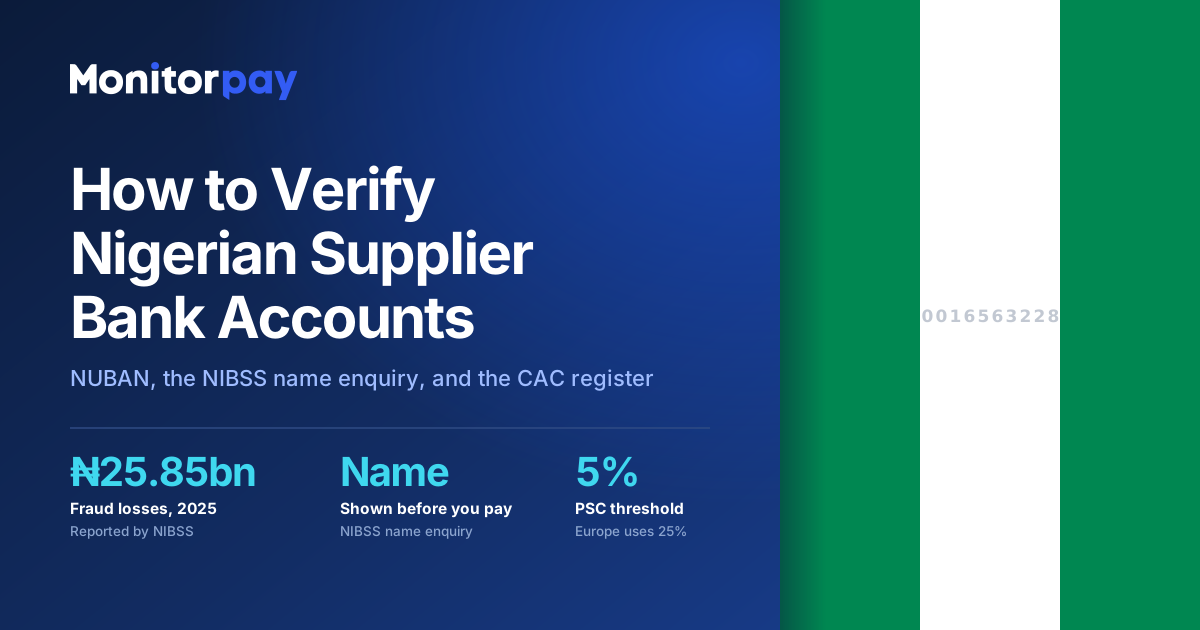
NIBSS publishes annual fraud data, and it is worth reading directly. Losses to electronic payment fraud were about ₦17.67 billion in 2023, rose to ₦52.26 billion in 2024 — a figure NIBSS attributes largely to a single incident of ₦31.1 billion involving one entity — and fell to ₦25.85 billion in 2025. Case counts have fallen for five years, from 123,918 in 2021 to 67,518 in 2025. Lagos accounted for roughly 63% of fraud activity. NIBSS names social engineering, and insider abuse in particular, as the most prevalent technique, and observes that losses are increasingly high-value and low-volume through internet banking.
Read that against the account controls above and a pattern appears. The tools that confirm an account number and a name are working; case counts prove it. What remains is fewer, larger, more targeted losses that route through legitimate-looking accounts and, often, through someone inside. That is not a problem a name enquiry solves. It is a problem of who the counterparty is.
The limits
Three caveats. First, access: the name enquiry is a NIBSS service to institutions and the display is a feature of Nigerian domestic channels. A foreign buyer paying by SWIFT does not see it; the receiving bank's beneficiary-name matching on the inbound wire is the nearest equivalent, and it operates after you have instructed the payment. If you have a Nigerian entity, a local payout partner or a corporate banking relationship in Nigeria, the enquiry is available through them.
Second, the name is the bank-held name. For a company that is the registered name as the bank recorded it, typically in upper case and often with "NIG LTD" or "LIMITED" spelled the bank's way. Match against the CAC-registered name and expect cosmetic differences. For a business name — a sole trader or partnership registered with a BN number — the account is frequently in the proprietor's personal name, which is not a mismatch; more on that below.
Third, a valid NUBAN and a matching name prove the account belongs to the named party. They do not prove the entity is active, that it can charge you VAT, that the person instructing you can bind it, or that it is the party that supplied you.
NIP transfers settle in seconds and cannot be reversed by the sending bank. Nigeria has no statutory mistaken-remittance recovery scheme; recovery runs through a recall request to your bank, the receiving bank's contact with the account holder, and beyond that the police and the courts. The check digit and the name enquiry before you send are the controls. Treat them that way.
International payments
An international payment to a Nigerian supplier is a SWIFT wire to the bank's BIC with the ten-digit NUBAN and the beneficiary's registered name. The naira is not freely convertible offshore, so cross-border supplier payments are made in US dollars or another major currency, and land either in the supplier's foreign-currency domiciliary account or are converted by the receiving bank. Nigerian banks apply the beneficiary name to inbound funds and query mismatches, so use the exact CAC-registered name rather than a trading name or an email signature.
Where account verification stops, and business verification starts
Paying a supplier safely means answering two questions. Does this account belong to the party I intend to pay? Nigeria answers that unusually well — a validatable number and a returned name. Is that party a business I should be paying at all? That is a different question, answered by different registers, and the point at which most onboarding processes stop asking.
An account match confirms one thing: that the name on the account corresponds to the entity you supplied. It does not tell you the company is active with the Corporate Affairs Commission rather than flagged inactive or struck off, who owns and controls it, whether it holds a valid tax identification number, whether it can lawfully charge you VAT, or whether the invoice it issues will validate under the new tax regime. Every one of those is a business-verification question, and in Nigeria each has a direct consequence for your money.
Bank account verification tells you the money will reach the account you were given, in the name you were given. Business verification tells you whether the entity behind that account is registered, active, correctly identified, properly controlled, and the real counterparty. Treating the first as a substitute for the second is the single most common gap in supplier onboarding — and NIBSS's own data says the losses that remain are exactly the ones that pass the account check. MonitorPay is designed around closing it: account verification and registry-sourced company intelligence returned together, so the account result and the business result arrive as one answer rather than two workflows.
The company layer: the CAC register
Every registered entity in Nigeria sits with the Corporate Affairs Commission, and the identifier tells you what kind of entity you are dealing with before you look anything up.
| Prefix | Entity | What it means for you |
|---|---|---|
| RC | Company — private or public limited, unlimited, or limited by guarantee | A separate legal person with directors, shareholders and persons with significant control on record. |
| BN | Business name — a sole trader or partnership trading under a registered name | Not a separate legal person. The proprietor is the counterparty; the account is often in their name. |
| IT | Incorporated trustees — associations, NGOs, religious bodies | Not a trading company; a supplier presenting an IT number is worth a question. |
| LP / LLP | Limited partnership or limited liability partnership | Partnership forms introduced under CAMA 2020. |
The public search, and what "inactive" means
The CAC public search is free and needs no account. Search by name or by RC/BN number and it returns the registered name, the registration number, the date of registration, the entity type, and the status. That status takes one of a small set of values, and the middle one is misread more often than any other field in Nigerian supplier verification.
Inactive does not mean the company has ceased to exist. It means annual returns are outstanding: the entity is still on the register and can still be restored to active status by filing. The CAC has moved to flagging this automatically, and the flag has real consequences in Nigeria — it is used by banks and by public procurement to gate access — so it is worth taking seriously. But it is a compliance signal about the supplier's housekeeping, and it is common enough among small suppliers that treating it as a hard stop will lose you legitimate counterparties. The right response is a question, and a look at whether anything else is off.
Directors, owners and persons with significant control
The free search shows the entity and its status. It does not, in the current portal, show the people behind it. For directors, shareholders, share capital and persons with significant control you request a status report from the CAC for a small fee — an official extract of the current record, and the document to hold for any supplier of consequence.
The persons-with-significant-control regime under CAMA 2020 is worth knowing on its own terms. The disclosure threshold is 5% of shares or voting rights, or equivalent control — lower than the 25% used across most of Europe — and companies must file PSC particulars with the Commission. So a Nigerian company should be able to show you who ultimately controls it in more detail than a European one would, and a status report with no PSC recorded for a trading company is itself a question.
The certificate of incorporation (for a company) or certificate of registration (for a business name) is what a supplier hands over at onboarding, and forged ones circulate. Take the RC or BN number and the exact registered name from it and run them through the public search. A number that returns nothing, or returns a different name, has told you what you need to know before any other check.
Business names: the supplier that is not a company
A large share of Nigerian small suppliers trade as business names — a sole trader or partnership registered with a BN number. A business name is not a separate legal person: the proprietor is the counterparty, there are no directors or shareholders to disclose, no PSC filing, and the bank account is very often in the proprietor's own name rather than the business's. When the NIBSS name enquiry returns an individual's name against what you thought was a company account, this is usually why, and it is not a mismatch.
The verification posture is different, not weaker. Confirm the BN registration and the proprietor's name in the public search, match that name to the account, and treat the absence of directors and PSC particulars as the entity type rather than a gap. What changes is your exposure: there is no corporate veil, no share capital, and the supplier's continuity is the individual's.
The tax layer: TIN, VAT, and the 2026 rules
Nigeria rewrote its tax code in 2025. The Nigeria Tax Act 2025 and the Nigeria Tax Administration Act 2025, signed on 26 June 2025, took effect on 1 January 2026, replacing the Value Added Tax Act among others and creating the Nigeria Revenue Service in place of the Federal Inland Revenue Service. Several provisions land directly on how a buyer verifies a supplier.
| Provision | What it requires | What it means for verification |
|---|---|---|
| Single TIN | A single tax identification number is mandatory for every individual and entity. | One number to verify across the register, the invoice and the payment instruction. A supplier without one is outside the system. |
| Input VAT widened | Input VAT is now recoverable on services and fixed assets, not only goods for resale or production, where attributable to taxable supplies. | Far more buyers now have real money riding on their suppliers' invoices being valid. The stakes of a bad invoice went up on 1 January 2026. |
| Small-company VAT exemption | Companies with turnover of ₦100 million or less and fixed assets of ₦250 million or less are exempt from VAT filing and cannot issue VAT-inclusive invoices unless they opt in. | A small supplier charging you 7.5% VAT on an invoice it is not entitled to issue has given you a document that will not support a credit. |
| E-invoicing | A mandatory fiscalisation and e-invoicing system with real-time validation — the Merchant-Buyer Solution — piloted by the revenue service and rolling out from 2026. | As the rollout completes, an invoice that has not been validated in the system is one whose VAT you should not assume you can recover. |
Under the old VAT Act, most businesses supplying services could not recover input VAT at all, so a bad supplier invoice cost them nothing on the VAT line. Under the Nigeria Tax Act 2025 they can — which means the validity of a supplier's VAT invoice is now a cash question for a much larger set of buyers. Verifying that the supplier holds a TIN, is VAT-registered and entitled to charge, and issues invoices that validate is no longer a formality. It is where the recovery sits.
Verifying the TIN
The tax layer and the account layer are also linked in law: Nigerian banks are required to obtain a TIN before opening or operating a business account, so a supplier's business account should sit behind a TIN, and a business account with no TIN traceable to it is a question in itself.
The Joint Tax Board operates a free TIN verification portal: enter the TIN, or the RC or BN number, and it returns the registered taxpayer name and tax office. Match the name to the CAC record and to the invoice. For a supplier of consequence, ask also for a current tax clearance certificate, the standard good-standing document in Nigerian procurement.
One further point for buyers that themselves operate in Nigeria: a Nigerian payer is required to deduct withholding tax from many categories of payment to a supplier and remit it, and a payer that fails to deduct becomes liable for the tax. That is an obligation on the payer's side of the transaction, and it makes knowing the supplier's entity type and TIN a payroll-and-payables matter, not only a fraud one.
What the account check will not catch
A NUBAN that passes the check digit and a name enquiry that returns the expected name is a strong account-layer result. Nigeria's own fraud data shows those controls working.
It answers nothing about the company — and this is the switch that has to happen in every onboarding, not only Nigeria's. Once the account is confirmed, the question changes from whose account to what business, and the tools change with it. The account can be genuinely in the supplier's registered name while the company is flagged inactive, has no PSC on file, is a small company charging VAT it cannot issue, or is a business name whose proprietor changed last month. There are several company red flags a bank account match alone will not catch, and NIBSS's remaining losses are a description of them.
When everything matches and it is still fraud
The hardest case is not a mismatch. It is the payment where every check passes — valid NUBAN, name enquiry returns the supplier, CAC status active, TIN validates — and the money still goes to a fraudster. A company can be entirely genuine and still be a vehicle set up for a handful of transactions, and NIBSS's observation that the remaining losses are high-value, low-volume and often insider-assisted is a description of exactly that.
Two things follow. The company facts have to be read together — age, address, directors, PSC, filing behaviour — and over time, because a director, an address and a bank account that all changed in the month before a payment instruction only look wrong against a record of what came before. The free single-purpose lookups each answer one question well; none of them answers the combined one.
The practical test: if a bank-detail change request arrived tomorrow, could you see, in one place, how old the company is, who controls it, what changed recently, and whether it is still filing? If that is four lookups and a spreadsheet, that is the gap this pattern walks through.
One integration, instead of one per country
Nigeria's NUBAN and name enquiry answer the account question well. The business question — status, control, tax standing, invoice validity — still has to be answered separately, and it shares no format with the next market you pay into.
MonitorPay returns both in one call across 49+ markets — account verification and payee name matching, plus company status, directors, shareholders and ownership from 200+ government registries. Bulk, API or platform. Every check logged. We do not move money.
A practical verification workflow
For a new Nigerian supplier, or a change to an existing one, a defensible sequence looks like this:
- Request the certificate of incorporation or registration. Take the RC or BN number and the exact registered name from it.
- Establish the entity type from the prefix. RC is a company with directors and PSC to check; BN is a proprietor, whose personal name may be on the account; IT is not a trading company.
- Run the CAC public search. Confirm the name and number match, and read the status. Active is clean; inactive is a compliance question, not a closure; under liquidation and struck off are stops.
- For an RC company, obtain the status report. Directors, shareholders, share capital and persons with significant control. No PSC on a trading company is a question.
- Verify the TIN. The Joint Tax Board portal returns the taxpayer name; match it to the CAC record. Ask for a tax clearance certificate for suppliers of consequence.
- Check VAT entitlement. A small company under the ₦100 million turnover and ₦250 million asset thresholds cannot issue VAT-inclusive invoices unless it has opted in. VAT on such an invoice will not support a credit.
- Validate the NUBAN. Ten digits, check digit verified, consistent with the institution the supplier names — using the full institution list, including microfinance banks, payment service banks and fintechs, not only the commercial-bank codes.
- Run the name enquiry. Where you or your Nigerian partner can call NIBSS, confirm the returned name against the registered name — allowing for upper case, abbreviation and, for a business name, the proprietor's personal name.
- Then switch questions. Once the account is confirmed, stop asking whose account it is and start asking what business stands behind it. The remaining steps are business verification, and none is answered by the account result.
- Check the invoice validates. As the Merchant-Buyer e-invoicing rollout completes, an invoice that does not appear in the system is one whose VAT you should not assume you can recover.
- Read the facts together, not one at a time. A young company, a shared address, a newly appointed director and no PSC are each ordinary alone. In combination, and close together in time, they are the pattern.
- Re-verify on any bank-detail change. The check digit and the name enquiry make this fast in Nigeria. Use both every time.
Bulk, API, or the online platform
Three ways in: bulk file checks for onboarding runs and supplier-base reviews, the REST API for verification inside your payment workflow, or the online platform for one-off checks with full audit logs.
Frequently asked questions
How do I verify a Nigerian supplier's bank account?
Two steps on the account itself. First, validate the NUBAN: it is ten digits, the tenth is a check digit computed from the bank code and the nine-digit serial by a modulo-10 calculation, and the CBN standard requires the payer to validate it before an instruction is presented. Second, run the NIBSS name enquiry, which returns the registered account name for a bank and account number, and match it against the CAC-registered name allowing for upper case and abbreviation.
Then verify the business: the free CAC public search for registration and status, a status report for directors and persons with significant control, and the Joint Tax Board portal for the TIN. A foreign buyer paying by SWIFT cannot call the name enquiry directly and relies on the company checks plus the receiving bank's beneficiary-name matching.
Does Nigeria have a payee name check like Confirmation of Payee?
Yes, in effect. NIBSS operates Name Enquiry as a service that returns the registered account name for a given bank and account number, individually or in bulk, and Nigerian banking apps use it to display the beneficiary's name before a transfer is confirmed. Because NIBSS Instant Payment transfers are irreversible within seconds, that display is the primary control.
The differences from Confirmation of Payee are that it returns the name itself rather than a match verdict, and that it sits on top of a validatable account number, so a NUBAN that passes its check digit and returns the expected name has cleared two independent tests. The limits are access — it is a service to institutions and a feature of domestic channels, not visible on an inbound SWIFT wire — and that the returned name is the bank-held name, which may differ cosmetically from the registered one.
Is bank account verification enough to onboard a Nigerian supplier?
No. A valid NUBAN and a matching name confirm the money will reach the entity you were given. They do not tell you the company is active rather than flagged inactive or struck off with the CAC, who owns and controls it, whether it holds a valid TIN, whether it is entitled to charge you VAT, or whether its invoice will validate under the 2026 tax regime.
Those are business-verification questions, answered by the CAC register, the status report, the TIN portal and the invoicing system — and each carries a direct consequence for your money. Treat account verification and business verification as two separate checks that both have to pass. MonitorPay returns both together, so the switch from one question to the other happens in the same call.
What is a NUBAN and how is the check digit calculated?
The Nigeria Uniform Bank Account Number is the ten-digit account number the CBN has required every Nigerian bank to use since 2010: a nine-digit serial unique to the account and a tenth check digit. The check digit is computed by applying a repeating weight pattern of 3, 7, 3 across the three-digit bank code and the nine-digit serial, summing, and taking the result modulo 10; if the result is 10 the check digit is 0.
Because the calculation includes the bank code, a valid NUBAN also constrains which banks it can belong to — which is how Nigerian apps shorten the bank list once an account number is typed, and how a buyer can catch a valid number given against the wrong bank. The CBN standard requires the payer to validate the check digit before an instruction is presented for clearing.
My Nigerian supplier banks with a fintech or a microfinance bank, not a commercial bank. Is that a red flag?
Not on its own. A great many legitimate Nigerian small businesses bank with microfinance banks, payment service banks and fintech wallets, and under the CBN's revised NUBAN standard those institutions carry longer institution codes than the three-digit codes of the deposit money banks. A validator built only on the commercial-bank list will reject a valid account at one of them, and a payer who treats "not a commercial bank" as disqualifying will lose good suppliers.
Validate the NUBAN against the full institution list, run the name enquiry as you would for any account, and treat the institution type as context to weigh alongside the company facts — age, address, directors, PSC — rather than as a verdict by itself.
Does Nigeria use IBAN?
No. Nigerian accounts are identified by the ten-digit NUBAN and a bank code, and an international payment is a SWIFT wire to the bank's BIC with the NUBAN and the beneficiary's registered name.
The naira is not freely convertible offshore, so cross-border supplier payments are made in US dollars or another major currency and land either in the supplier's foreign-currency domiciliary account or are converted by the receiving bank. Use the exact CAC-registered name on the instruction, since Nigerian banks apply the beneficiary name to inbound funds and query mismatches.
What is the difference between an RC number and a BN number?
RC identifies a company registered with the Corporate Affairs Commission — a separate legal person with directors, shareholders and persons with significant control on record. BN identifies a business name: a sole trader or partnership trading under a registered name, which is not a separate legal person. IT identifies incorporated trustees such as associations and NGOs, and LP or LLP identifies partnership forms introduced under CAMA 2020.
The prefix tells you what to verify. For an RC company, obtain the status report and read the directors and PSC. For a BN, confirm the proprietor's name and expect the bank account to be in that name. An IT number on a supplier presenting as a trading business is worth a question.
My Nigerian supplier shows as "inactive" on the CAC portal. Should I stop paying?
Not automatically. Inactive means the entity is still on the register but its annual returns are outstanding; it is a compliance flag, not a closure, and the company can return to active status by filing. The CAC now applies the flag automatically, and it has real consequences in Nigeria — banks and public procurement use it — so it is worth taking seriously. But it is common among small suppliers, and treating it as a hard stop will cost you legitimate counterparties.
The right response is a question to the supplier and a look at whether anything else is off — a recent director change, a missing PSC, a bank-detail request. Under liquidation and struck off are different: the first means payments may be clawed back and the second means there is no legal person left to pay.
How do I see who owns and controls a Nigerian company?
The free CAC public search shows the entity and its status but not, in the current portal, the people behind it. For directors, shareholders, share capital and persons with significant control, request a status report from the CAC for a small fee — an official extract of the current record.
Under CAMA 2020, persons with significant control must be disclosed at a threshold of 5% of shares or voting rights, or equivalent control — lower than the 25% common in Europe — and companies must file PSC particulars with the Commission. A trading company whose status report shows no PSC has a gap worth asking about.
My Nigerian supplier's account is in a person's name, not the company's. Is that a problem?
Usually it means the supplier is a business name rather than a company. A business name is a sole trader or partnership registered with a BN number; it is not a separate legal person, so the proprietor is the counterparty and the bank account is very often in the proprietor's own name. When the name enquiry returns an individual against a BN supplier, that is the expected result, not a mismatch.
Confirm the BN registration and the proprietor's name in the CAC public search and match that name to the account. Where the supplier is an RC company and the account is nonetheless in an individual's name, that is a different situation and needs an explanation before payment.
Can I lose input VAT because of my Nigerian supplier?
Yes, and more buyers can than before. Under the Nigeria Tax Act 2025, in force from 1 January 2026, input VAT is recoverable on services and fixed assets as well as goods, where attributable to taxable supplies — a major widening from the previous law, under which most service businesses could not recover input VAT at all. That means the validity of a supplier's VAT invoice is now a cash question for a much larger set of buyers.
Two supplier-side facts decide it. A small company below the ₦100 million turnover and ₦250 million fixed-asset thresholds is exempt from VAT filing and cannot issue VAT-inclusive invoices unless it opts in, so VAT charged on such an invoice will not support a credit. And as the mandatory e-invoicing system with real-time validation rolls out, an invoice that has not been validated in it is one whose VAT you should not assume you can recover.
How do I verify a Nigerian supplier's TIN?
The Joint Tax Board operates a free TIN verification portal. Enter the TIN, or the RC or BN number, and it returns the registered taxpayer name and the tax office. Match the name to the CAC record and to the invoice. Under the Nigeria Tax Administration Act 2025 a single TIN is mandatory for every individual and entity, so a supplier without one is outside the system.
For a supplier of consequence, ask also for a current tax clearance certificate, the standard good-standing document in Nigerian procurement.
What do Nigeria's fraud statistics say about supplier payments?
NIBSS reports that electronic payment fraud losses were about ₦17.67 billion in 2023, ₦52.26 billion in 2024 — largely driven by a single ₦31.1 billion incident involving one entity — and ₦25.85 billion in 2025, with case counts falling for five years to 67,518. Lagos accounted for roughly 63% of activity, and NIBSS names social engineering and insider abuse as the most prevalent techniques, with losses increasingly high-value and low-volume through internet banking.
The pattern is instructive. The account-level controls — NUBAN validation, name enquiry, BVN linkage — are working, and case counts show it. What remains is fewer, larger, more targeted losses that pass through legitimate-looking accounts and often through someone inside. That is a question of who the counterparty is, not whether the account number is valid.
Can a fraudster pass every check — a valid NUBAN, matching name, and a company that exists?
Yes, and this is the case that gets through. A company can be genuinely incorporated, hold a real account in its own name that passes the check digit and returns the right name, show as active with the CAC, and validate its TIN — and still exist only to receive a handful of payments.
What exposes it is not any single check but the combination: how recently it was incorporated, whether its address is shared with many other entities, when the director was appointed and what companies sit in their history, whether any person with significant control has been filed, and what changed in the weeks before the payment instruction. None of the free single-purpose lookups shows that combination; it has to be assembled from registry-sourced company data and, ideally, watched for change after onboarding rather than checked once.
Does a matching account name mean a Nigerian supplier is legitimate?
No. A valid NUBAN and a name enquiry that returns the expected name is a strong account-layer result — the account exists, the number is well-formed, and it is registered to the party named. That is close to a complete answer to whether the account is theirs.
It says nothing about whether the company is active with the CAC, who controls it, whether it holds a valid TIN, whether it can charge you VAT, or whether it is the real supplier behind the goods. Those are the questions that decide your position in Nigeria, and they are answered on the company layer — the register, the status report, the TIN portal and the invoicing system.
Can a foreign company use the NIBSS name enquiry?
Not directly from abroad. Name Enquiry is a NIBSS service to institutions and the beneficiary-name display is a feature of Nigerian domestic channels. A foreign buyer paying by SWIFT does not see it.
If you have a Nigerian subsidiary, a local payout partner or a corporate banking relationship in Nigeria, the enquiry is available through them. If not, your account-side protection is the NUBAN check digit, which you can validate yourself, and the receiving bank's beneficiary-name matching on the inbound wire — and the weight shifts to the company checks, all of which are open to anyone.