Top Bank Account Verification Providers in 2026 (9 vendors Compared)
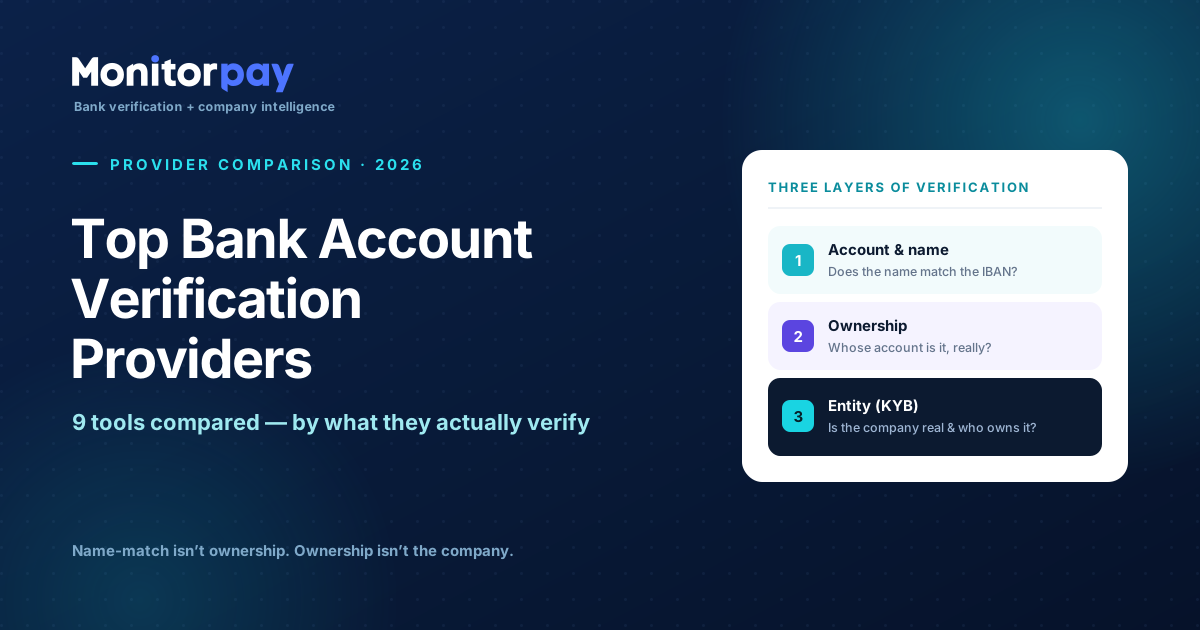
“Bank account verification” isn’t one thing — it’s three different jobs, and most providers only do one of them. This guide compares nine of the leading tools by what they actually verify, so you can match the provider to the problem instead of the marketing.
Search “bank account verification provider” and you’ll get a list that mixes name-match utilities, identity platforms, open-banking APIs, and managed fraud services as if they were interchangeable. They aren’t. A tool that confirms a payee name matches an IBAN does a completely different job from one that confirms who owns the company behind the account. Buy the wrong category and you’ll pass an audit while still wiring money to a fraudster.
So before the list, the framework. Verification happens in three layers, and the right provider depends on which layers you actually need to close.
Keep that in mind as you read. Some providers below are excellent at Layer 1 and do nothing else. Some are identity platforms that recently added account checks. One verifies the company but never touches the bank account. Here’s how the nine stack up.
The shortlistNine providers, by what they actually verify
MonitorPay closes all three layers in a single API call. It validates the IBAN, runs the payee-name match, and confirms account ownership — then verifies the business behind the account from registry-sourced data: legal entity, status, incorporation date, directors, shareholders and UBO, ultimate parent and full group structure. Bank verification spans 49+ countries directly plus EU/UK coverage through the VoP and CoP schemes, sub-second, with continuous monitoring on changes.
- Bank account and the company behind it in one call
- Registry-sourced UBO, group structure & financials
- 49+ countries direct, plus EU/UK VoP & CoP
- Continuous monitoring with change alerts
- API, bulk file, or online platform
- Newer name than the long-established incumbents
- A verification API, not a full AP-automation suite
A company-intelligence and KYB platform that sources data directly from official government registries — verified company profiles, beneficial ownership, financial statements, and corporate hierarchies across a very large global footprint (600M+ companies, 200+ countries) — and verifies bank accounts alongside that company data. It answers both the account and the entity question: is this account valid, and is the business behind it real, active, and who controls it.
- Bank account verification plus deep company data
- Registry-sourced UBO, financial statements & full group structure
- Strong for KYB and counterparty due diligence
- API and platform access
- Built as a broad company-intelligence platform, not a single-purpose payment-verification API
- Oriented to due diligence and KYB more than embedded, payment-time checks
The European name-match incumbent. A 2016 Rabobank spinoff, SurePay invented the IBAN-Name Check and is now the dominant Verification of Payee provider across Europe, embedded in hundreds of banks and covering the vast majority of Dutch accounts.
- Benchmark VoP / CoP match accuracy
- Deep EU/UK bank coverage, scheme-compliant
- Trusted by hundreds of European banks
- Layer 1 only — name-to-IBAN matching
- EU/UK-centric
- No ownership or company/entity verification
A vendor-payment fraud-prevention platform founded in Paris in 2017, aimed at large corporate finance teams. Trustpair validates supplier bank accounts and runs fraud-detection logic inside ERP and treasury environments (SAP, Oracle, Coupa), primarily in the US and France.
- Strong account validation + continuous controls
- Deep ERP and treasury integrations
- Built for enterprise AP at scale
- Enterprise implementation can be heavy
- Best fit needs SAP / Oracle / Coupa
- Less registry/entity depth
A managed payment-fraud-prevention service for accounts payable, strongest in Australia/New Zealand and the US. Eftsure cross-checks vendor details against a large database of verified business records, falls back to human verification, monitors the vendor master continuously, and integrates with ERPs (NetSuite, SAP, Oracle, Dynamics, Xero). Verified payments are backed by a guarantee of up to US$1M.
- Managed service with human verification
- Continuous vendor-master monitoring
- Payment guarantee of up to US$1M
- ERP-integrated
- Managed model depends on suppliers responding
- Historically domestic (ANZ / US)
- International coverage still expanding
A US identity-verification and fraud-decisioning leader — its RiskOS platform serves most of the largest US banks. In early 2026 Socure expanded its Account Intelligence / Bank Account Verification beyond the US and Canada to 30+ countries, confirming account status and ownership in real time, with no logins or micro-deposits.
- Best-in-class US identity + fraud signals
- Real-time account status & ownership
- Expanded to 30+ markets in 2026
- No micro-deposits or logins
- Identity-first and consumer-oriented
- Not a registry-sourced B2B entity tool
- US-centric heritage
Europe’s leading open-banking platform, owned by Visa since 2022, connected to thousands of banks across roughly 18 European markets. Its Account Check products verify account ownership by having the account holder authenticate with their own bank.
- Strong European open-banking coverage
- Fast, accurate for in-flow onboarding & payouts
- Verified data straight from the bank; Visa-backed
- Permission-based — the holder must log in
- Verifies the authenticating user’s own account, not a third-party supplier’s
- Europe-focused
A Lithuanian RegTech combining KYC (document + biometric verification with human review), KYB (company verification across 180+ registries in 120+ countries, UBO mapping), and AML screening in one platform — with bank and IBAN verification available as a feature. ISO 27001 certified and SOC 2 audited.
- KYC + KYB + AML in one suite
- Broad registry coverage for company checks
- ISO 27001 certified, SOC 2 audited
- Bank verification is a supporting feature, not the core
- Centre of gravity is identity / compliance
The largest open-banking network, connecting 12,000+ financial institutions across the US, Canada, and Europe — broadest by far in the US. Its Auth product instantly verifies account and routing details and confirms ownership for ACH, with Identity for KYC, all permission-based via Plaid Link.
- Unmatched US bank coverage (≈99.9%)
- Instant account verification, no micro-deposits
- Developer-friendly APIs
- Free tier to start
- Permission-based — the holder connects their own account
- Consumer- and US-centric
- Not a registry-sourced B2B entity tool
Side by sideThe comparison table
The fastest way to see the categories: who covers the bank layer, who covers the entity layer, and who does both.
| Provider | Primary lane | Bank layer | Entity (KYB) | Coverage focus | Best for |
|---|---|---|---|---|---|
| MonitorPay | Bank + entity API | ✓ | ✓ | 49+ direct, EU/UK VoP, global registries | Combined account + company in one call |
| Global Database | Company data / KYB | ✓ | ✓ | 200+ countries | Counterparty & supplier due diligence |
| SurePay | VoP / CoP name-match | ✓ | — | EU / UK | Bank/PSP scheme compliance |
| Trustpair | Enterprise AP fraud | ✓ | ◐ | US / France, ERP | Large ERP-based finance teams |
| Eftsure | Managed AP fraud | ✓ | ◐ | ANZ / US, expanding | AP teams wanting a managed guarantee |
| Socure | Identity + fraud | ✓ | — | US + 30 markets | US consumer accounts & ACH fraud |
| Tink | Open banking | ◐ | — | Europe | Consented onboarding & payouts |
| iDenfy | KYC / KYB / AML | ◐ | ✓ | 200+ countries | Regulated onboarding suites |
| Plaid | Open banking | ◐ | — | US / CA / EU | US account linking & ACH |
✓ core capability · ◐ partial or feature-level / via authentication · — not the product’s job. Categorisation reflects each provider’s primary positioning as of 2026.
How to chooseMatch the provider to the job, not the buzzword
Cut through the category with four questions:
- Which layers do you need? Pure VoP/CoP compliance → a name-match provider is enough. Paying suppliers you didn’t onboard in person → you need ownership and entity layers too.
- Consumer or business? Identity-first and open-banking tools shine for consumer/customer accounts. Supplier and counterparty verification needs registry-sourced company data.
- Where do you pay? Coverage is the silent dealbreaker. EU-only or US-only tools leave cross-border payments unprotected — confirm the provider covers the corridors you actually pay into.
- One vendor or two? Bank-layer and entity-layer tools solve different halves of the same problem. You can buy both and integrate them, or choose a provider that returns both in one call.
The account and the company behind it — verified in one call.
Most tools answer one layer. MonitorPay was built to answer all three: validate the IBAN, match the payee name, confirm account ownership, then verify the business from registry-sourced data — legal entity, status, directors, shareholders and UBO, ultimate parent and group structure. One API, sub-second, with continuous monitoring on changes.
Going deeperHead-to-head comparisons
If you’ve narrowed to a specific incumbent, we’ve written dedicated breakdowns for the providers buyers most often evaluate against each other:
- SurePay competitors — the top IBAN-verification alternatives compared.
- Trustpair alternatives — vendor payment verification platforms for 2026.
- iPiD competitors — the best Know-Your-Payee solutions compared.
- ClearBank competitors — payee-verification alternatives to a banking-bundled CoP.
Verify one account — or your whole vendor master file.
Bank account and company verification through a single integration, however your team works: