Beneficial Ownership Verification: What UBO Means for B2B Payments in 2026
UBO verification and bank account verification are two halves of the same fraud control. Bank verification confirms a specific account belongs to the entity that's claiming it. UBO verification confirms the entity itself is real and who actually owns it. Neither alone is sufficient: a perfectly verified bank account can still belong to a shell company, and a clean UBO check on a legitimate entity doesn't stop someone redirecting payments to an unverified account. The 2025 regulatory shifts make the layered model more important, not less — here's how to operationalise both in a B2B payment workflow.
For most of the past decade, B2B payment teams treated bank account verification and ownership verification as two separate compliance problems. Bank verification was the AP team's concern — does the IBAN match the supplier name, does the account exist, does it pass VoP or CoP. UBO verification was the compliance team's concern — is the supplier registered, who owns it, are any beneficial owners sanctioned. The two workflows ran in parallel, with different tools, different vendors, and different audit trails.
That separation no longer works. The fraud variants that defeat one layer routinely pass the other. A vendor with an inbox-compromise attack will have a perfectly verified bank account at the bank-level but a beneficial owner who doesn't exist at the entity-level. A shell company set up for invoice fraud has clean UBO documentation from a complicit director, but the bank account doesn't match the entity name when properly verified. The 2025 FinCEN reversal — which removed BOI reporting requirements for all U.S.-formed companies — made the gap wider by removing one of the two data sources B2B teams had been relying on. The EU went the opposite direction, tightening UBO verification standards under the new AML Regulation, but the principle holds: both layers have to work together, in any jurisdiction.
This article explains how UBO verification and bank account verification combine into a single fraud control in 2026 — what changed in the U.S., what changed in the EU, where the data comes from, and how to operationalise both layers in a B2B payment workflow. The framing throughout is operational: not the regulatory theory of UBO, but the workflow that survives an examiner, an auditor, or a sophisticated VEC attack.
What "beneficial owner" actually means
Beneficial owner — also called Ultimate Beneficial Owner or UBO — is the natural person who ultimately owns or controls a legal entity, directly or indirectly. The point of the concept is to look through layers of corporate structures, nominee shareholders, trusts, and other arrangements to identify the real human being benefiting from the entity's activities.
The standard threshold across most regulatory regimes is 25% ownership or control, though it varies in detail:
- FATF recommends the 25% threshold as the international standard, applied via direct ownership, indirect ownership through chains of entities, or control by other means (voting rights, board control, contractual arrangements).
- U.S. (FinCEN definition, still on the books) — a beneficial owner is any individual who, directly or indirectly, exercises substantial control over a reporting company OR owns or controls at least 25% of its ownership interests. Note: the definition hasn't changed; what changed is which companies have to report it.
- EU AMLR (Regulation 2024/1624) — also 25% ownership threshold, though the European Commission may lower it for high-risk sectors. The EU regulation harmonises this across all 27 Member States from July 10, 2027.
- UK — uses "Person with Significant Control" (PSC), with 25% as the headline threshold, plus control-via-other-means tests.
For B2B payments, the operational distinction that matters most is between direct ownership (a person who personally holds shares) and indirect or control-based ownership (a person controlling the entity through a holding company, voting agreement, or contractual arrangement). Most fraudsters who use shell companies design ownership structures to obscure the second category. UBO verification that only checks direct shareholders misses the people the regulation was written to surface.
What changed in the U.S. — the FinCEN reversal
The Corporate Transparency Act, enacted in 2021 and effective January 1, 2024, required most U.S. entities and foreign entities registered to do business in the U.S. to file Beneficial Ownership Information reports with FinCEN. Penalties for non-compliance were severe — civil penalties up to $591 per day, plus potential criminal liability.
The reversal happened in stages. On December 3, 2024, the U.S. District Court for the Eastern District of Texas, in Texas Top Cop Shop, Inc. v. McHenry, issued a nationwide preliminary injunction halting CTA enforcement. The case bounced between courts. By February 18, 2025, reporting requirements were briefly reinstated.
Then, on March 21, 2025 — consistent with a Treasury Department announcement on March 2 — FinCEN issued an interim final rule that fundamentally rewrote the scope of the CTA. The rule:
- Removed BOI reporting requirements for all U.S.-formed entities ("domestic reporting companies" as previously defined).
- Exempted U.S. persons from being identified as beneficial owners in any reports filed by foreign entities.
- Narrowed the "reporting company" definition to only foreign entities registered to do business in U.S. states or tribal jurisdictions.
- Set new deadlines for foreign reporting companies — most required to file by April 25, 2025; new registrants get 30 days from their effective registration date.
The practical effect: FinCEN's BOI database, which was designed to be the authoritative source for ownership data on roughly 32 million U.S. companies, is now operationally relevant only for foreign-registered entities — a small fraction of that volume. The vast majority of U.S. companies a B2B buyer might pay are no longer required to file BOI at all. If you want ownership data on a U.S. counterparty, FinCEN's database isn't where you'll find it.
Two further notes for operational accuracy. First, the definition of "beneficial owner" itself has not changed — only the reporting obligation. The concept still applies in customer due diligence rules (FinCEN's 2016 CDD Rule), in state-level requirements, and in U.S. obligations to foreign jurisdictions. Second, FinCEN signalled in the interim final rule that it intends to issue a finalised rule "this year" (i.e., during 2025), and in Congressional testimony on September 9, 2025, FinCEN Director Andrea Gacki confirmed that intent. As of early 2026, no final rule has been issued — meaning the interim rule remains in effect, but is subject to further change.
What changed in the EU — AMLR and AMLD6
The EU went in the opposite direction. On May 31, 2024, the European Parliament and Council adopted the new AML Package — three pieces of legislation that together replace the existing AML Directive framework:
- EU Regulation 2024/1624 (the "AML Regulation" or AMLR) — the directly applicable "Single Rulebook" that harmonises customer due diligence, beneficial ownership transparency, and obligated-entity rules across all 27 Member States. Applies from July 10, 2027.
- Directive (EU) 2024/1640 (AMLD6) — the 6th Anti-Money Laundering Directive, which sets out granular rules on Member States' beneficial ownership registers and supervisory frameworks. Member States must transpose most provisions by July 10, 2027. Provisions on access to beneficial ownership registers (including for persons with legitimate interest) had to be transposed by July 10, 2025. Further beneficial ownership register provisions must be transposed by July 10, 2026.
- Regulation (EU) 2024/1620 (AMLAR) — established the new EU Anti-Money Laundering Authority (AMLA), based in Frankfurt, with supervisory authority over high-risk cross-border financial entities.
What AMLR actually changes for beneficial ownership verification:
- Harmonised UBO definition across all 27 Member States. Previously, transposition variation produced 27 different operational interpretations of "beneficial owner." From July 2027, one definition applies everywhere.
- Expanded reporting obligations to more entity types — including legal arrangements like trusts, non-EU entities holding EU real estate, and entities with complex ownership structures.
- Stricter timelines for change reporting — beneficial ownership changes must be reported within 28 calendar days, and the data verification standards have tightened.
- Public access remains constrained following the November 2022 European Court of Justice ruling in WM and Sovim, but AMLD6 reinstates access for persons with "legitimate interest" — including journalists, civil society, and academics — and creates a presumption of legitimate interest for that category.
The European Commission has been actively enforcing the existing transposition deadlines. In late September 2025, the Commission initiated infringement proceedings against 11 Member States for failing to fully notify their transposition of AMLD6's first set of requirements on access to beneficial ownership information by the July 10, 2025 deadline.
The net direction: while the U.S. removed reporting requirements for most domestic companies, the EU tightened, harmonised, and expanded UBO requirements across the bloc — and added a supranational supervisor to enforce them. For a B2B buyer paying suppliers in both regions, the asymmetry is meaningful.
Who is exempted from what — the 2026 matrix
Reading both regulatory narratives back-to-back creates a common confusion: am I still subject to anything? The answer depends on three variables — your entity's jurisdiction of formation, whether you're paying a domestic or foreign counterparty, and whether you're an "obligated entity" under EU AMLR (most banks, payment institutions, and financial services firms are). The matrix below resolves the most common scenarios.
| Scenario | U.S. FinCEN BOI obligation | EU AMLR UBO verification obligation | Where to source UBO data |
|---|---|---|---|
| U.S. company paying U.S. supplier | None (interim rule exemption) | None — unless you're an EU obligated entity or have EU counterparty | State-level registries, commercial aggregators |
| U.S. company paying EU supplier | None on you; supplier subject to EU rules | Indirect — through your supplier's compliance obligations | EU national registries, commercial aggregators |
| EU company paying U.S. supplier | None — your supplier likely exempt unless foreign-registered | Yes — you must verify supplier UBO under AMLR | State-level registries, commercial aggregators (no FinCEN data) |
| EU obligated entity (bank, PSP) | Limited — only for foreign-registered U.S. counterparties | Full AMLR CDD obligations, including UBO verification | National registries + AMLR-driven verification |
| U.S. financial institution (under FinCEN CDD Rule) | 2016 CDD Rule applies separately — UBO identification still required | Only if EU operations or counterparties | Customer-supplied BOI + registry data |
| Foreign entity registered in U.S. | BOI filing required (30 days from registration) | Depends on home jurisdiction | FinCEN BOI data (restricted access) + home registry |
Two operational takeaways from this matrix. First: U.S. companies don't escape UBO obligations by virtue of FinCEN's interim rule — financial sector obligations under the 2016 CDD Rule are unchanged, and EU counterparties pull you into AMLR's orbit through their compliance obligations. Second: the data source has shifted — from a centralised FinCEN database that was supposed to solve the problem, back to fragmented national registries that have always been the operational source.
Why this matters for B2B payments
| United States (post March 2025) | European Union (AMLR/AMLD6) | |
|---|---|---|
| Direction of change | Deregulated — most companies exempted | Tightened — harmonised and expanded across 27 Member States |
| Who must file UBO data | Only foreign entities registered to do business in the U.S. | All entities meeting AMLR definition of obligated entity, plus expanded categories under AMLD6 |
| Who is exempt | All U.S.-formed entities; all U.S. persons as beneficial owners | Limited exemptions — definition broadened to cover trusts, non-EU entities holding EU real estate, complex structures |
| Where the data lives | FinCEN BOI database (operationally near-empty for domestic entities) | 27 Member State central registers + EU-wide interconnection system |
| Public access | None — database restricted to law enforcement and authorised users | Constrained by 2022 ECJ ruling, but reinstated for "persons with legitimate interest" under AMLD6 |
| Standard ownership threshold | 25% (definition unchanged; only reporting changed) | 25% (with Commission power to lower for high-risk sectors) |
| Reporting timeline for changes | 30 days (foreign entities only) | 28 calendar days under AMLR (Art. 63/64) |
| Status | Interim final rule (pending final rule) | AMLR applies from July 10, 2027; AMLD6 provisions phased through 2025-2027 |
| Verification standard for obligated entities | FinCEN 2016 CDD Rule still applies (separate from BOI reporting) | "Reasonable measures to verify" — higher than screening alone |
The asymmetry is striking. The U.S. reduced its UBO reporting requirements while the EU expanded them. For B2B teams operating in both regions, the practical implication is that EU-side obligations now extend further than U.S.-side obligations through the supply chain. A U.S. company paying a German supplier is subject to German verification expectations via the supplier's compliance with AMLR. A German company paying a U.S. supplier has lost FinCEN as a data source and must rely on state-level filings and commercial registry data instead.
The simplest framing: your verification obligations don't follow your physical location — they follow the regulatory regime of the counterparty and the underlying transaction. A U.S. company paying European suppliers operates under EU AMLR's UBO due diligence rules through those counterparties, regardless of whether the U.S. company files anything with FinCEN. An EU company paying a U.S. supplier still has to verify the supplier's ownership under EU AMLR — and now has less help from FinCEN's BOI database to do it.
Three specific operational consequences of the post-2025 environment:
1. The FinCEN BOI database is not a usable verification source for U.S. counterparties anymore. Even if a foreign entity has filed, the data is non-public and accessible only by law enforcement and authorised financial institutions in narrow contexts. For B2B verification, you need a different source.
2. Sanctions and PEP screening can't substitute for UBO verification. Many compliance teams have historically treated sanctions screening as the primary AML control, with UBO verification deprioritised. Under EU AMLR, that approach is increasingly insufficient — obligated entities must "identify the beneficial owners and take reasonable measures to verify their identity," not just screen them against lists. The verification standard is rising.
3. Shell-company fraud has become harder to detect with deregulated U.S. data. A fraudster who registers a U.S. LLC for a vendor email compromise attack no longer has to disclose ownership to FinCEN. The only way to identify the entity's owners is through state-level registries (which vary wildly in depth) or commercial registry-data providers. For an in-depth look at how shell-company fraud defeats bank-level verification, see our analysis of vendor email compromise.
For B2B payment teams that operate across both regions — which is most enterprise and mid-market AP teams — the practical conclusion is that UBO verification has become more important in the deregulated environment, not less, because the data is harder to source and the failure modes (shell companies, opaque foreign owners, intentionally complex structures) have a wider operational gap to exploit.
Three layers. Each catches what the others miss.
What this looks like in practice — two scenarios where one layer alone fails
Two anonymised scenarios, composite from publicly reported B2B fraud incidents, that illustrate why both layers matter — and what happens when either one is missing.
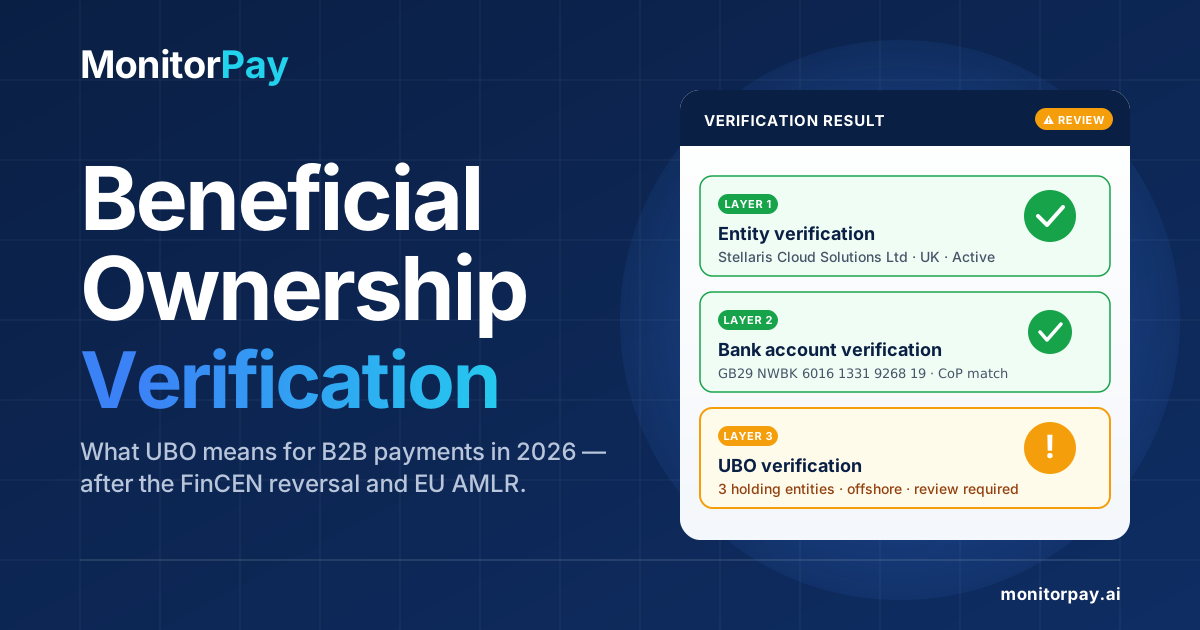
Scenario 1 — Shell company with a verified bank account. A mid-market AP team in Germany onboards a new IT services vendor, "Stellaris Cloud Solutions Ltd," a UK-registered company supplying cloud infrastructure. Standard onboarding: VAT number checked, Companies House registration confirmed, bank account verified via UK CoP. Match. The vendor passes onto the master file; a €240,000 contract is signed. What the bank-level CoP check could not see: Stellaris is a shell company. Its beneficial owner — through three holding entities in two offshore jurisdictions — is the cousin of a fraudster the AP team unknowingly paid €180,000 to two years earlier under a different shell. CoP correctly confirmed the account belongs to "Stellaris Cloud Solutions Ltd." That fact is true. What CoP cannot confirm is who ultimately owns Stellaris. A registry-based UBO check at onboarding would have surfaced the corporate group structure and the connection to the prior fraudster. The contract would not have been signed.
Scenario 2 — Legitimate vendor, hijacked bank details. A different mid-market AP team in France has worked with "Maréchal Industriel SARL" — a real French manufacturer — for four years. UBO data is on file from onboarding; Maréchal's directors and beneficial owners are documented in the French Registre du Commerce. Every quarter, an automated check confirms the registry data hasn't changed. Then on a Wednesday morning, an email arrives at the AP team — from Maréchal's actual address — requesting that the upcoming €82,000 invoice be paid to a new IBAN. The vendor's inbox has been compromised; the "new IBAN" belongs to a fraudster's account in Cyprus, opened in the name "Maréchal Industriel SARL" through identity-theft documentation. A registry-based UBO check would pass cleanly — Maréchal is real, the directors are real, the company is in good standing. What catches the fraud is the bank-account-layer verification: the new IBAN does not pass a VoP check, because the account holder name registered at the receiving bank does not match Maréchal's legal name.
The instructive pattern is that each scenario defeats one layer and is caught only by the other. In Scenario 1, bank verification passed but UBO would have caught the fraud. In Scenario 2, UBO data was clean but bank verification would have caught the fraud. A team running only one layer is exposed to whichever attack variant the other layer would have stopped. A team running both — at onboarding and continuously — closes both gaps.
How UBO and bank account verification work together
The two layers address different parts of the same fraud problem. Putting them side-by-side makes clear why neither alone closes the operational gap.
| Bank account verification | UBO verification | |
|---|---|---|
| What it confirms | The bank account is valid, active, and belongs to the entity claiming it (via VoP, CoP, ACH validation, NPCI, penny drop, or equivalent) | The entity itself is real and registered, and the natural persons behind it are identified |
| What it cannot catch | Shell companies with valid bank accounts. The fraudster's account name might match perfectly — the question is who controls the company. | Account redirection. A legitimate company with clean UBO data can have its bank details intercepted via VEC and replaced with a fraudster's account. |
| Data source | Banking infrastructure (Pay.UK, ECB SEPA scheme, NPCI, Nacha-compliant validation providers, etc.) | Government business registries (200+ countries), sanctions/PEP databases, customer-supplied documentation |
| Regulatory driver | EU Instant Payments Regulation (VoP), UK PSR SD17 (CoP), Nacha 2026 ACH rules, regional equivalents | EU AMLR/AMLD6, FinCEN CDD Rule (2016), local AML/CFT regimes |
| Where it runs in the workflow | At every bank-detail change and pre-payment for high-value transactions | At vendor onboarding and continuously thereafter, with re-checks at material payment events |
| Failure mode if missing | Vendor email compromise attacks succeed — the wrong account receives the payment | Shell-company fraud succeeds — payment goes to a verified account at a fake entity |
The two layers are complementary, not interchangeable. Skipping bank verification while running UBO checks doesn't catch VEC attacks. Skipping UBO checks while running bank verification doesn't catch shell-company fraud. The operational architecture most regulated B2B payment teams now build runs both layers — bank verification at every payment cycle, UBO verification at onboarding and continuously — and treats a failure at either layer as a stop signal for the payment.
Each fraud variant is caught by one layer — but not the same one
This is why MonitorPay was built as a single verification platform spanning both layers. Bank account verification across 49+ countries via direct integrations with Pay.UK, SEPA VoP, Nacha-aligned ACH validation, NPCI, and equivalent rails. UBO verification across 200+ government registries with 600M+ companies in coverage. The same API call can return both — so an AP team's decision tree is one path, not two parallel workflows.
For a deeper comparison of how bank-level verification methods themselves differ by country, see the 7 verification methods compared. For why one-time verification at either layer is insufficient against continuously shifting fraud patterns, see why one-time verification fails.
How MonitorPay helps
Both layers. One API. Every market that matters.
MonitorPay was built around the operational reality that neither bank account verification nor UBO verification alone is sufficient. One API delivers both — bank-level verification across 49+ countries with the right method per market, plus registry-sourced UBO and entity data across 200+ jurisdictions. The same call covers both layers, the same response normalises both outcomes, and the same continuous monitoring watches for changes at either level.
- ✓Bank account verification in 49+ countries — VoP in the EU, CoP in the UK, ACH validation in the US, NPCI in India, and more
- ✓Shareholder, UBO, and corporate group data — across 200+ government registries with 600M+ companies and 378M+ corporate linkage records
- ✓Continuous monitoring at both layers — webhook alerts when bank account status changes OR when UBO/registry data shifts
- ✓Unified API response — one decision tree for your AP system, regardless of which method ran underneath
Where UBO data actually comes from in 2026
With FinCEN's BOI database operationally unavailable for most U.S. counterparties, and EU public access constrained by the 2022 ECJ ruling, the practical sources of UBO data for B2B verification have shifted. The four sources that matter in 2026:
Where the data actually comes from in 2026
1. National business registries
Most countries maintain public business registries that include directors, officers, and (depending on jurisdiction) shareholders or persons with significant control. Coverage and depth vary widely:
- UK (Companies House) — strong public access, includes PSC information for most companies.
- EU Member States — varies. AMLD6 is requiring tighter access rules for "persons with legitimate interest" by July 2026, but national implementation varies. Germany's Transparenzregister, France's INPI, and Italy's Camera di Commercio all maintain UBO data.
- U.S. — state-level Secretary of State filings provide director/officer data but not ownership. Beneficial ownership data is now generally not available at the federal level under the interim final rule.
- Asia / LatAm — varies significantly. India's MCA21, Brazil's Receita Federal, Mexico's SAT all provide entity-level data but not always beneficial ownership.
2. Sanctions and PEP databases
OFAC SDN List, EU Consolidated List, UN Sanctions List, and various national PEP databases. These are necessary but not sufficient — they tell you whether a known person is on a watchlist, but they don't help you identify who the beneficial owners of an entity are in the first place. Sanctions screening sits downstream of UBO verification, not in place of it.
3. Commercial registry aggregators
Providers that aggregate data from national registries into unified APIs. This is the layer most B2B verification platforms operate at — including MonitorPay, which sources UBO data from 200+ government registries covering 600M+ companies, with 378M+ corporate linkage records mapping parent-subsidiary relationships. The value proposition is operational: one API call returns harmonised UBO data regardless of which national registry actually holds the underlying record.
4. Self-attestation and supporting documents
Customers fill out UBO declaration forms; vendors submit shareholder schedules; suppliers provide certified ownership documents. This is the layer most B2B onboarding processes use in addition to registry data — it works as a confirmation against registry data, not as a substitute for it. Self-attestation alone fails the "reasonable measures to verify" standard under EU AMLR.
The combination most regulated B2B verification workflows use is registry data as the primary source, sanctions/PEP screening as the secondary check, and self-attestation as the customer-supplied confirmation. Where registries don't go deep enough — typically for entities in jurisdictions without modern beneficial ownership registers — manual review with supporting documents (notarised ownership certificates, audited financials) takes over.
Sample API response — entity + bank + UBO in one call
For more on how registry-sourced data fits into the broader bank verification toolchain, see the 7 verification methods compared.
The UBO verification workflow that works in 2026
What a working UBO verification workflow looks like for a typical B2B payment operation in 2026 — across onboarding, before-payment checks, and continuous monitoring.
Both layers run at each checkpoint in the vendor lifecycle
At vendor onboarding
Onboarding is when both layers are cheapest and most informative. The vendor's incentive to provide accurate data is highest (they want to be paid); the verifications can run before any commercial relationship exists; and the audit trail starts at the point of first contact.
- Run registry verification at the entity level — confirm the vendor exists, is in good standing, and the registration details match the supplied information.
- Verify the bank account at the bank level — use VoP (EU), CoP (UK), ACH validation (US), NPCI (India), or equivalent rail-appropriate verification to confirm the supplied bank account belongs to the vendor's legal entity name. Mismatches at this layer indicate the bank details either are wrong or belong to a different party.
- Pull UBO data from registries — identify all natural persons owning ≥25% directly or through control mechanisms. Map the corporate group structure where the vendor isn't an ultimate parent.
- Cross-check self-attested UBO declarations against registry data — discrepancies between what the vendor declares and what the registry shows are the most common signal of an intentional obfuscation attempt.
- Sanctions and PEP screening on every identified UBO — including individuals identified through indirect control, not just direct shareholders.
- Document both verifications with timestamps, source attribution, and result codes — auditors expect this; under EU AMLR the documentation standard is rising, and Nacha 2026 rules require equivalent documentation for ACH originators.
Before each material payment
For high-value payments — typically over a threshold defined by the firm's risk policy — pre-payment verification runs at both layers. The case for each: bank verification catches the VEC and account-redirection variants where bank details have been hijacked since the last payment; UBO verification catches restructurings, acquisitions, and corporate changes since onboarding.
- Re-verify the bank account — confirm the registered account holder name still matches the vendor's legal entity, especially after any bank-detail change request. This is the single highest-yield control against vendor email compromise.
- Re-run UBO verification — confirm the registered ownership at the time of payment matches what was verified at onboarding.
- Check entity status — confirm the vendor is still active in the registry; dissolved or inactive entities trigger an immediate pause.
- Re-screen UBOs against current sanctions lists — sanctions designations change frequently; an UBO who cleared screening at onboarding may have been designated since.
Continuous monitoring between payments
The case for continuous monitoring applies to both layers. Ownership changes happen between onboarding and the next payment — acquisitions, restructurings, new shareholders, director changes, dissolutions. Bank account changes happen too — vendor inbox compromises, supplier banking-relationship changes, account closures, fraudulent change requests submitted between payment cycles. Continuous monitoring catches both via webhook alerts when registry data or bank account status changes, so the next payment flows through checks that reflect current state rather than stale onboarding data.
See why one-time verification fails for the operational case for continuous monitoring across the full vendor lifecycle, and KYB verification for marketplaces for how UBO verification fits into high-volume onboarding workflows.
Which workflow applies to your situation
The workflow above describes the full pattern. Most teams need a smaller version of it depending on their situation. Use the questions below to identify which subset applies.
- Q1. Are you an EU-regulated obligated entity (bank, PSP, fintech, payment institution)?
- Yes → Full AMLR-compliant workflow: onboarding UBO verification, pre-payment checks for high-value transactions, continuous monitoring. Document everything with the rigour AMLA examiners will expect from July 2027.
- No → Continue to Q2.
- Q2. Are you a U.S. financial institution subject to the 2016 FinCEN CDD Rule?
- Yes → CDD-compliant UBO identification at account opening, plus ongoing monitoring. The interim final rule did not change the CDD Rule — only BOI reporting changed.
- No → Continue to Q3.
- Q3. Do you pay suppliers in jurisdictions with AMLR-equivalent UBO rules (EU, UK, parts of LatAm/APAC)?
- Yes → Lighter version of the workflow: registry-based UBO check at onboarding, pre-payment re-verification for high-value transactions, continuous monitoring for material vendors. Your obligations come through your counterparties' compliance expectations.
- No → Continue to Q4.
- Q4. Is fraud prevention the primary driver (not regulatory compliance)?
- Yes → Even with no direct regulatory obligation, registry-based UBO verification at onboarding remains the strongest control against shell-company fraud. Skip the formal AMLR-style audit trail; keep the verification.
- No → You likely don't need UBO verification at all. Most non-financial, non-EU-exposed B2B operations sit here. But "I don't need to" and "I shouldn't bother" are different — registry-based entity verification (without full UBO depth) is still worthwhile as a fraud control.
The pattern that emerges: most teams need some version of UBO verification, but the depth varies dramatically by regulatory exposure. Full AMLR-compliant workflows are heavy. Fraud-driven workflows can be much lighter. The mistake is assuming "no regulatory obligation" means "no UBO check needed" — for fraud prevention, the answer is almost always to keep the check, even when the regulator isn't watching.
Ready to verify beneficial ownership at scale?
Verify 50 bank accounts for free. No credit card required.
Try MonitorPay Free →Frequently Asked Questions
Is UBO reporting still required in the United States?
For most U.S. companies, no. The interim final rule FinCEN published on March 26, 2025 exempts all entities formed in the United States from the Beneficial Ownership Information reporting requirement under the Corporate Transparency Act. U.S. persons are also exempt from being identified as beneficial owners in reports filed by foreign entities. The only entities still required to file BOI with FinCEN are foreign entities registered to do business in the United States. The interim final rule remains in effect pending issuance of a final rule, which FinCEN has indicated will follow but has not yet published as of early 2026.
Does the FinCEN reversal mean U.S. companies don't need UBO data anymore?
It means they don't have to file it. Verifying it is a separate question. Financial institutions remain subject to FinCEN's 2016 Customer Due Diligence Rule, which requires identifying beneficial owners as part of CDD obligations. U.S. companies paying European or other foreign suppliers are subject to those counterparties' regulatory regimes — including EU AMLR, which tightens UBO verification rather than relaxing it. And for fraud prevention purposes, UBO data remains the strongest signal for detecting shell-company schemes, even where no regulatory filing is required.
When does the EU AMLR take effect?
The EU AML Regulation (Regulation 2024/1624) applies from July 10, 2027 across all 27 Member States. The 6th AML Directive (Directive 2024/1640) requires national transposition by the same date, with earlier deadlines for specific provisions — including access to beneficial ownership registers (July 10, 2025) and further register requirements (July 10, 2026). The European Commission has already initiated infringement proceedings against 11 Member States for failing to fully transpose the July 2025 access provisions on time.
What's the difference between AMLD6 and the AMLR?
The AMLR is a directly applicable Regulation — it applies uniformly across all 27 Member States without national transposition. AMLD6 is a Directive — it sets out rules that Member States must transpose into national law. The two work together: the AMLR harmonises customer due diligence and beneficial ownership transparency for obligated entities (banks, payment institutions, etc.), while AMLD6 sets the rules for Member States' central beneficial ownership registers and supervisory frameworks. Both adopted on May 31, 2024.
What is the 25% threshold for beneficial ownership?
It's the standard ownership level above which an individual is considered a beneficial owner of a legal entity under most regulatory regimes — FATF, FinCEN, EU AMLR, and UK PSC rules all use 25% as the headline threshold. The threshold can apply through direct ownership, indirect ownership via chains of entities, or control by other means (voting rights, board control, contractual arrangements). The European Commission may lower the threshold for high-risk sectors under AMLR. The 25% figure is a screening threshold, not a safe harbour — individuals controlling an entity through means other than equity (e.g., shareholder agreements, voting trusts) are also beneficial owners regardless of percentage.
Can I access FinCEN's BOI database for UBO verification?
Generally no. Even when BOI reporting was in force, the database was restricted by statute to a narrow set of authorised users — law enforcement, certain regulators, and financial institutions accessing customer-supplied BOI for CDD purposes with customer consent. The general public, B2B counterparties, and most non-financial businesses cannot query the database. For B2B verification, the operational sources of UBO data are national business registries, commercial registry aggregators, and sanctions/PEP databases — not FinCEN.
How do I verify UBO for a private company with opaque ownership?
Layered verification using multiple sources. Start with the relevant national business registry, which discloses what's mandatorily public. Cross-check against the entity's self-attested declarations (UBO forms, shareholder schedules supplied during onboarding). Run sanctions and PEP screening against every identified owner and director. Where the structure is genuinely opaque — common with trusts, nominee shareholders, and offshore jurisdictions — request supporting documents (certified shareholder registers, audited financials, beneficial ownership declarations notarised by an independent party). For high-risk cases, manual review with KYB analysts is the right call rather than relying on automation alone.
How often does beneficial ownership data change?
More frequently than most onboarding teams assume. M&A activity, internal restructurings, new investors, director appointments and resignations, share transfers, and corporate dissolutions all happen continuously across any meaningful vendor portfolio. Studies of B2B payment fraud indicate that a significant proportion of fraud incidents occur with vendors whose ownership or status changed after the initial onboarding check passed. This is the operational case for continuous monitoring with webhook alerts when registry data changes, rather than relying on point-in-time onboarding verification alone.
Is sanctions screening the same as UBO verification?
No, and conflating them is a common compliance mistake. Sanctions screening checks whether a person or entity appears on a known watchlist. UBO verification identifies who the beneficial owners of an entity are. Sanctions screening is necessary but only useful once the identities are established; if you don't know the beneficial owners, you don't know whom to screen. Under EU AMLR, obligated entities must take "reasonable measures to verify" beneficial ownership — a higher standard than screening alone.
What happens if my counterparty refuses to disclose beneficial owners?
Under EU AMLR and most equivalent regimes, the obligated entity (you, as the payer) must decline to enter into or continue the business relationship if beneficial ownership cannot be verified through reasonable measures. The same standard applies under FinCEN's 2016 CDD Rule for financial institutions. Practically, this means a B2B AP team's verification workflow needs a clear escalation path: if registry data is insufficient and the counterparty won't supply attestations or supporting documents, the payment doesn't proceed. Documenting that decision with timestamps and reasoning is essential for the audit trail.