Verification of Payee (VoP) vs. Full Account Verification: Why EU Compliance Isn’t Enough
- What Is Verification of Payee (VoP)?
- How VoP Works: The 4-Step Process
- VoP vs. Confirmation of Payee (CoP): EU vs. UK
- 5 Critical Limitations of VoP That Most Companies Miss
- What Is Full Account Verification?
- VoP vs. Full Account Verification: Side-by-Side
- When VoP Is Enough — And When It's Not
- How MonitorPay Bridges the Gap
- What Smart Compliance Teams Are Doing Now
- Frequently Asked Questions
1. What Is Verification of Payee (VoP)?
Verification of Payee (VoP) is a mandatory EU scheme that requires payment service providers to check whether a payee's name matches their IBAN before executing a SEPA credit transfer.
The regulation went live on October 9, 2025 for all Eurozone PSPs. Non-euro EU countries have until July 9, 2027 to comply.
VoP is part of the EU's Instant Payments Regulation (IPR). It was designed to fight Authorised Push Payment (APP) fraud — the kind where a scammer impersonates a trusted party and tricks you into sending money to the wrong account.
The concept is simple: before you send payment, your bank asks the recipient's bank to confirm the name on the account matches the name you entered. If there's a mismatch, you get a warning.
💡 Think of VoP as a spell-check for payment details. Useful? Absolutely. Sufficient to stop sophisticated fraud? Not even close.
2. How VoP Works: The 4-Step Process
The entire VoP check happens in under 3 seconds.
The payer enters the payee's name and IBAN into their banking interface.
The payer's PSP (Requesting PSP) sends a verification request to the payee's PSP (Responding PSP) via the EPC Directory Service.
The Responding PSP compares the name provided against the name registered on the account.
The result is returned to the payer. Four possible outcomes:
| Result | What It Means |
|---|---|
| Match | Name and IBAN match the bank's records. Payment proceeds. |
| Close Match | Name is similar but not exact. The payer sees the registered name and decides whether to proceed. |
| No Match | Name does not match. The payer is warned but can still send the payment (and assumes liability). |
| Not Possible | Verification could not be completed. The recipient bank doesn't support VoP or is unreachable. |
The payer always has the final decision. Even with a "No Match" result, the payment can still be executed — but liability shifts to the payer.
3. VoP vs. Confirmation of Payee (CoP): EU vs. UK
If you operate in both the UK and EU, you'll encounter two separate schemes solving the same problem.
The UK launched Confirmation of Payee (CoP) in 2019. The EU's VoP arrived six years later. Both check whether the payee's name matches the account. But they operate under different regulatory frameworks and infrastructure.
| CoP (UK) | VoP (EU) | |
|---|---|---|
| Governing Body | Pay.UK | European Payments Council (EPC) |
| Live Since | 2019 | October 2025 |
| Coverage | UK domestic payments | SEPA zone (36 countries) |
| What It Checks | Name + sort code + account number | Name + IBAN |
| Payment Types | FPS, CHAPS, BACS | SEPA SCT + SCT Inst |
| Cross-Border? | No — UK only | Within SEPA only |
⚠️ Neither scheme covers payments outside their zone. A UK company paying a supplier in Singapore, or an EU company paying a vendor in Brazil, gets zero protection from CoP or VoP.
4. 5 Critical Limitations of VoP That Most Companies Miss
VoP is a good first step. It's not a complete fraud prevention strategy. Here's where it falls short:
Limitation 1: SEPA-Only Coverage
VoP applies exclusively to SEPA credit transfers. If you send payments outside the EU/EEA — to the US, Asia, Africa, Latin America, or the Middle East — VoP doesn't exist. No name check, no verification, no safety net. For any company with a global supply chain or international payouts, this is a massive blind spot.
Limitation 2: Name Matching Only — No Ownership Verification
VoP checks whether the name you entered matches the name on the bank account. That's it. It doesn't tell you who legally owns the account. It doesn't confirm the entity behind the account is a real, registered business. A fraudster who opens a bank account under a company name resembling your supplier's will pass VoP with a "Match" result.
Limitation 3: No Protection Against Identity Theft
If a criminal steals a business identity and opens a bank account under that stolen name, VoP will return "Match." The name checks out perfectly — because the criminal specifically chose a name that would pass. VoP cannot detect whether an account has been compromised, taken over, or set up using stolen credentials.
Limitation 4: No Beneficial Ownership, Corporate Linkage, PEPs, or Sanctions Checks
VoP doesn't look behind the account. It can't tell you whether the company you're paying is controlled by a sanctioned entity, a shell company, or a politically exposed person. It can't trace the corporate linkage — parent companies, subsidiaries, branches, or group structures. It can't screen the individuals behind the entity against global sanctions lists, PEP databases, or adverse media. For regulated industries — banking, insurance, fintech — this gap means VoP alone cannot satisfy KYB, AML, or CDD obligations. You're checking a name. You're not checking who's behind it.
Limitation 5: Friction Without Resolution
When VoP returns "Close Match" or "Not Possible," your treasury team is stuck. Is it a typo? A trade name vs. legal name mismatch? A red flag? VoP doesn't give you the data to resolve the ambiguity. It adds a speed bump and passes the decision — and liability — back to you.
5. What Is Full Account Verification?
Full account verification goes several layers deeper than VoP. Instead of just checking whether a name matches an IBAN, it confirms:
🔐 Legal Ownership
Who is the registered legal owner of this bank account? Sourced from government registries — not self-reported data.
🏢 Beneficial Ownership + Corporate Linkage
Who controls the entity? What's the full corporate tree — parent, subsidiaries, branches, group structure? Who are the UBOs?
🛡️ PEPs & Sanctions Screening
Are the company or its directors, shareholders, and UBOs flagged on global sanctions lists, PEP databases, or adverse media? Screening covers both entities and individuals.
📊 Account Status
Is the account active? Has it been flagged, frozen, or closed? Has ownership changed recently?
🌍 Global Coverage
Does verification work outside SEPA? Can it cover payments to Asia, Americas, Africa, and the Middle East?
📡 Continuous Monitoring
Can you track changes over time — not just verify once at onboarding, but get alerts when ownership, sanctions status, or corporate structure changes?
✅ If VoP is a spell-check, full account verification is a full background check. It tells you not just "does the name look right" but "is this the right entity, who controls it, are they sanctioned, and should you be sending them money."
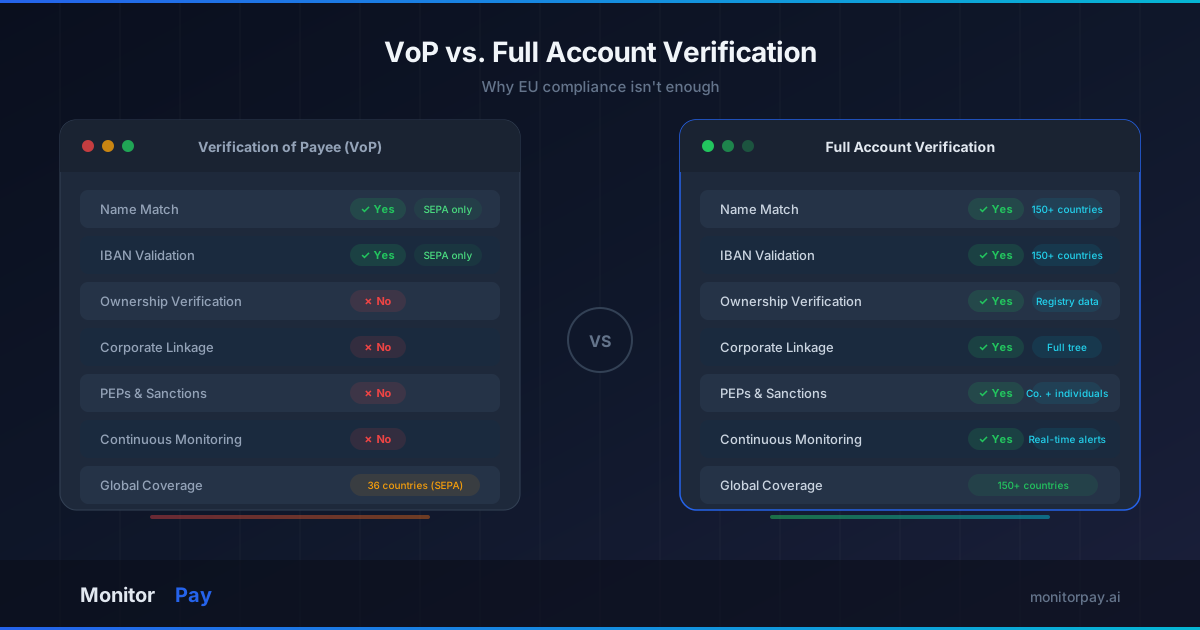
6. VoP vs. Full Account Verification: Side-by-Side
Here's how VoP compares to full account verification across the dimensions that matter to compliance, treasury, and risk teams:
| Dimension | VoP (EU Mandate) | Full Account Verification |
|---|---|---|
| What's Checked | Name + IBAN match | Name + ownership + beneficial owners + corporate linkage + PEPs/sanctions + account status |
| Data Source | Receiving bank's records | Government registries, banking authorities, corporate filings |
| Geographic Coverage | SEPA zone only (36 countries) | 150+ countries globally |
| Ownership Verification | No | Yes — legal + beneficial owners |
| Corporate Linkage | No | Yes — parent, subsidiaries, branches, group structure |
| PEPs & Sanctions Screening | No | Yes — companies + individuals (directors, shareholders, UBOs) |
| Continuous Monitoring | No — point-in-time only | Yes — ongoing alerts for ownership, sanctions, and structure changes |
| Fraud Types Prevented | Typos, basic name mismatch | APP fraud, identity theft, shell companies, sanctioned entities, PEP exposure |
| KYB / AML Compliance | Partial — name check only | Comprehensive — full entity + individual verification |
| Integration | Bank-to-bank via EPC scheme | Single API for any workflow |
7. When VoP Is Enough — And When It's Not
VoP isn't bad. For certain use cases, it's perfectly adequate.
✅ VoP Is Sufficient When:
You process low-value domestic SEPA transfers between known parties. Your payments stay entirely within the Eurozone. You're a consumer making P2P transfers. Your compliance obligations are limited to basic payment verification.
🚫 VoP Is NOT Enough When:
You pay vendors, suppliers, or contractors outside the SEPA zone. You onboard merchants, sellers, or freelancers on a marketplace. You process high-value B2B payments where a single misdirected transfer costs six or seven figures. Your regulatory framework requires beneficial ownership checks under AMLD6, CDD, or KYB. You operate in fintech, banking, insurance, or lending — where the regulator expects more than a name match. You need to continuously monitor counterparties, not just check them once.
💡 If even one of those "not enough" scenarios applies to you, VoP compliance is your floor — not your ceiling.
8. How MonitorPay Bridges the Gap
MonitorPay was built for the exact scenario VoP doesn't cover: verifying payment counterparties globally, continuously, and beyond a simple name check.
Verify Ownership — For Both Companies and Individuals
MonitorPay confirms legal ownership for both business and personal accounts. Whether you're paying a freelancer in the Philippines or onboarding a corporate supplier in Germany, the same API call returns the verified account holder, match result, and source reference.
🌐 Global Ownership Verification
Confirm who legally owns a bank account using data from government registries in 150+ countries. First-party, structured data from 200+ trusted sources. Works for individuals and companies.
🏗️ Full Corporate Linkage
Trace the entire corporate tree: parent companies, subsidiaries, branches, and group structures. Understand who controls the entity you're paying — not just who's named on the account.
PEPs & Sanctions Screening — Across the Entire Linkage
This is where MonitorPay goes far beyond what any VoP scheme can offer. Once ownership and corporate linkage are established, MonitorPay screens every entity and individual in the chain against global risk databases:
🛡️ Company-Level Screening
Screen the account-holding entity, its parent company, and all subsidiaries against global sanctions lists (OFAC, EU, UN, HMT), enforcement databases, and adverse media.
👤 Individual-Level Screening
Screen directors, shareholders, UBOs, and authorized signatories against PEP databases, sanctions lists, and watchlists. Covers the full ownership chain — not just the named account holder.
🔗 Linkage-Wide Risk
A clean entity can be controlled by a sanctioned parent. A compliant company can have a PEP as its UBO. MonitorPay flags risk at every level of the corporate structure — so nothing hides behind layers.
📡 Continuous Monitoring
Set rules, track accounts, receive alerts when ownership changes, sanctions status updates, new PEP designations emerge, or corporate structures are reorganized. VoP checks once. MonitorPay watches continuously.
Plus the Basics — Covered
✓ IBAN + Payee Name Matching
Validate IBAN format, confirm the issuing bank, and match payee names — all in one API call.
🏦 Account Status Checks
Verify whether an account is active, flagged, or recently changed ownership. Don't just check the name — check the account itself.
📋 Enriched Firmographics
Get company website, industry codes, estimated revenue, employee count, legal entity type, registration number, and incorporation details — all enriched from registry data.
💰 Transparent Pricing
100 free checks to start. Usage-based from €0.10/check. No monthly minimums. Invoice at month-end based on actual volume.
💡 MonitorPay doesn't replace VoP. It completes it. VoP handles SEPA name matching. MonitorPay handles ownership, corporate linkage, PEPs and sanctions screening for both companies and individuals, global coverage, and ongoing monitoring — the full verification layer that VoP was never designed to provide.
9. What Smart Compliance Teams Are Doing Now
The best compliance and treasury teams aren't treating VoP as the finish line. They're treating it as the starting point.
Audit your payment flows. Map every payment route. Where do payments go inside SEPA? Where do they go outside? Which routes have zero verification coverage today?
Identify your exposure. For every non-SEPA payment, you currently have no mandated verification. Quantify that exposure. How much money moves without any account ownership check?
Layer full verification on top of VoP. Use VoP for SEPA name matching. Add full account verification for everything VoP can't cover — ownership, global payments, and beneficial ownership checks.
Automate continuous monitoring. Verification at onboarding is a snapshot. Ownership changes. Accounts get compromised. Set up continuous monitoring to catch changes before your next payment goes out.
Build an audit trail. Regulators don't just want you to verify. They want proof. Use a platform that logs every check, every result, every alert — with timestamps and source data.
Ready to Go Beyond VoP?
Start with 100 free checks. See how MonitorPay adds ownership verification, full corporate linkage, PEPs and sanctions screening, and continuous monitoring on top of your existing compliance workflow.
10. Frequently Asked Questions
Yes. As of October 9, 2025, all PSPs in the Eurozone must offer VoP for SEPA credit transfers. PSPs in non-euro EU countries have until July 9, 2027 to comply. The requirement covers both standard and instant SEPA credit transfers.
VoP compares the payee's name against the name registered with the receiving bank for a given IBAN. It returns one of four results: Match, Close Match, No Match, or Verification Not Possible. It does not verify ownership, beneficial owners, or account status.
No. VoP applies exclusively to SEPA credit transfers. Payments to countries outside the EU/EEA — including the US, Asia, Africa, and Latin America — are not covered. For global payment verification, you need a solution like MonitorPay that covers 150+ countries.
CoP is the UK's equivalent, governed by Pay.UK and live since 2019. Both check name vs. account details, but CoP covers UK domestic payments while VoP covers the SEPA zone. Neither covers the other's territory or international payments.
Full account verification goes beyond name matching. It confirms legal ownership of a bank account using government registry data, checks beneficial ownership structures, verifies account status, and works globally across 150+ countries — not just within SEPA.
No. VoP only checks whether a name matches an IBAN. If a fraudster opens an account under a stolen business name, VoP returns a "Match" result. It cannot detect compromised accounts, stolen identities, or shell companies.
Any organization that pays vendors outside SEPA, onboards merchants on marketplaces, processes high-value B2B payments, or is subject to AML/KYB regulations requiring beneficial ownership verification. This includes banks, fintechs, PSPs, insurers, and corporates with international supply chains.
Account ownership verification confirms the legal entity or individual that owns a specific bank account. Unlike VoP (which only matches names), ownership verification uses data from government registries and banking authorities to confirm true ownership.
No. MonitorPay complements VoP. VoP handles SEPA name-matching as required by regulation. MonitorPay adds ownership verification, full corporate linkage (parent, subsidiaries, branches), PEPs and sanctions screening for both companies and individuals across the entire ownership chain, global coverage across 150+ countries, and continuous monitoring — the layers VoP was never designed to provide.
MonitorPay offers 100 free checks to start. After that, pricing is usage-based from €0.10 per check with no monthly minimums. You're invoiced at month-end based on actual volume. See full details at monitorpay.ai/pricing.