UK Confirmation of Payee vs EU Verification of Payee: A Complete Comparison for 2026
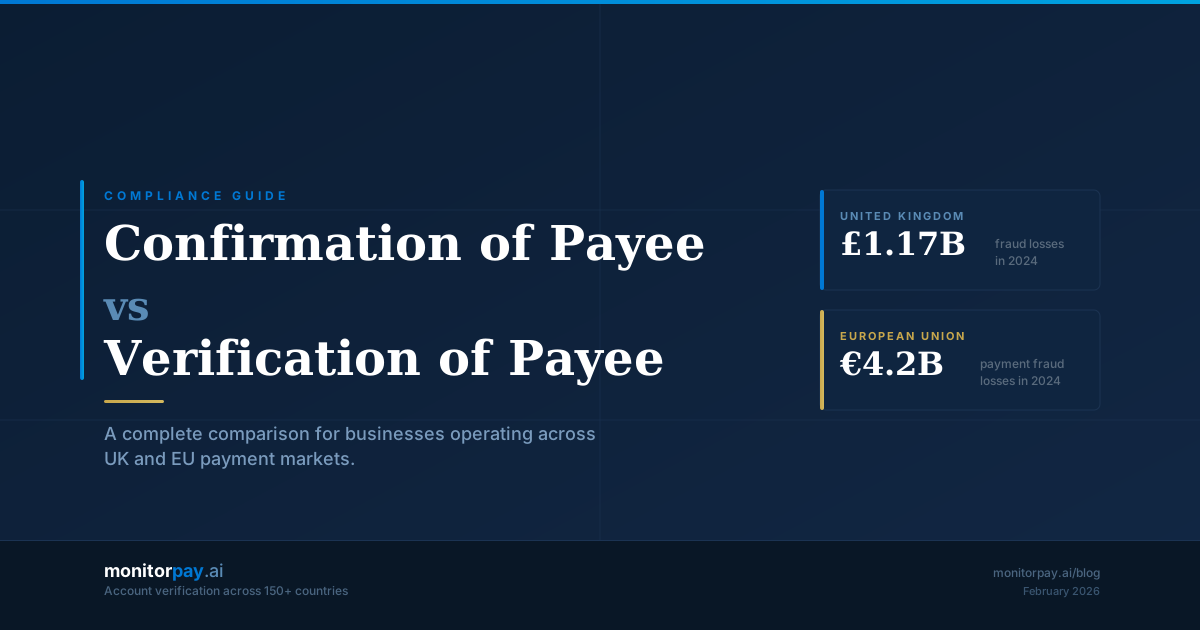
In 2024, UK fraud losses topped £1.17 billion. Across the EU, payment fraud reached €4.2 billion. Fraudulent instant payment transactions in Europe jumped 175% in two years.
The response? Two mandatory payment verification schemes now live on either side of the Channel. The UK has Confirmation of Payee (CoP). The EU has Verification of Payee (VoP). Both check whether the name you enter matches the account you’re paying.
But they’re not the same. They run on different rails, cover different geographies, and leave different gaps. If your business operates across both markets—or pays suppliers outside either zone—you need to understand where each scheme starts, where it stops, and what fills the space in between.
This guide breaks it all down.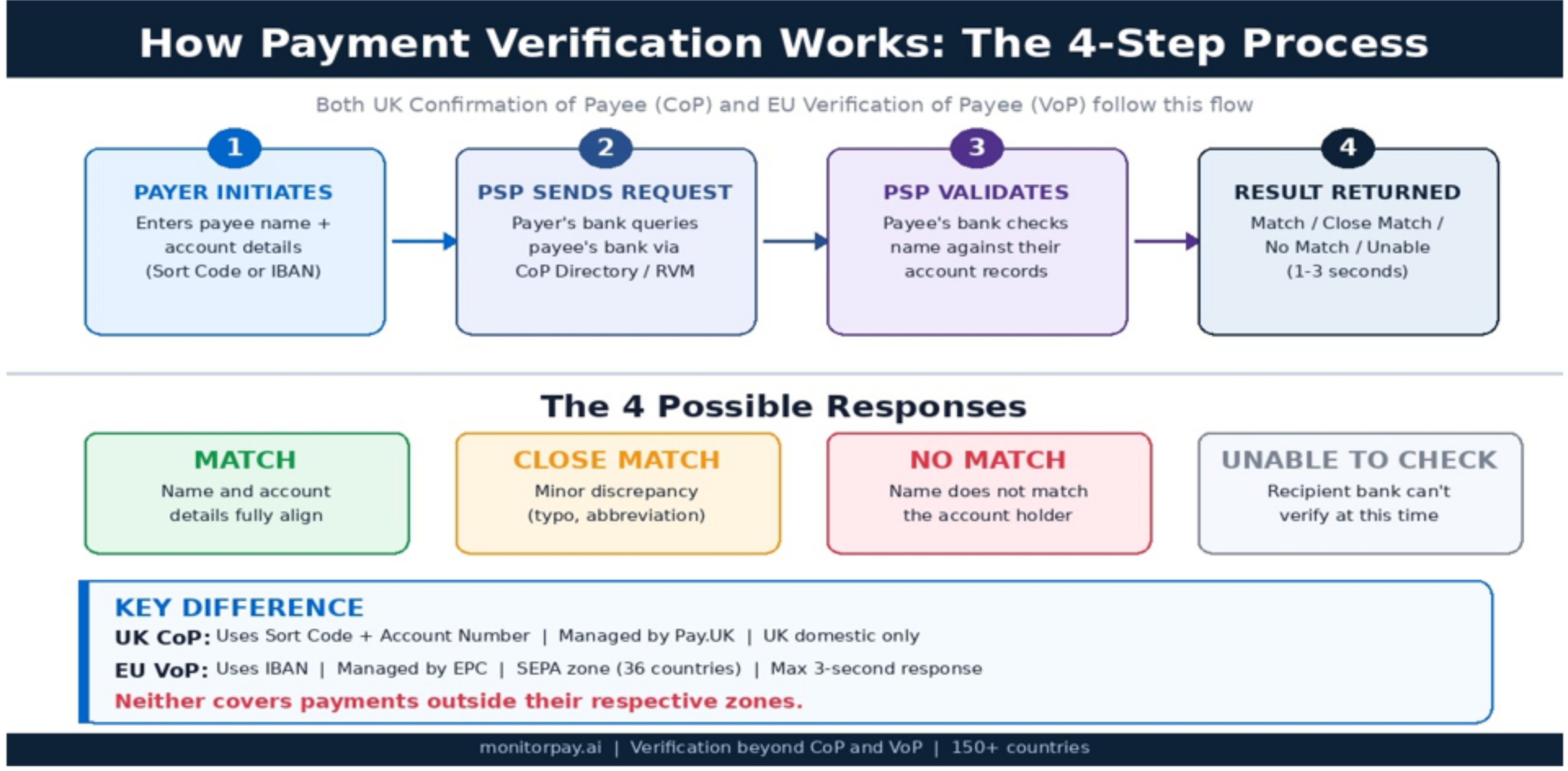
What Is Confirmation of Payee (CoP)?
Confirmation of Payee is a name-checking service for UK payments. It was launched in 2020 by Pay.UK to combat Authorised Push Payment (APP) fraud—where victims are tricked into sending money to accounts controlled by criminals.
Here’s how it works: when you set up a new payee or amend payment details, your bank sends the recipient’s name, sort code, and account number to their bank. Their bank checks whether the name matches their records and sends back one of four responses:
| Response | What It Means |
| ✅ Match | Name and account details align. Payment proceeds. |
| ⚠️ Close Match | Minor discrepancy (typo, abbreviation). You’re shown the correct name and asked to confirm. |
| ❌ No Match | Name does not match the account. Warning issued—proceed at your own risk. |
| 🚫 Unable to Check | Recipient’s bank doesn’t support CoP or can’t verify. |
Since launch, over 2.5 billion CoP checks have been completed. Phase II (October 2024) brought 400+ additional PSPs onto the service under the PSR’s Specific Direction 17. CoP has contributed to a 20% drop in APP fraud cases in 2024—though losses still hit £450.7 million.
Key detail: CoP only applies to UK domestic payments using sort code and account number. It does not cover international payments, SEPA transfers, or any transaction outside the UK banking system.
What Is Verification of Payee (VoP)?
Verification of Payee is the EU’s equivalent scheme. It was mandated by the Instant Payments Regulation (IPR) and is governed by the European Payments Council (EPC). VoP requires banks to check whether the payee’s name matches the IBAN before executing a SEPA credit transfer—standard or instant.
The flow is similar to CoP: the payer’s PSP sends a verification request to the payee’s PSP via a Routing and Verification Mechanism (RVM). The payee’s PSP checks the IBAN against their records and returns one of the same four responses: Match, Close Match, No Match, or Not Possible.
The entire check must complete within 1–3 seconds. The service is free to the payer.
Timeline: Eurozone PSPs (20 countries) were required to comply by October 9, 2025. Non-euro EU member states—including Bulgaria, Czech Republic, Denmark, Hungary, Poland, Romania, and Sweden—must comply by July 9, 2027.
Key detail: VoP applies only to SEPA credit transfers denominated in euros. Payments outside the SEPA zone, in non-euro currencies, or via non-SEPA rails are not covered.
CoP vs VoP: The Definitive Side-by-Side Comparison
Below is the comparison table that every compliance officer, treasury lead, and fintech product manager needs. No other source has published this level of detail in one place.
| Feature | UK Confirmation of Payee (CoP) | EU Verification of Payee (VoP) |
| Governing Body | Pay.UK | European Payments Council (EPC) |
| Regulator | Payment Systems Regulator (PSR) | EU Commission via IPR / EPC Rulebook |
| Geography | United Kingdom only | SEPA zone (36 countries) |
| Account Identifier | Sort code + Account number | IBAN |
| What’s Checked | Payee name vs account holder name | Payee name vs IBAN holder name |
| Payment Types Covered | FPS, BACS, CHAPS (domestic GBP) | SEPA CT and SEPA Instant CT (EUR) |
| Response Types | Match, Close Match, No Match, Unable to Check | Match, Close Match, No Match, Not Possible |
| Max Response Time | Not formally specified (near-instant) | 1–3 seconds (EPC mandate) |
| Cost to Payer | Free | Free |
| Mandatory Since | Phase I: June 2020 | Phase II: Oct 2024 | Eurozone: Oct 2025 | Non-euro EU: Jul 2027 |
| Liability if PSP Fails to Warn | PSR enforcement + APP reimbursement rules | PSP liable under IPR Article 5c / PSR Article 57 |
| Cross-Border Coverage | UK domestic only | Within SEPA only (no global reach) |
| Directory Service | Pay.UK CoP Directory | EPC Directory Service (EDS) + RVMs |
| Name Matching Approach | Bank-specific algorithms | Bank-specific (EPC provides guidelines, not a standard algorithm) |
What MonitorPay adds: MonitorPay.ai supports IBAN validation, payee name matching, and account ownership verification across 150+ countries through a single API—covering both UK and EU markets and going far beyond what either scheme offers alone.
Compliance Timelines: Who Must Act and When
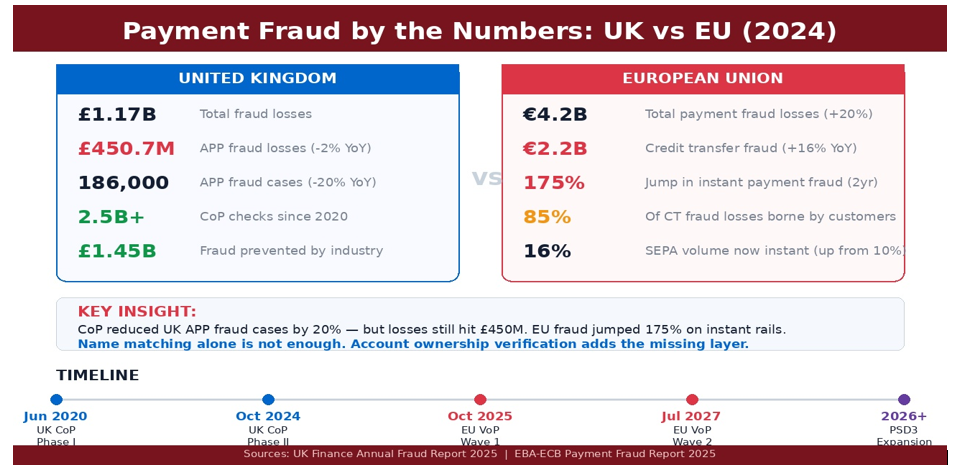
Payment fraud is rising across both the UK and EU, driving regulatory urgency.
VoP is rolling out in two waves. If your business pays suppliers or onboards customers in any of these markets, you need to know the deadlines.
Wave 1: Eurozone Countries (Live Since October 9, 2025)
| Country | Country |
| Austria | Belgium |
| Cyprus | Germany |
| Estonia | Spain |
| Finland | France |
| Greece | Croatia |
| Ireland | Italy |
| Lithuania | Luxembourg |
| Latvia | Malta |
| Netherlands | Portugal |
| Slovenia | Slovakia |
Wave 2: Non-Euro EU States (Deadline: July 9, 2027)
Bulgaria, Czech Republic, Denmark, Hungary, Poland, Romania, and Sweden. These countries have until mid-2027 to implement VoP for SEPA transfers.
For businesses: If you’re paying vendors or onboarding customers in Wave 2 countries today, VoP won’t protect those transactions until 2027. MonitorPay.ai already covers these markets—verifying IBANs, matching payee names, and confirming account ownership in real time, without waiting for regulatory rollout.
How Name Matching Works—And Where It Breaks
Both CoP and VoP rely on name matching—comparing the name the payer enters against the name the payee’s bank has on file. In theory, this is straightforward. In practice, it’s where most friction occurs.
Common causes of false “Close Match” or “No Match” results:
| Challenge | Example |
| Typos | “Mathieu” vs “Matthieu” — one letter triggers a mismatch |
| Trading name vs legal name | Payer enters “Stripe” but account is registered to “Stripe Payments Europe, Ltd.” |
| Abbreviations | “Ltd” vs “Limited” vs “Ltd.” — all valid, all potentially flagged |
| Transliteration | Greek name Μαρία entered in Latin as “Maria” — different alphabets, same person |
| Joint accounts | Account held by “John & Jane Smith” — payer enters only “John Smith” |
| Name order | “Tanaka Yuki” vs “Yuki Tanaka” — family name first vs given name first |
| Accented characters | “Müller” vs “Mueller” vs “Muller” — all referring to the same person |
These edge cases cause real operational pain. A “Close Match” on a €500,000 supplier payment doesn’t just slow things down—it triggers manual review, delays disbursement, and erodes trust in the payment flow.
How MonitorPay solves this: MonitorPay’s payee name verification uses intelligent fuzzy matching, transliteration support, and confidence scoring. It handles swapped name orders, abbreviations, and cross-alphabet matching natively—returning a confidence score rather than a binary pass/fail. This reduces false positives and keeps payments moving.
What CoP and VoP Don’t Catch
This is the section most articles skip. CoP and VoP are useful tools. They are not complete fraud prevention.
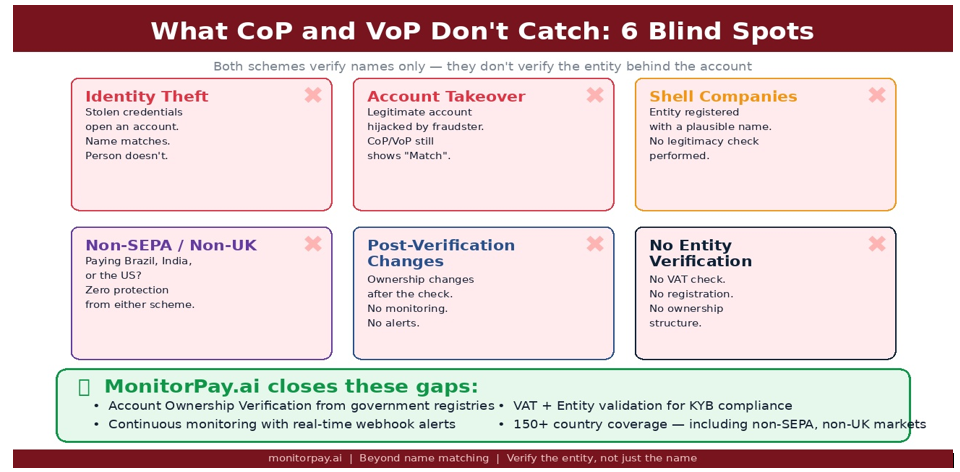
Both schemes verify one thing: does the name the payer entered match the name the bank has on file for that account? That’s it. They do not verify:
| Blind Spot | Why It Matters |
| Identity theft | Account opened with stolen credentials will return a “Match” — the name is correct, the person behind it is not. |
| Compromised accounts | If a legitimate account is taken over by a fraudster, CoP/VoP will still show a match against the original holder’s name. |
| Shell companies | A shell entity registered with a plausible name will pass name matching. Neither scheme verifies the entity’s legitimacy. |
| Non-SEPA / non-UK payments | Paying a supplier in Brazil, India, or the US? Neither CoP nor VoP applies. Zero protection. |
| Post-verification changes | Account ownership can change after verification. Neither scheme monitors for this. |
| Legal entity verification | CoP/VoP check the name, not the business. No company registration, VAT, or ownership structure validation. |
The bottom line: CoP and VoP are a first line of defence. They catch typos, simple misdirection, and some impersonation attempts. But they were never designed to verify the entity behind the account. For that, you need a different layer.
The Cross-Border Gap: What Happens Between UK and EU
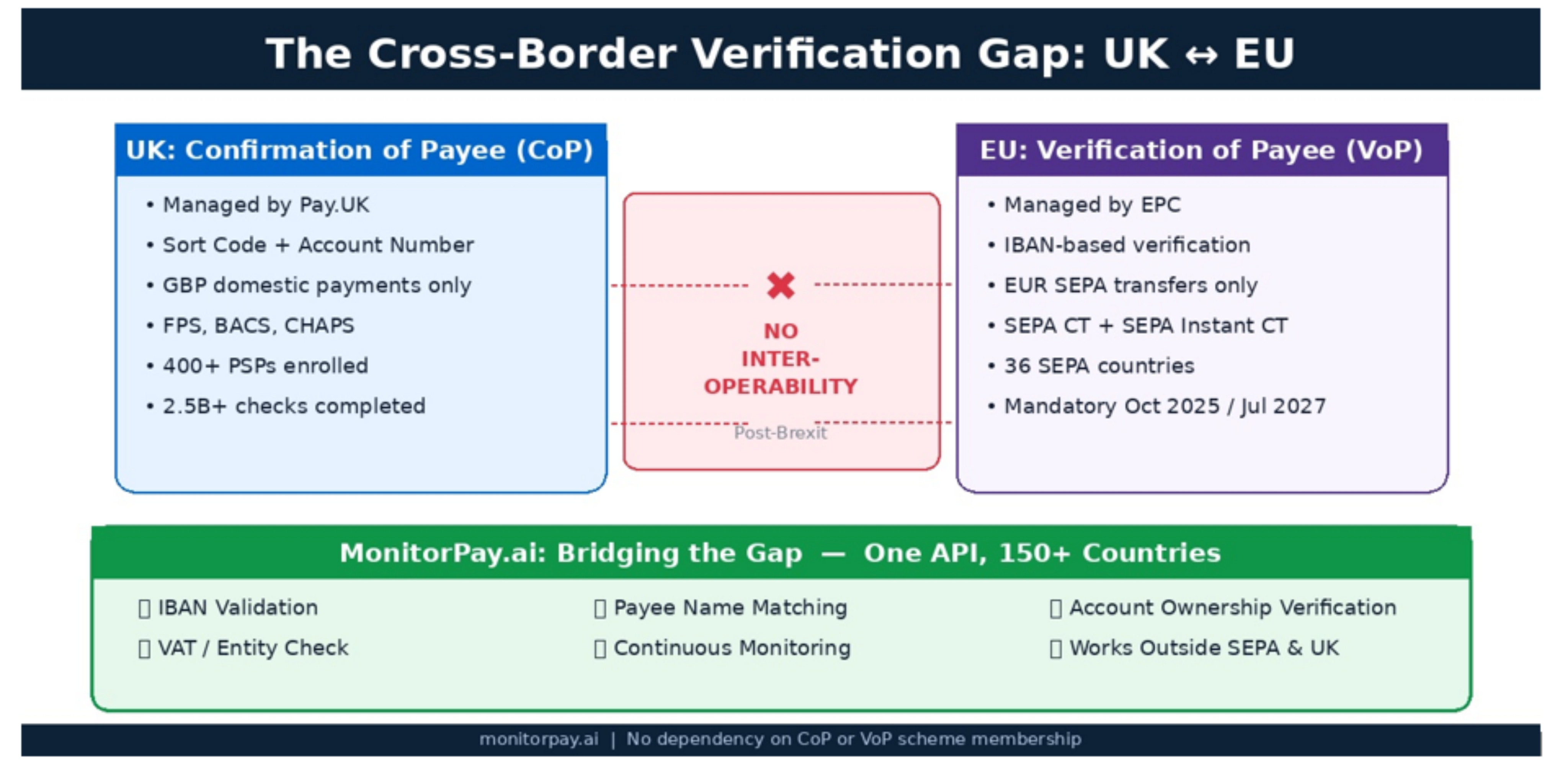
Post-Brexit, the UK sits outside the SEPA zone. CoP covers UK payments. VoP covers SEPA payments. There is no interoperability between the two.
This creates a real problem for businesses that trade across the Channel:
A UK company paying a German supplier: The UK bank can run CoP on domestic payments, but the outbound EUR payment to Germany is a SEPA transfer. If the German bank’s VoP system is live, the payer’s UK bank may or may not be able to query it—there’s no mandated bridge.
An EU company paying a UK supplier: The VoP request goes to the UK bank. But UK banks respond via the Pay.UK CoP directory, not the EPC’s RVM infrastructure. Interoperability is being discussed but not mandated.
SWIFT’s Beneficiary Account Validation (BAV) and startups like iPiD are building cross-border verification bridges, but adoption is patchy and voluntary.
How MonitorPay bridges this gap: MonitorPay’s API doesn’t depend on CoP or VoP scheme membership. It verifies IBANs, matches payee names, and confirms account ownership across 150+ countries—including both UK and EU markets—through direct connections to government registries and banking systems. One API, one integration, global coverage.
Going Beyond CoP/VoP: Why Account Ownership Verification Matters
CoP and VoP answer one question: does the name match the account?
Account Ownership Verification answers a different question: who legally owns this account?
The distinction matters. Name matching relies on whatever name the bank has on file. That name could be outdated, abbreviated, or—in cases of fraud—entirely fabricated through identity theft. Account Ownership Verification goes to the source: government registries, banking systems, and official records that confirm the legal entity or individual behind the account.
This is the layer that catches what CoP/VoP misses:
| CoP / VoP Name Check | MonitorPay Account Ownership Verification |
| Checks name against bank records | Confirms legal owner from government registries |
| Returns Match / Close Match / No Match | Returns verified legal entity name + confidence score |
| No entity validation | Validates company registration, VAT, legal status |
| Point-in-time check only | Continuous monitoring with webhook alerts |
| UK or SEPA only | 150+ countries via single API |
| Bank-dependent matching logic | Standardised fuzzy matching + transliteration |
How to Build a Complete Payment Verification Stack
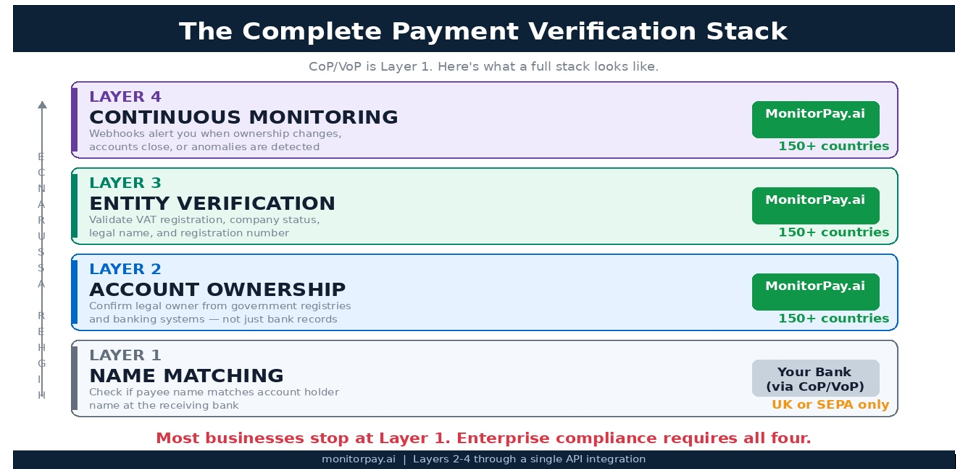
A layered approach to payment verification goes beyond what any single regulation requires.
Relying on CoP or VoP alone is like locking the front door but leaving the windows open. A complete payment verification stack has four layers:
| Layer | What It Does | Who Provides It | Coverage |
| Layer 1 | Name-IBAN / Name-Account match | Your bank via CoP or VoP | UK or SEPA only |
| Layer 2 | Account ownership verification | MonitorPay.ai | 150+ countries |
| Layer 3 | Entity verification (VAT, registration, legal status) | MonitorPay.ai | 150+ countries |
| Layer 4 | Continuous monitoring (ownership changes, closures, anomalies) | MonitorPay.ai | 150+ countries |
Practical checklist for compliance and treasury teams:
- Confirm your PSP supports CoP (UK) and/or VoP (SEPA) for domestic payments.
- Integrate MonitorPay’s API for account ownership verification on all supplier and vendor payments—especially cross-border.
- Audit your supplier master data. Stale bank details are the #1 vector for invoice fraud.
- Enable continuous monitoring. Account ownership changes after a one-time check. Ongoing monitoring catches this.
- Validate VAT and company registration as part of KYB onboarding—not as an afterthought.
- Demand an audit trail. Every verification should be logged, timestamped, and exportable for compliance reviews.
What’s Next: PSD3, LEI Integration, and Global Convergence
Regulatory convergence is driving global standardisation of payment verification.
Payment verification is not standing still. Several developments will reshape this landscape over the next 12–24 months:
PSD3 and the Payment Services Regulation (PSR): The EU’s successor to PSD2 will expand VoP requirements to all credit transfers in any EU currency—not just euros. It will also introduce mandatory fraud reimbursement for impersonation scams, increasing PSP liability and the incentive to invest in deeper verification.
LEI Integration: The Global Legal Entity Identifier Foundation (GLEIF) is pushing for LEI-to-IBAN matching. Unlike name matching, LEI matching is binary: Match or No Match, with no “Close Match” ambiguity. The IPR already recognises LEI as a verification tool. Expect wider adoption by 2027.
Global Expansion: Australia launched its own Confirmation of Payee scheme in 2024. SWIFT’s Beneficiary Account Validation is expanding globally. India, Singapore, and Brazil are developing domestic equivalents. Payment verification is going worldwide.
MonitorPay’s position: As regulations expand and converge, the demand for a single platform that verifies accounts, entities, and ownership across borders will only grow. MonitorPay already operates in 150+ countries—built for the global verification standard that’s coming.
Frequently Asked Questions
- What is the difference between Confirmation of Payee and Verification of Payee?
Confirmation of Payee (CoP) is a UK-specific name-checking service managed by Pay.UK that matches payee names against sort code and account number. Verification of Payee (VoP) is the EU equivalent, mandated by the Instant Payments Regulation, matching payee names against IBANs across the SEPA zone. Both serve the same purpose—preventing misdirected payments and fraud—but operate under different regulatory frameworks and geographies.
- Is Verification of Payee mandatory in the EU?
Yes. Since October 9, 2025, all PSPs in eurozone countries must support VoP for SEPA credit transfers. Non-euro EU member states have until July 9, 2027. The mandate comes from the EU Instant Payments Regulation (IPR), and VoP must be offered free of charge to payers.
- Does Confirmation of Payee work for international payments?
No. CoP only covers UK domestic payments made via sort code and account number (Faster Payments, BACS, CHAPS). If you’re paying a supplier in Europe, Asia, or anywhere outside the UK, CoP provides no protection. For international payment verification, MonitorPay.ai covers 150+ countries through a single API.
- What happens when VoP returns a “Close Match”?
A Close Match means there’s a minor discrepancy between the name entered and the name on file—typically a typo, abbreviation, or name format difference. The payer is shown the registered name and can choose to proceed, correct, or cancel. MonitorPay’s fuzzy matching and confidence scoring helps reduce Close Match friction by handling these edge cases natively.
- Can VoP prevent APP fraud completely?
No. VoP reduces APP fraud by flagging name mismatches before payment, but it cannot detect compromised accounts, identity theft, or shell companies. EU payment fraud still reached €4.2 billion in 2024, with fraudulent instant payment transactions jumping 175%. VoP is a necessary layer, not a complete solution.
- What is Account Ownership Verification and how is it different from VoP?
VoP checks whether a name matches an IBAN at the bank level. Account Ownership Verification confirms the legal entity or person who owns the account using government registry and banking data. MonitorPay provides this service across 150+ countries, adding a layer of assurance that goes beyond what CoP or VoP can offer.
- Which countries does Verification of Payee cover?
VoP covers the 20 eurozone countries (Wave 1, live since October 2025) and will expand to 7 non-euro EU states by July 2027 (Bulgaria, Czech Republic, Denmark, Hungary, Poland, Romania, Sweden). Payments outside the SEPA zone—to the US, UK, Asia, Latin America, Africa—are not covered. MonitorPay fills this gap with verification across 150+ countries.
- How long does a VoP check take?
The EPC mandates a maximum response time of 3 seconds, with a target of 1 second. In practice, most checks complete in under 2 seconds. MonitorPay’s API also delivers sub-second response times for IBAN validation, name matching, and account ownership verification.
- Do I still need payment verification if my bank already supports CoP or VoP?
Yes. CoP and VoP only cover domestic UK or SEPA payments respectively. They only match names—they don’t verify legal ownership, entity status, or VAT registration. And they don’t monitor for changes after the initial check. MonitorPay adds account ownership verification, entity validation, and continuous monitoring across 150+ countries.
- How do I verify a payee for non-SEPA, non-UK payments?
Neither CoP nor VoP applies outside their respective zones. For payments to suppliers in the US, Brazil, India, or any non-SEPA country, you need an independent verification platform. MonitorPay.ai verifies IBANs, matches payee names, and confirms account ownership across 150+ countries using data from government registries and banking systems—regardless of whether CoP or VoP exists in that market.