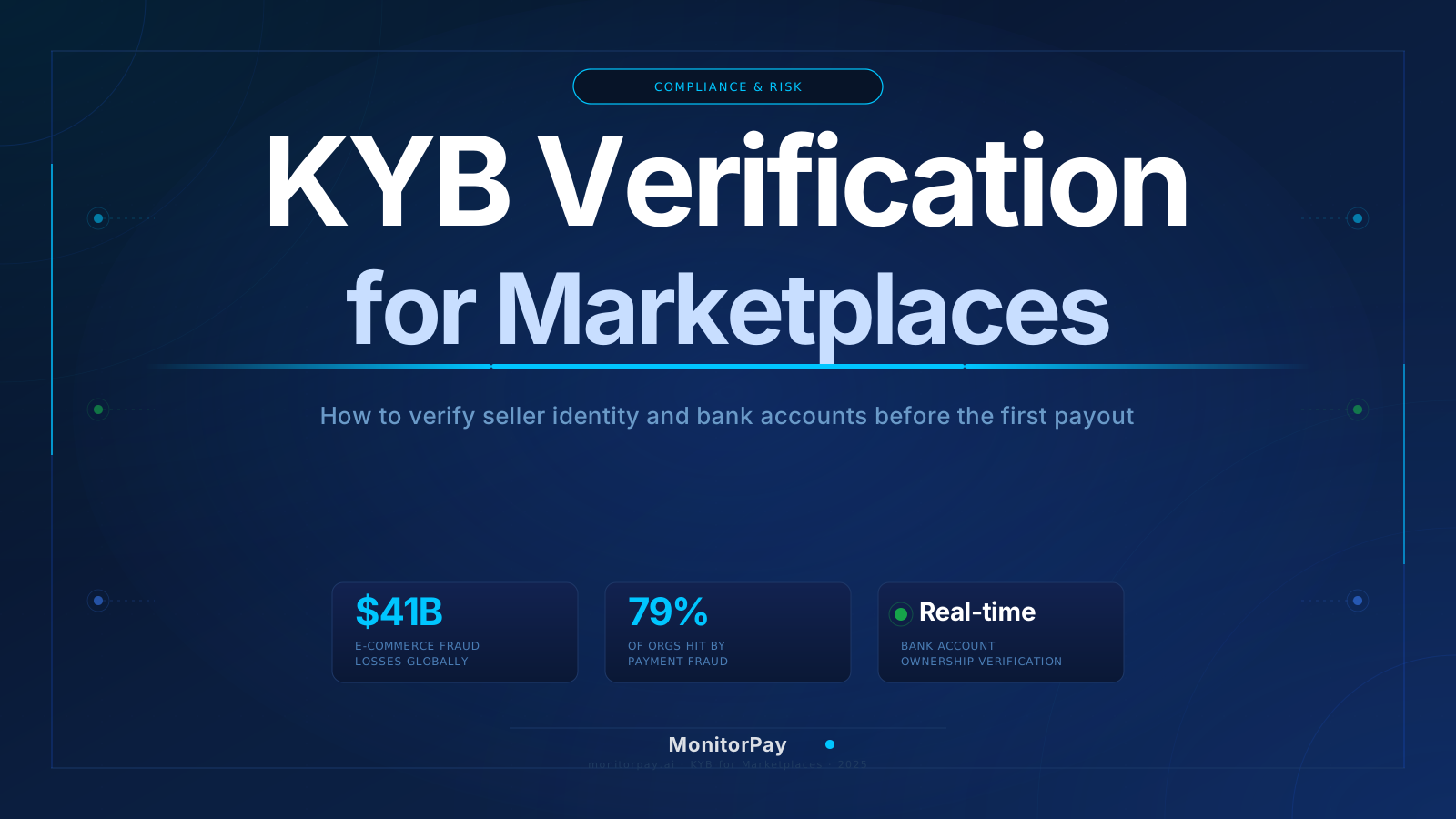
KYB Verification for Marketplaces: How to Verify Seller Identity and Bank Accounts Before the First Payout
The Marketplace Fraud Problem Nobody Talks About
Everyone talks about buyer fraud. Card fraud. Chargebacks. But the more expensive problem — and the harder one to fix — sits on the supply side.
Fraudulent sellers are the silent drain on marketplace economics. They inflate GMV numbers, damage buyer trust, trigger regulatory scrutiny, and create legal exposure that doesn't go away when the seller account is deleted.
The core issue: most marketplace onboarding treats sellers like buyers. You collect a name, a bank account, maybe a document upload — and you call it done. That's not KYB. That's a sign-up form with extra steps.
KYB (Know Your Business) verification is the process of confirming that the business entity behind a seller account is real, registered, legally operating, and owned by who they say they are. It's what separates a marketplace with a compliance posture from one that will eventually explain itself to a regulator.
What KYB Actually Means for Marketplaces
KYB is not a single check. It's a set of verifications that, together, confirm you know who you're doing business with.
For a marketplace onboarding business sellers, a complete KYB process covers:
| KYB Layer | What It Confirms | Why It Matters |
|---|---|---|
| Business Registration | Company is legally registered and active in its home jurisdiction | Filters out shell companies and dissolved entities |
| Director/Owner Identity | Identity of named directors or principals | Confirms real humans are behind the entity |
| Ultimate Beneficial Owner (UBO) | Who ultimately owns or controls 25%+ of the business | AML requirement; exposes hidden controllers |
| Bank Account Ownership | Payout account is owned by the registered entity | Prevents payout fraud and mule account abuse |
| AML & Sanctions Screening | Entity and principals not on watchlists or sanctions lists | Mandatory for regulated platform operations |
| VAT / Tax ID Validation | Tax registration is valid and active | Reduces tax fraud exposure; required in EU |
| Ongoing Monitoring | Status, ownership, and account details remain unchanged over time | Catches changes after onboarding that create new risk |
Most marketplace platforms complete two or three of these. The ones that get hit hardest by fraud — or regulatory action — are the ones that skipped the last four.
How Fraudulent Sellers Actually Get Through
Knowing the attack patterns tells you exactly where your KYB gaps are.
1. Fake or Stolen Identity, Real-Looking Documents
AI has made synthetic identity creation cheap and fast. A fraudster registers a business using stolen or fabricated details. The company registration looks real. The documents look real. Basic document checks pass. But a government registry lookup would show the company either doesn't exist, was registered 72 hours ago, or is already listed as dissolved elsewhere.
2. Shell Companies with Legitimate Bank Accounts
Fraudsters register dormant or newly-formed shell entities. These have valid company numbers and matching bank accounts. A name-matching check returns green. But the entity has no directors on file, no trading history, and was registered from an address that houses 400 other "companies." Ownership verification against a government registry exposes this immediately.
3. Mule Payout Accounts
The seller registers with legitimate business credentials but submits bank account details belonging to a money mule. Payouts go to an unrelated account. The "business" vanishes after the first payout cycle. Without account ownership verification — confirming the bank account is legally owned by the registered business entity — this goes undetected until the chargebacks arrive.
4. Reuse of Fraudulent Details Across Platforms
Organized fraud rings test credentials across marketplaces. If your platform lacks cross-referenced monitoring and anomaly detection, you'll onboard the same fraudulent entity that was already rejected elsewhere. Velocity checks and registry cross-referencing catch this. Manual review doesn't.
5. Post-Onboarding Account Takeover
A legitimate seller account gets compromised. Bank details get updated to a mule account. Without continuous monitoring on payout account changes, you'll process the next batch of payouts to a fraudster while the real seller has no idea their account was touched.
The Business Cost of Getting This Wrong
Marketplace operators tend to undercount the true cost of a fraudulent seller. The direct losses — refunds, chargebacks, fraud write-offs — are visible. Everything else accumulates quietly.
| Risk Category | What It Costs You |
|---|---|
| Chargeback exposure | Merchants bear 75%+ of chargeback financial impact (Mastercard, 2024) |
| Regulatory fines | AML/KYB non-compliance penalties under PSD2, AMLD6 can reach millions of euros |
| Payment processor risk | High fraud rates can trigger elevated processing fees or payment account termination |
| Buyer trust erosion | 76% of consumers stop using a platform after experiencing payment fraud (Sift) |
| Operational cost | Manual investigation of fraud incidents averages $12.10 per failed transaction (AFP) |
| Reputational damage | Fraud incidents tied to named brands generate press coverage that takes years to reverse |
Organizations that experienced fraud in 2024 recovered less than 25% of losses on average — down significantly from prior years. Instant payment rails make recovery nearly impossible once funds clear.
The math is simple. The cost of preventing a fraudulent onboarding is measured in cents per API call. The cost of cleaning it up afterward is measured in six figures.
KYB vs. KYC: What Marketplaces Are Often Confusing
A common mistake: applying a KYC framework — designed for verifying individuals — to business seller onboarding and calling it done.
| Dimension | KYC (Know Your Customer) | KYB (Know Your Business) |
|---|---|---|
| Subject | Individual person | Legal business entity |
| Data sources | ID documents, biometrics, selfie | Government registries, corporate filings, financial records |
| Key checks | Identity, age, watchlist screening | Registration status, directors, UBO, bank account ownership |
| Complexity | Lower — one subject | Higher — multi-layer entity + individual verification |
| Regulatory basis | GDPR, eIDAS, local ID laws | AML directives, PSD2, FATF guidance |
| Applies to marketplaces? | For individual/freelance sellers | For any registered business entity |
Most marketplace fraud involving business sellers exploits this gap. The platform ran a KYC check — confirmed a person's identity — but never verified the company that person claims to represent. The company registration is a fiction. The payout account doesn't match. KYC alone would never catch either of those things.
For platforms onboarding business sellers, KYB is not optional. It's the verification layer your KYC process was never designed to handle.
Bank Account Verification: The Step Most Marketplaces Skip
You can verify a seller's identity perfectly. You can confirm their company is registered and active. And you can still send money to the wrong account — to a fraudster, a mule, or a third party who has nothing to do with the business you just vetted.
That's the bank account problem. It sits at the end of the onboarding funnel, and most platforms treat it as an afterthought: collect an IBAN, validate the format, move on. That is not bank account verification. That is structure checking. It tells you the IBAN is a valid sequence of characters. It tells you nothing about who owns the account.
Three Checks That Sound Similar — But Are Not
| Check Type | What It Actually Does | What It Misses |
|---|---|---|
| IBAN Validation | Confirms the IBAN is structurally correct — right format, right country code, valid check digits, issuing bank identified | Does not confirm the account exists, is active, or belongs to anyone in particular |
| Payee Name Matching | Compares the name entered by the user against the name registered on the receiving account at the bank | A fraudster with a mule account in the right name, or a name match on a stolen identity, passes this check cleanly |
| Bank Account Ownership Verification | Confirms the legal owner of the account — cross-referenced against official banking and government registry records — is the same registered entity as your seller | This is the check that catches everything the first two miss |
Most marketplace platforms do the first two and call it done. The third — ownership verification — is what actually closes the gap.
What Payout Fraud Looks Like Without Ownership Verification
Here are three scenarios that pass IBAN validation and name matching, but fail ownership verification:
The Mule Account
A seller registers with legitimate business credentials — real company number, real director — but submits a payout bank account belonging to a third-party mule. The IBAN is valid. The name on the account is close enough to pass a fuzzy match. Payouts are processed. The mule forwards funds. The "business" disappears. Without ownership verification confirming the account is legally held by the registered entity, this attack is invisible until the chargebacks land.
The Post-Onboarding Account Swap
A legitimate seller onboards cleanly. Six months later, their account is compromised. A fraudster updates the payout bank account to a new IBAN. Your platform validates the new IBAN — it's structurally correct. The name still matches. Payouts for the next cycle go to the fraudster. The real seller has no idea. Continuous ownership monitoring — re-verifying account ownership whenever banking details change — is the only check that catches this before money moves.
The Personal Account Substitution
A seller submits a personal bank account instead of a business account. The account is in the name of one of the directors — so the name match passes. But the account is not owned by the registered business entity. This is both a fraud risk and a compliance risk: payouts going to personal accounts rather than business accounts create regulatory exposure around tax, AML, and beneficial ownership reporting. Ownership verification against business registry records catches the mismatch immediately.
What Ownership Verification Actually Checks
Bank account ownership verification — as MonitorPay delivers it — queries official banking and government registry records to answer one specific question: is this bank account legally owned and operated by the business entity your seller claims to be?
That involves cross-referencing:
- The account holder name against the registered legal entity name
- The registered address of the account holder against the company's registered address in the government registry
- The account's active/dormant status — a closed or frozen account that still passes IBAN validation will fail at the ownership check
- Whether the account is a personal or business account — and whether the business entity has authorised it as a payout account
This verification is sourced directly from official registries — not inferred from a name match, not guessed from a credit database. The result is a legally defensible, audit-ready confirmation that the money you are about to send is going to the right entity.
How to Build a KYB-First Seller Onboarding Flow
The architecture matters as much as the checks. Here's what a production-grade seller onboarding flow looks like when KYB is built in from the start:
Business Registration Verification
On signup, collect company name, registration number, and jurisdiction. Run an immediate lookup against government registries to confirm the entity exists, is active, and has not been dissolved or suspended. This single step eliminates the majority of shell company attempts.
Director and UBO Identity Confirmation
Pull the registered directors from the company filing. For entities with 25%+ ownership by a single party, identify and verify the Ultimate Beneficial Owner. Cross-reference principals against sanctions lists, PEP databases, and adverse media sources. This step is required under AMLD6 and FATF standards.
Bank Account Ownership Verification
This is the most critical step most platforms skip. Before any payout is enabled, MonitorPay confirms the submitted bank account is legally owned by the registered vendor entity — queried directly against official banking and government registry records. A matching IBAN is not enough. A matching name is not enough. Ownership confirmation means the account is provably linked to the registered business. This single check eliminates mule accounts, third-party payout fraud, and account substitution attacks.
VAT / Tax ID Validation
For EU sellers, validate the VAT number against the VIES database and, where available, country-level registry sources. For non-EU sellers, validate tax IDs against relevant authority records. Invalid or reused tax IDs are a strong fraud signal and a liability for your platform's own tax obligations.
Risk Scoring and Tiered Review
Not all sellers carry the same risk. Apply risk scoring based on jurisdiction, business age, sector, and ownership complexity. Low-risk sellers pass straight through. High-risk sellers trigger enhanced due diligence — additional documentation, manual review, or a delayed payout window.
Continuous Monitoring Post-Onboarding
Onboarding is not the end of your KYB obligation. Company status, director changes, sanctions designations, and bank account updates can happen at any time. Continuous monitoring with real-time alerts means you catch changes before they become your liability, not after.
Why Government Registry Data Is Non-Negotiable
The quality of a KYB check is only as good as its data source.
There are two types of business verification providers:
- Those that compile data from multiple secondary sources — business directories, credit databases, commercial filings aggregated across data providers. Coverage is broad. Freshness and accuracy vary significantly. In many jurisdictions, data can be months out of date.
- Those that connect directly to government registries — the authoritative, primary source for every company's legal existence, status, and ownership. If the registry says the company is dissolved, it's dissolved. No inference. No lag.
For KYB that can withstand regulatory scrutiny, primary source data is the baseline. When a compliance team needs to demonstrate due diligence — to an auditor, to a regulator, to a card network — the answer "we checked the government registry directly" is categorically stronger than "we checked a commercial database."
MonitorPay connects directly to 100+ government and financial institution registries worldwide. Company status, director information, registered addresses, and ownership data are pulled from the source — not inferred, not compiled, not estimated. Every verification creates an audit-ready record tied to the specific registry record that supported the decision.
Balancing Compliance With Seller Experience
The friction objection is real. Onboarding processes that take days kill seller acquisition. But the assumption that compliance and speed are in opposition is outdated.
Modern KYB automation platforms process standard verification cases in under 60 seconds. For a marketplace onboarding business sellers, that means:
- Registration verification: < 3 seconds via API
- Bank account ownership check: real-time, embedded in your signup flow
- VAT validation: instant, no manual review
- AML/sanctions screening: sub-second
- Enhanced due diligence (high-risk sellers only): triggered automatically, no manual triage
The seller experience for a low-risk, clean application is seamless. They enter their details. Checks run silently in the background. They're approved in minutes. The friction only appears where the risk justifies it.
That's not a compromise between compliance and experience. That's what properly-built KYB infrastructure delivers.
Regulatory Landscape: What Marketplaces Need to Know in 2025
The regulatory bar for marketplace platforms is rising. The relevant frameworks you need to understand:
| Framework | Jurisdiction | Key Obligation for Marketplaces |
|---|---|---|
| AMLD6 (EU) | European Union | Expanded definition of money laundering; UBO verification required for all business relationships |
| PSD2 | European Union | Payment facilitators must conduct due diligence on payees; strong authentication required |
| eIDAS 2.0 | European Union | Digital identity wallet framework — changes how identity verification will work across EU member states from 2026+ |
| FATF Recommendations | Global (40+ countries) | Risk-based approach to AML; UBO identification mandatory for business customers |
| PSR (UK) | United Kingdom | Mandatory reimbursement for APP fraud losses — platforms face direct liability for fraud that could have been prevented |
| BSA / FinCEN | United States | Beneficial ownership reporting now required for most US companies under the Corporate Transparency Act |
The direction is consistent across jurisdictions: more transparency, more verification, more direct liability for platforms that process payments on behalf of third-party sellers. Building KYB infrastructure now is not just a fraud prevention decision. It's a regulatory positioning decision.
How MonitorPay Powers Marketplace KYB
MonitorPay is built for one specific problem: confirming that the bank account a vendor or seller submits for payout is legitimately theirs — and that the entity behind it is real, active, and compliant. That verification runs in real time, sourced directly from government and banking registries, not inferred from commercial databases.
For marketplace compliance and finance teams, this means every payout account in your system is either verified against the registered vendor entity — or flagged for review before money moves.
| Capability | What MonitorPay Does |
|---|---|
| Bank Account Ownership Verification | ✓ Confirms the payout account is legally owned by the registered vendor — sourced from official banking and government registries, not name-matching |
| IBAN Validation | ✓ Structure, format, issuing bank, and country confirmed — 150+ countries |
| Payee Name Matching | ✓ Fuzzy matching and confidence scoring to catch mismatches before payout |
| Business Registration Verification | ✓ Confirms vendor is legally active — pulled from 100+ government registries live |
| VAT Number Validation | ✓ EU, UK, and beyond — with official entity name and registration status |
| Account Status Check | ✓ Flags closed, dormant, or frozen accounts before a payout fails or is misdirected |
| Continuous Monitoring | ✓ Real-time alerts when a verified account changes ownership, status, or IBAN details |
| Bulk Vendor Validation | ✓ Verify thousands of vendor accounts simultaneously via API or file upload |
| Embedded Verification Widget | ✓ Drop directly into your seller signup flow — verification runs silently at point of onboarding |
| Audit Trail | ✓ Every check logged with source registry, timestamp, and result — audit-ready by default |
The result: your marketplace processes payouts to vendors whose bank accounts and business registrations have been verified against primary source data — not assumed, not approximated, not left to chance.
For platforms scaling vendor networks across multiple countries, MonitorPay provides the single verification layer that covers bank account confirmation, business legitimacy, and ongoing account monitoring — without rebuilding your onboarding stack.
Verify Every Seller's Bank Account Before the First Payout.
MonitorPay confirms that payout accounts are owned by the registered vendor — sourced directly from government and banking registries. One API. Real-time. Audit-ready.
Request a DemoFrequently Asked Questions
What is KYB verification for marketplaces?
KYB (Know Your Business) verification for marketplaces is the process of confirming that a seller or merchant registering on your platform is a legitimate, legally operating business entity. It goes beyond basic identity checks to verify company registration status, director identities, ultimate beneficial ownership (UBO), and bank account ownership.
For marketplaces, KYB is the primary layer of defence against fraudulent sellers, shell companies, and money mules using your payout infrastructure to move illicit funds.
Why do marketplaces need KYB and not just KYC?
KYC (Know Your Customer) is designed to verify individuals — a person's identity, age, and watchlist status. When your seller is a registered business entity, KYC alone is insufficient. You need to verify the company's legal existence, its registration status in its home jurisdiction, who owns and controls it, and whether the payout account matches the registered entity.
KYB addresses all of these dimensions. Many marketplace fraud schemes specifically exploit platforms that run KYC checks without ever verifying the underlying business entity — a gap that standard KYC processes were not designed to close.
What documents are required for marketplace seller KYB?
For automated KYB via API, sellers typically need to provide their company registration number, jurisdiction of incorporation, and the name of at least one director or owner. With these details, a KYB platform like MonitorPay can pull verification data directly from government registries — no document upload required for standard cases.
For enhanced due diligence (high-risk entities, complex ownership structures), additional documentation may include proof of address, shareholder agreements, or ID documents for beneficial owners.
What is the difference between IBAN validation and bank account ownership verification?
IBAN validation confirms that an account number is structurally correct — the right format, country code, and check digits, with the issuing bank identified. It does not confirm the account exists, is active, or belongs to the person or company submitting it.
Bank account ownership verification goes further. It queries official banking and government registry records to confirm that the legal owner of the submitted account is the same registered entity as your seller. A fraudster can submit a structurally valid IBAN belonging to a mule account — it will pass IBAN validation and even name matching, but it will fail ownership verification because the account is not linked to the registered business entity.
For marketplace seller onboarding, ownership verification is the check that makes payout fraud structurally difficult. IBAN validation alone is a format check, not a fraud prevention tool.
Why is bank account verification critical specifically for marketplace payouts?
Marketplaces are uniquely exposed because they process outbound payments — payouts — to a large and often rapidly-changing pool of sellers. Each payout is an opportunity for a fraudulent or misdirected transfer if the destination account has not been properly verified.
The three most common payout fraud patterns — mule accounts, post-onboarding account swaps, and personal account substitution — all require the same fix: confirming that the bank account is legally owned by the registered business entity before any funds are released. IBAN validation and name matching do not catch any of these patterns. Ownership verification does.
Beyond fraud, incorrect payouts to unverified accounts also create regulatory exposure: AML reporting obligations, PSD2 due diligence requirements, and tax liability issues when funds reach personal rather than business accounts.
What is UBO verification and is it required for marketplaces?
UBO (Ultimate Beneficial Owner) verification identifies the individual(s) who ultimately own or control 25% or more of a business entity. It's required under AMLD6 (EU Anti-Money Laundering Directive) and FATF global standards for any business relationship involving financial flows.
For marketplaces that pay out to business sellers, UBO verification is not optional in regulated jurisdictions. It's what prevents your platform from being used to route funds through complex ownership structures that obscure the true beneficiary of the payments.
How long does KYB verification take for marketplace seller onboarding?
With automated KYB via API, standard business verification completes in under 60 seconds for the majority of cases. Registration checks typically return in 2–5 seconds. IBAN validation and payee name matching are sub-second. VAT validation is near-instant for EU entities via the VIES database.
Enhanced due diligence cases — complex ownership structures, high-risk jurisdictions — may require additional time, but these are a minority of total onboardings. The net effect of automated KYB is faster seller activation, not slower, because clean applications pass through without manual review queues.
What regulations require marketplaces to perform KYB on sellers?
The primary regulatory frameworks requiring or strongly implying KYB obligations for marketplace platforms include:
- AMLD6 (EU) — Anti-Money Laundering Directive 6, requiring UBO identification for all business relationships
- PSD2 (EU) — Payment Services Directive 2, requiring due diligence for payment facilitators
- FATF Recommendations — global AML standards adopted in 40+ countries
- UK PSR — Payment Systems Regulator, with new APP fraud reimbursement obligations creating direct platform liability
- US Corporate Transparency Act / FinCEN — beneficial ownership reporting requirements
If your marketplace holds, moves, or facilitates payments on behalf of business sellers, you likely have KYB obligations in every jurisdiction where you operate. Legal advice specific to your platform's activities and jurisdictions is strongly recommended.
What happens if a marketplace doesn't do KYB verification on sellers?
The consequences operate on multiple levels simultaneously. Operationally: fraudulent sellers generate chargebacks, refund claims, and payment reversals that you bear the cost of. Financially: regulatory fines under AML and PSD2 frameworks can reach millions of euros. Strategically: high fraud rates trigger elevated processing fees from card networks or payment processor account termination. Reputationally: fraud incidents tied to your platform generate press coverage that damages buyer and seller trust for years.
The single most common mistake marketplace operators make is treating KYB as a compliance cost rather than a fraud prevention investment. The data consistently shows the cost of not doing KYB exceeds the cost of doing it by an order of magnitude.
Can KYB verification be embedded directly into seller onboarding flows?
Yes. MonitorPay provides both a REST API and an embeddable verification widget that can be integrated directly into your seller signup or account setup flow. Sellers confirm their business details and payout account as part of onboarding — the verification runs silently in the background and returns a pass/flag result without disrupting the user journey.
For platforms that need to verify thousands of sellers at once — a batch migration, a new market launch — MonitorPay also supports bulk validation via API or secure file upload.
What is continuous seller monitoring and why does it matter after onboarding?
Continuous monitoring tracks previously verified seller accounts for changes that could create new risk: company status changes (dissolution, suspension), director changes, bank account updates, sanctions designations, and ownership changes. These events can happen at any time after onboarding — often months or years later.
MonitorPay's continuous monitoring product alerts you via webhook in real time when a monitored account changes status or ownership. This means you can pause payouts, trigger re-verification, or flag for review before a problem becomes a fraud event. Without continuous monitoring, your KYB coverage expires the moment onboarding ends.