IBAN Validation vs. Account Ownership Verification: What’s the Difference and Why It Matters
Most finance teams believe they're protected because they validate IBANs before sending payments. They're wrong. IBAN validation confirms the account number is formatted correctly. That's it. It tells you nothing about who owns the account on the other end.
The gap between knowing an account exists and knowing who controls it is where payment fraud lives.
In 2024, payment fraud across the European Economic Area hit €4.2 billion, up from €3.5 billion the year before. In the UK alone, over £1 billion was stolen by criminals, with APP fraud accounting for £450.7 million. Criminals aren't breaking through security systems — they're walking through the front door with valid account details that nobody bothered to verify beyond format.
This article breaks down the real difference between IBAN validation and account ownership verification, explains why name matching alone doesn't close the gap, and shows what registry-based verification looks like in practice.
What Is IBAN Validation?
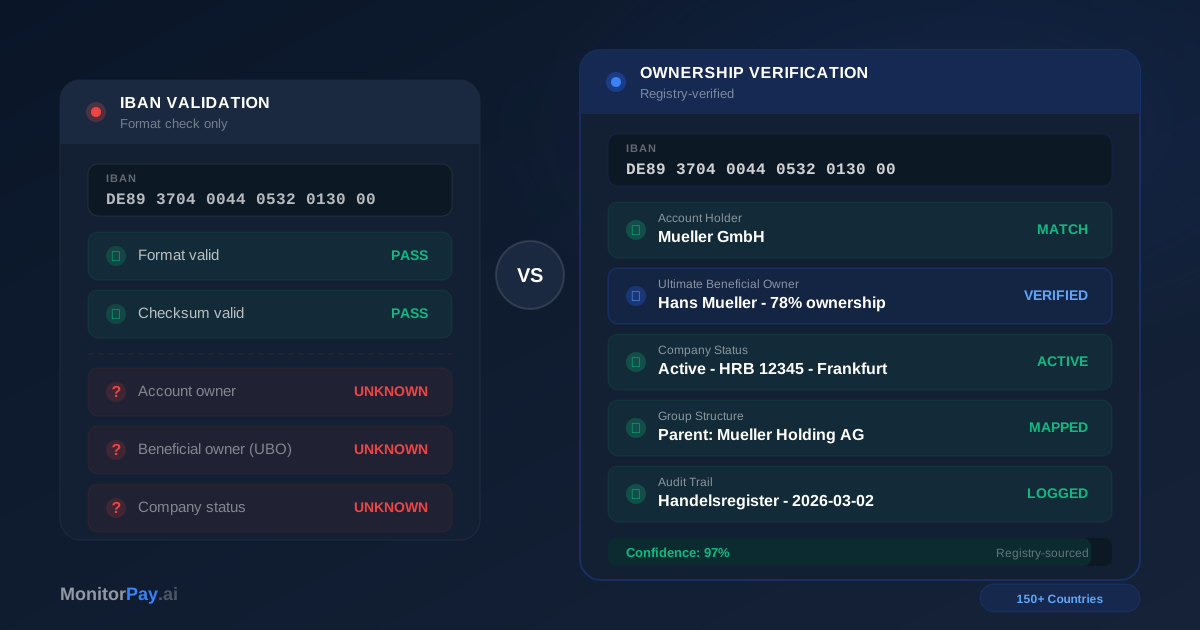
IBAN validation is a technical check. It confirms three things: the IBAN follows the correct structure for its country (length, prefix, format), the checksum digits are mathematically valid, and the bank identifier within the IBAN corresponds to a real financial institution.
That's the entire scope. When your system "validates" an IBAN, it's confirming syntax. Think of it like checking that an email address has an @ symbol and a domain — it tells you the format is correct, not that the person you're emailing actually owns that inbox.
Fraudulent accounts, impersonation, misdirected payments to the wrong company, shell company bank accounts, accounts belonging to sanctioned entities. IBAN validation catches typos. It doesn't catch criminals.
For low-risk, high-volume consumer payments, IBAN validation reduces failed transfers. For B2B payments — supplier invoices, vendor onboarding, cross-border transfers — format validation alone is dangerously insufficient.
What Is Account Ownership Verification?
Account ownership verification goes beyond format. It answers the question: who legally owns this account?
Instead of checking whether an IBAN is structurally valid, ownership verification confirms that the person or company you intend to pay is the actual, registered holder of the account you're about to send money to.
There are two approaches:
Name matching compares the name you provide against the name the bank has on file for that account. If the names match (or closely match), the payment is flagged as safe.
Registry-based verification goes further. It cross-references the account holder against official government company registries — confirming not just that a name matches, but that the legal entity behind the account is a real, registered, active business. And critically, it reveals the Ultimate Beneficial Owner (UBO) — the real person who controls or profits from the company behind that account. This is the layer that name matching cannot touch.
Name matching checks a string of characters. Registry-based verification checks the legal reality — the entity, its status, and the beneficial owner behind it.
IBAN Validation vs. Account Ownership Verification: Key Differences
| Feature | IBAN Validation | Name Matching (CoP/VoP) | Registry-Based Verification |
|---|---|---|---|
| What it checks | Format, structure, checksum | Name on the account vs. name provided | Legal entity against government registries |
| Data source | Algorithmic (no external lookup) | Bank records | Government company registries (100+ countries) |
| Catches typos | ✓ Yes | ✓ Yes | ✓ Yes |
| Catches fraud | ✗ No | ◐ Partially | ✓ Yes |
| Catches shell companies | ✗ No | ✗ No | ✓ Yes |
| Reveals Ultimate Beneficial Owner (UBO) | ✗ No | ✗ No | ✓ Yes |
| Cross-border coverage | IBAN countries only | Limited (UK, NL, expanding EU) | Global — 150+ countries |
| Regulatory alignment | Basic | PSD3/VoP compliant | Exceeds PSD3 — full audit trail |
| Audit trail | None | Match/no-match result | Full record: source, timestamp, entity details |
The gap between columns two and three is where most enterprise risk sits.
Why IBAN Validation Alone Is Not Enough
The numbers make the case. The EBA and ECB reported that across the European Economic Area, credit transfer fraud losses reached €2.2 billion in 2024 — a 16% increase year-on-year. Payment service users bore approximately 85% of those losses, primarily because scams tricked them into initiating payments to fraudulent accounts.
In the UK, APP fraud — where victims are manipulated into authorising payments themselves — accounted for £450.7 million in losses. About 70% of APP fraud cases originated on online platforms.
Every one of those payments passed IBAN validation. The format was correct. The money went through. It just went to the wrong entity.
For enterprise finance teams making high-value B2B payments, the risk compounds. A single misdirected supplier payment can mean six or seven figures lost — not because the system failed, but because nobody verified who actually controlled the destination account.
Why Name Matching Falls Short
The EU's Instant Payments Regulation made Verification of Payee (VoP) mandatory for SEPA credit transfers in euros starting October 2025. Under PSD3 — where a political agreement was reached in November 2025 — this extends to all credit transfers across currencies. The UK has had Confirmation of Payee (CoP) since 2019.
These systems work by matching the name a payer enters against the name the receiving bank has on file. SurePay, the dominant provider in Europe, has built an effective name-matching algorithm that handles typos, name order variations, and partial matches. In the Netherlands, where it covers 99.5% of bank accounts, it contributed to reducing fraud by 81% and misdirected payments by 67%.
Strong results for consumer payments. But name matching has structural limitations for B2B and cross-border use cases:
Name variations. Companies operate under trading names, legal names, abbreviations, and local-language names. "Deutsche Bank AG" vs. "Deutsche Bank" vs. "DB" — which one is on file?
Transliteration. Cross-border payments involve names in different scripts. A Chinese company name romanized one way by the sender and another by the bank triggers a false mismatch — or a false match.
Shell companies, nominees, and hidden UBOs. A name-matching check confirms that "ABC Holdings Ltd" matches the account. It doesn't tell you ABC Holdings is a shell with no employees, registered yesterday, controlled by a sanctioned individual three layers deep in an ownership chain. Without UBO visibility, you're verifying a label — not the person behind it.
Limited geographic coverage. CoP and VoP are bank-dependent schemes. They work where participating banks have implemented the system. For payments outside the Eurozone and UK, coverage drops sharply.
Name matching was a necessary first step. But for enterprise compliance, treasury, and procurement teams, it's not enough to match a name. You need to verify the entity.
How MonitorPay.ai Approaches Account Ownership Verification
MonitorPay.ai takes a fundamentally different approach. Instead of relying on bank-held name records, MonitorPay verifies account ownership by cross-referencing account holder data against official government company registries across 150+ countries — and goes one step further by identifying the Ultimate Beneficial Owner (UBO) behind the entity.
This means you don't just see the company name on the account. You see who actually controls it — the natural person(s) with significant ownership or control, even when hidden behind layers of holding companies, trusts, or nominee structures.
When you submit a verification request, the system returns:
Verified Account Holder NameMatched against registry records, not just bank data
Ultimate Beneficial Owner (UBO)The real person(s) who own or control the entity — even through layered ownership structures
Company DetailsLegal name, registration number, address, status, VAT number, incorporation date
Group StructureParent companies, subsidiaries, branches — full corporate hierarchy
Enriched FirmographicsIndustry codes, revenue estimates, employee count, technology stack
Match Result & Confidence ScoreExact, partial, or mismatch — with account type (business/personal)
Full Audit TrailTimestamped verification with source reference for compliance
Continuous MonitoringWebhook alerts when ownership changes, accounts close, or risk signals emerge
This isn't a name check. It's a full identity verification of the legal entity — and the beneficial owner — behind the account.
The practical difference: name matching tells you the name on the account looks right. MonitorPay tells you the company behind the account is registered, active, located where it claims to be, controlled by the people it claims are in charge — and shows you the real human being who ultimately benefits from it.
Use Cases: When Ownership Verification Matters Most
Vendor onboarding and supplier payments
New supplier submits bank details. IBAN validates. Name matches. But is this a legitimate company or a recently created entity impersonating your real supplier? And who actually owns it? Registry-based verification with UBO data catches what name matching cannot — including payments routed to entities controlled by sanctioned or high-risk individuals.
Cross-border B2B transactions
Paying a supplier in a country where VoP/CoP isn't available. Without bank-side name matching, you have zero verification at the point of payment — unless you verify ownership through registries.
High-value payment approval workflows
Any payment above a material threshold should include ownership verification as a standard control. The cost of a single fraudulent high-value payment dwarfs the cost of verification.
AML/KYB compliance checks
Regulatory expectations are moving beyond account names toward verifying beneficial ownership. The EU's Anti-Money Laundering Regulation already requires identification of UBOs holding 25%+ ownership. PSD3 is the floor, not the ceiling. Teams that build ownership and UBO verification into their payment workflows now are ahead of the next regulatory cycle — and the next audit.
How to Evaluate an Account Ownership Verification Provider
Not all verification services are equal. When evaluating providers, look for:
Data sources. Does the provider access government company registries directly, or aggregate from third parties? First-party registry data is more accurate and more defensible in an audit.
Geographic coverage. How many countries are covered? Enterprise payments are global. A solution limited to the EU and UK leaves gaps.
Depth of verification. Does the provider return only a match/no-match result, or full entity details including registration status, ownership structure, and UBO information? Knowing the account holder name is table stakes. Knowing the beneficial owner behind three layers of holding companies is the real value.
Audit trail. Can you prove, in a regulatory review, exactly what was verified, when, and from what source?
API integration. Can verification be embedded into existing payment workflows, ERP systems, and onboarding processes? Manual portal checks don't scale.
Continuous monitoring. Ownership changes. Companies dissolve, merge, or get acquired. A one-time check at onboarding isn't sufficient.
MonitorPay.ai checks every one of these boxes — with 150+ country coverage, direct government registry connections, enriched firmographic data, real-time API access, and continuous monitoring with webhook alerts.
Ready to verify who you're really paying?
Start with 100 free checks. No subscription. No credit card. Pay only for what you use.
Start Free VerificationVolume pricing from €0.10 per check