IBAN Validation API: How to Verify Bank Accounts Before You Pay
IBAN Validation API: How to Verify Bank Accounts Before You Pay
Learn how IBAN validation APIs work, why format checks alone won’t protect you from payment fraud, and what to look for when choosing a verification provider.
79% of organizations experienced payment fraud in 2024. The average cost per failed B2B payment is $12.10. For companies processing thousands of payments monthly, these errors compound into six-figure losses.
An IBAN validation API is your first line of defense. But not all validation is equal. This guide breaks down what IBAN validation actually checks, where it falls short, and how to build a verification workflow that catches fraud before money moves.
What Is an IBAN Validation API?
An IBAN (International Bank Account Number) is a standardized format for identifying bank accounts across borders. Used in 80+ countries, it combines a country code, check digits, and the domestic bank account number into a single string.
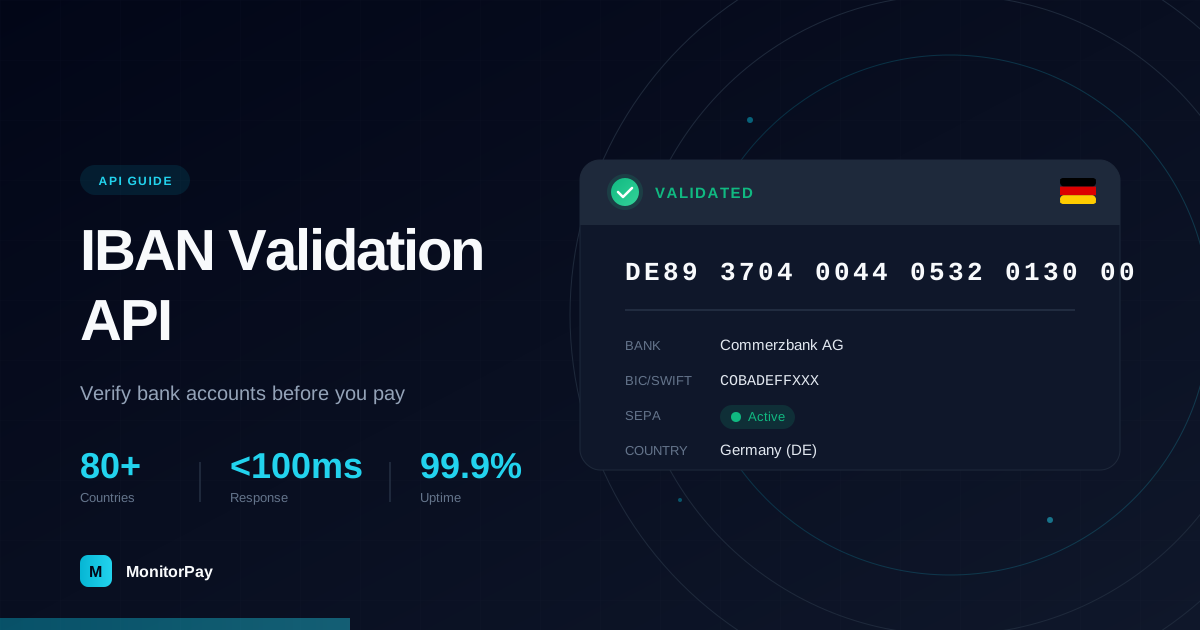
An IBAN validation API checks whether a given IBAN is technically correct. It verifies structure, length, and checksum in milliseconds, returning data about the associated bank before you initiate a transfer.
How IBAN Validation Works
When you submit an IBAN to a validation API, the system runs multiple checks:
- Country code verification – Confirms the 2-letter ISO code matches an IBAN-enabled country
- Length validation – Each country has a fixed IBAN length (e.g., DE = 22 characters, GB = 22, FR = 27)
- Checksum calculation – Uses MOD-97 algorithm to verify the check digits
- Bank code lookup – Returns bank name, BIC/SWIFT code, and branch details
- SEPA membership – Indicates whether the bank supports SEPA credit transfers
What Data an IBAN Check Returns
A typical API response includes:
| Field | Description |
|---|---|
| Valid (true/false) | Whether the IBAN passes all format checks |
| Country Code | ISO 3166-1 alpha-2 code (e.g., DE, GB, FR) |
| Bank Name | Official name of the financial institution |
| BIC/SWIFT | 8 or 11-character bank identifier code |
| Branch | Branch address and location details |
| SEPA Support | SCT, SDD, B2B, and instant payment capabilities |
Why IBAN Validation Alone Isn’t Enough
Here’s the problem: a valid IBAN doesn’t mean you’re paying the right person.
IBAN validation confirms format. It tells you the IBAN could exist. It doesn’t confirm that the account belongs to your intended recipient.
The Gap Between “Valid Format” and “Correct Account”
Consider this scenario: A fraudster sends you an invoice with updated bank details. The IBAN passes validation—it’s structurally correct and belongs to a real bank. But the account holder isn’t your supplier. It’s a mule account.
This is Business Email Compromise (BEC). The FBI reports BEC has cost businesses $55 billion over the past decade. Format validation catches typos. It doesn’t catch fraud.
Real-World Cost of Misdirected Payments
| Metric | Impact |
|---|---|
| Average cost per failed B2B payment | $12.10 |
| Organizations experiencing payment fraud (2024) | 79% |
| B2B invoices currently overdue in the US | 55% |
| Average annual loss to invoice fraud | $1M+ per company |
| Finance teams still manually checking bank details | 72% |
Sources: AFP, LexisNexis, CFO.com (2024)
IBAN Validation vs. Account Ownership Verification
These are two different layers of verification. You need both.
| Check | IBAN Validation | Ownership Verification |
|---|---|---|
| What it verifies | Format, structure, checksum | Account holder identity |
| Data source | Algorithm + bank directories | Bank records / registries |
| Catches typos | Yes | Yes |
| Catches fraud | No | Yes |
| Response time | < 100ms | < 1 second |
| Use case | Form input validation | Payment approval gate |
When You Need Both
Use IBAN validation at the point of data entry—when a vendor submits their details or when your team inputs payment information. This catches obvious errors before they enter your system.
Use account ownership verification before you authorize payment—especially for new vendors, large transfers, or changed bank details. This confirms the account actually belongs to who they claim to be.
Key Features to Look for in an IBAN Validation API
Not all APIs are equal. Here’s what separates basic validators from enterprise-grade solutions:
- Real-Time Response
Sub-second response times are non-negotiable for inline form validation. Look for providers with < 100ms latency and 99.9%+ uptime SLAs. - Bank and BIC Lookup
The API should return enriched data: bank name, BIC/SWIFT code, branch address, and SEPA capabilities. This helps your team verify the payment route before execution. - Payee Name Matching
The most valuable addition to IBAN validation is name matching—checking whether the account holder’s name matches what you expect. This is now mandatory in the EU under Verification of Payee (VoP) regulations (effective October 2025). - Bulk Validation Support
For treasury teams processing hundreds or thousands of payments, batch validation is essential. The API should accept CSV uploads or bulk API calls with efficient rate limits.
Coverage (Countries and Banks)
| Region | IBAN Countries | Key Markets |
|---|---|---|
| Europe (SEPA) | 36 | DE, FR, GB, IT, ES, NL |
| Middle East & Africa | 20+ | AE, SA, IL, EG, QA |
| Americas | 5 | BR, CR, GT, SV, LC |
| Total IBAN-enabled | 80+ | — |
Note: The US, Canada, and Australia do not use IBAN. They require local account number + routing code validation.
How to Integrate an IBAN Validation API
Most IBAN APIs use REST with JSON responses. Integration typically takes less than a day.
API Request/Response Example
Request:
GET /api/v1/validate?iban=DE89370400440532013000
Response:
{ “valid”: true, “iban”: “DE89370400440532013000”, “country_code”: “DE”, “bank_name”: “Commerzbank”, “bic”: “COBADEFFXXX”, “sepa”: { “sct”: true, “sdd”: true, “instant”: true }}
Common Integration Patterns
- Vendor onboarding: Validate IBAN when suppliers submit bank details. Block submission if invalid.
- Payment approval: Re-validate before authorizing transfers. Flag changed IBANs for manual review.
- ERP sync: Batch-validate your vendor master file nightly. Surface invalid records to AP teams.
Use Cases by Industry
- Fintechs and PSPs
Embed validation into onboarding and payout flows. Reduce failed transactions and protect against authorized push payment (APP) fraud. With instant payments now mandatory in the EU, pre-payment verification is a compliance requirement. - Corporate Treasury and AP Teams
Validate supplier bank details before payment runs. Flag IBANs that don’t match your records. Automate the manual checking that consumes 72% of finance teams’ time. - Marketplaces and Platforms
Verify seller and freelancer accounts at signup—not after the first payout fails. Continuous monitoring catches account changes before they cause chargebacks. - Banks and Lenders
Automate KYB checks with registry-verified ownership data. Validate disbursement accounts to prevent loan fraud. Meet VoP requirements with real-time name matching.
Compliance Considerations
PSD2 and Verification of Payee (VoP) Requirements
As of October 9, 2025, Verification of Payee is mandatory for all Payment Service Providers in the Eurozone. Non-Euro EU countries must comply by July 2027.
VoP requires PSPs to check that the payee’s name matches the IBAN before executing SEPA credit transfers. Responses include: Match, Close Match, No Match, or Unable to Verify. The payer then decides whether to proceed.
GDPR and Data Handling
Choose providers that don’t store sensitive payment data beyond what’s necessary for verification. Look for: EU-based data centers, no logging of full IBANs, and clear data retention policies.
Audit Trail Requirements
For regulated industries, every validation request should be logged with timestamp, result, and unique reference. This creates the paper trail auditors require and supports dispute resolution.
How to Choose the Right IBAN Validation Provider
Questions to Ask Before You Integrate
- What’s your data source? Direct bank directories and official registries are more reliable than aggregated data.
- Do you support name matching? With VoP now mandatory, this is a must-have.
- What’s your coverage? Ensure the provider covers all countries where you do business.
- What’s your uptime SLA? Payment verification is mission-critical. Look for 99.9%+.
- How is pricing structured? Per-check pricing with volume discounts is standard. Avoid providers with hidden fees.
Red Flags to Avoid
- No name matching capability
- Stale bank directory data (check update frequency)
- No audit logging or compliance documentation
- Slow response times (>500ms)
- No bulk validation option for treasury use cases
FAQs
- Is IBAN validation free?
Basic format validation can be performed locally using the MOD-97 algorithm—that’s free. But enriched validation (bank lookup, name matching, ownership verification) requires API access, typically priced per check (€0.01–€0.50 depending on features and volume). - Which countries support IBAN?
80+ countries use IBAN, including all of Europe, the UK, and much of the Middle East. Major exceptions: the US, Canada, Australia, and most of Asia use local account formats instead. - Can I validate IBANs in bulk?
Yes. Most enterprise-grade APIs support batch validation via CSV upload or bulk API endpoints. This is essential for treasury teams validating vendor master files. - What happens if the IBAN is valid but the name doesn’t match?
This is the most important alert. A valid IBAN with a name mismatch is a strong indicator of potential fraud or data entry error. Under VoP regulations, you’ll receive a “No Match” or “Close Match” response—you should investigate before proceeding with payment.
Next Steps: Verify Bank Accounts Before You Pay
MonitorPay combines IBAN validation with account ownership verification—powered by data from 200+ official government registries.
- Validate IBAN structure, bank details, and SEPA support
- Match payee names to account holders
- Verify account ownership from official sources
- Monitor for changes after verification
- First 100 checks free—no commitment required