Verification of Payee (VoP): The Complete Guide to EU Payment Verification Requirements
The European Union’s Instant Payments Regulation (IPR) introduced a game-changing requirement for payment security: Verification of Payee (VoP). This mandate requires all Payment Service Providers (PSPs) in the Eurozone to verify that a payee’s name matches their IBAN before executing credit transfers.
For finance teams, compliance officers, and treasury departments, VoP represents both a regulatory obligation and a powerful fraud prevention tool. This guide covers everything you need to know about implementing VoP, meeting compliance deadlines, and protecting your organisation from payment fraud.
What Is Verification of Payee?
Verification of Payee (VoP) is a fraud prevention service developed by the European Payments Council (EPC) that confirms whether the name on a bank account matches the account details provided by a payer before processing a payment.
When you initiate a SEPA credit transfer, VoP performs a real-time check between the payee name you entered and the name registered at the receiving bank. This verification happens instantly before the payment is authorised, giving you the opportunity to cancel if something doesn’t match.
The service applies to both standard SEPA Credit Transfers (SCT) and SEPA Instant Credit Transfers (SCT Inst). This is particularly important for instant payments, which are immediate and irrevocable, leaving virtually no time to reverse fraudulent transactions.
Why Was VoP Introduced?
The EU introduced VoP as part of the Instant Payments Regulation (IPR) to address the alarming rise in payment fraud across Europe. The statistics paint a concerning picture:
| Fraud Metric | Value |
|---|---|
| Total EU payment fraud (2022) | €4.3 billion |
| EU payment fraud (H1 2023) | €2.0 billion |
| UK APP fraud losses (2024) | £450.7 million |
| UK APP fraud H1 2025 (YoY increase) | £257.5 million (+12%) |
| Businesses experiencing B2B payment fraud attempts | 80% |
| Global cross-border payment fraud (2024 est.) | >$1 trillion |
Sources: EBA/ECB 2024 Report on Payment Fraud, UK Finance Annual Fraud Report 2025, AFP 2024 Payments Fraud Survey, Experian 2024
Authorised Push Payment (APP) fraud, where victims are tricked into sending money to accounts controlled by criminals, has become one of the most damaging fraud types. In the UK, APP fraud accounted for 41% of all fraud losses in H1 2025, with investment scams alone surging 55% year-over-year.
The EU recognised that the growth of instant payments required equally instant security measures. Without name verification, payments could be misdirected in seconds with little chance of recovery.
VoP Compliance Deadlines and Requirements
The EPC VoP Scheme Rulebook entered into force on 5 October 2025, just days before the regulatory deadline. Here are the key dates:
| Deadline | Requirement | Affected PSPs |
|---|---|---|
| 9 January 2025 | Receive instant payments | Eurozone PSPs |
| 9 October 2025 | Send instant payments + VoP mandatory | Eurozone PSPs |
| 9 July 2027 | Full VoP compliance | Non-Euro EU PSPs |
Countries Affected by October 2025 Deadline
The first group of 20 EU Member States whose currency is the Euro: Austria, Belgium, Cyprus, Germany, Estonia, Spain, Finland, France, Greece, Croatia, Ireland, Italy, Lithuania, Luxembourg, Latvia, Malta, Netherlands, Portugal, Slovenia, and Slovakia.
Countries Affected by July 2027 Deadline
Non-euro EU Member States: Bulgaria, Czech Republic, Denmark, Hungary, Poland, Romania, and Sweden.
Note: Other SEPA countries (UK, Switzerland, Norway, etc.) are in the EPC VoP scheme scope but are not bound by EU regulation dates. Adoption depends on local law.
How Verification of Payee Works
The VoP process operates through a standardised inter-PSP communication flow:
- Initiation: The payer enters the payee’s IBAN and name when setting up a payment.
- Verification Request: The payer’s PSP (Requesting PSP) sends the information to the payee’s PSP (Responding PSP) via SEPA networks or dedicated Routing and Verification Mechanisms (RVMs).
- Validation: The Responding PSP checks the provided name against their customer records using advanced matching algorithms.
- Response: A match result is returned (Match, Close Match, No Match, or Unable to Verify).
- Decision: The payer receives the result and decides whether to proceed, modify, or abort the transaction.
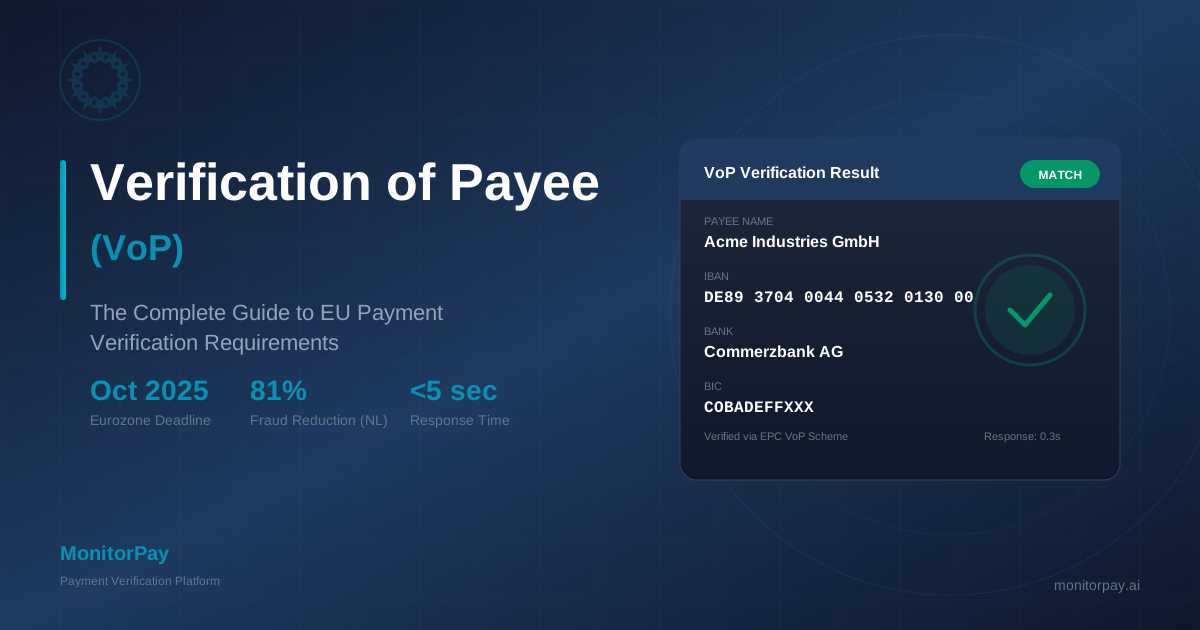
The entire process must complete within 5 seconds, with a target of under 1 second. The EPC Directory Service acts as a centralised lookup mechanism supporting interoperability between PSPs.
VoP Response Types Explained
Understanding VoP response types is critical for payment operations:
| Response | Meaning | Recommended Action |
|---|---|---|
| Match | Name exactly matches bank records | Safe to proceed with payment |
| Close Match | Minor differences detected (typos, abbreviations) | Review and verify before proceeding |
| No Match | Name does not match account holder | Do not proceed; verify payee details |
| Unable to Verify | Technical issues or bank cannot perform check | Proceed with caution; verify manually |
When VoP returns a ‘No Match’ or ‘Close Match’, the payer must be informed and warned of the risks before proceeding. If a payer authorises a transfer after being warned of an incorrect unique identifier, they assume liability for the transfer reaching an unintended recipient.
The Proven Success of Name Verification
Name verification services have already demonstrated remarkable fraud prevention results in countries that implemented them early:
Netherlands: IBAN-Name Check Results
The Netherlands pioneered IBAN-Name Check through SurePay in 2017. Results after implementation:
| Metric | Result |
|---|---|
| Fraud reduction in payments to Dutch IBANs | 81% decrease |
| Reduction in misdirected payments | 67% decrease |
| Invoice fraud reduction (Rabobank pilot) | 70% decrease |
| Total checks performed | 3.5+ billion |
| Coverage of Dutch payments | 99.5% |
Source: SurePay, European Payments Council
United Kingdom: Confirmation of Payee Results
The UK launched Confirmation of Payee (CoP) in 2020. Key achievements:
- 2.5+ billion CoP checks completed since launch
- 2+ million checks performed daily
- 99% coverage of Faster Payments and CHAPS transactions
- 300+ financial institutions now offering CoP
- Nearly 60% reduction in related fraud cases since 2020
These results demonstrate that when implemented correctly, name verification significantly reduces both fraud and accidental misdirected payments.
VoP vs. Confirmation of Payee: Key Differences
While VoP and CoP serve similar purposes, there are important distinctions:
| Feature | VoP (Europe) | CoP (UK) |
|---|---|---|
| Governing Body | European Payments Council | Pay.UK |
| Geographic Scope | SEPA zone (36 countries) | United Kingdom |
| Account Identifier | IBAN | Sort code + Account number |
| Mandatory Since | October 2025 (Eurozone) | March 2020 (major banks) |
| Payment Types | SCT, SCT Inst | Faster Payments, CHAPS |
| Additional Identifiers | VAT number, LEI (optional) | Business/Personal indicator |
VoP was heavily influenced by the UK’s CoP experience. The EPC studied CoP’s implementation and incorporated lessons learned into the VoP scheme design.
VoP Limitations and What It Doesn’t Cover
While VoP is a powerful fraud prevention tool, it’s not a complete solution. Understanding its limitations is essential:
Geographic Limitations
- VoP only applies within the SEPA zone
- Cross-border payments outside SEPA remain unprotected
- No verification for payments to non-participating banks
Technical Limitations
- Name matching algorithms vary between PSPs
- ‘Close Match’ definitions may differ across institutions
- Trade names vs. legal entity names can cause mismatches
Fraud Types VoP Cannot Prevent
- Identity theft (fraudster opens account in victim’s name)
- Money mule accounts (legitimate accounts used for fraud)
- Account takeover (fraudster controls legitimate account)
- Sophisticated social engineering scams
- Deepfake impersonation of executives
VoP should be seen as a first line of defence, not a silver bullet. Businesses need to embed it into a broader fraud prevention strategy.
How to Prepare Your Organisation for VoP
Whether you’re a PSP implementing VoP or a corporate preparing for the changes, here’s your action plan:
For Payment Service Providers
- Register with the EPC Directory Service (EDS)
- Implement VoP API following ISO 20022 standards
- Develop name-matching algorithms (Levenshtein, phonetic)
- Ensure sub-5-second response times
- Update customer-facing interfaces with VoP messaging
- Train staff on VoP requirements and customer communication
For Corporate Finance Teams
- Audit vendor master data for name accuracy
- Ensure beneficiary names match official bank records
- Update invoicing processes to capture exact legal entity names
- Check ERP/TMS system compatibility with VoP responses
- Establish procedures for handling ‘No Match’ results
- Train AP/Treasury teams on VoP workflows
Beyond VoP: Building a Complete Payment Security Strategy
VoP addresses one critical vulnerability in the payment chain. But sophisticated fraudsters use multiple attack vectors. A comprehensive strategy should include:
| Security Layer | Purpose |
|---|---|
| VoP/Name Verification | Confirms payee identity matches bank records |
| Account Ownership Verification | Validates company actually owns the bank account (via registry data) |
| Continuous Account Monitoring | Detects changes to vendor bank details in real-time |
| Vendor Onboarding Verification | Validates new vendors before adding to payment systems |
| Sanctions Screening | Ensures payees aren’t on restricted party lists |
| Behavioural Analytics | Detects unusual payment patterns indicating fraud |
Why Account Ownership Verification Matters
VoP confirms a name matches an account. But it doesn’t verify that the company you’re paying actually owns that account. A fraudster could open an account in a similar name, or use a compromised legitimate account.
Account ownership verification goes deeper by cross-referencing bank account details against official company registry data. This adds a critical verification layer that VoP alone cannot provide.
MonitorPay provides this enhanced verification by connecting to 200+ government registries worldwide, verifying that the company requesting payment actually owns the bank account they’re providing—before you send funds.
Impact on Business Operations
VoP implementation creates operational considerations for businesses processing SEPA payments. Finance teams need to understand both the opportunities and challenges.
Process Efficiency Considerations
Because VoP checks happen at the point of payment initiation, any ‘Close Match’, ‘No Match’, or ‘Unable to Verify’ result can disrupt the payment flow. This creates potential friction in several scenarios:
- Supplier payments may be delayed while teams investigate mismatches
- Commercial relationships can be strained by payment delays
- Vague statuses like ‘Close Match’ create confusion about whether to proceed
- Batch payment processing may require more manual intervention
Common Causes of VoP Mismatches
Understanding why mismatches occur helps teams proactively address issues:
| Cause | Example |
|---|---|
| Trade name vs. legal name | Invoice shows ‘ABC Software’ but account registered to ‘ABC Technologies Ltd’ |
| Abbreviations | ‘Intl’ vs ‘International’, ‘Ltd’ vs ‘Limited’, ‘GmbH’ vs full legal form |
| Special characters | Umlauts, accents, or other diacritical marks handled differently |
| Outdated records | Company renamed after merger but bank records not updated |
| Subsidiary confusion | Payment to holding company account but invoice from operating subsidiary |
The Growth of Instant Payments in Europe
VoP arrives as instant payments are experiencing rapid growth across Europe. According to ECB statistics, instant credit transfers now account for approximately 16% of all credit transfer transactions by volume in the Eurozone, with the market expected to grow at 11.56% CAGR through 2033.
In Germany alone, SEPA instant credit transfers rose 37% year-over-year in 2024, reaching 337 million transactions. Their share of all electronically initiated credit transfers increased to 4.9%. This growth trajectory makes VoP’s fraud prevention capabilities increasingly important.
From October 2025, all Eurozone banks must both send and receive instant payments. Experts predict the volume of SEPA instant payments could quickly reach 30-40% of all credit transfers as corporates convert bulk payments to instant transfers for improved cash flow management.
Frequently Asked Questions
- Is VoP mandatory for all payments?
Yes, for SEPA credit transfers (both standard and instant) processed by PSPs in the Eurozone from October 2025. Non-consumer payers can opt out, but this shifts liability to them. - Does VoP cost anything?
PSPs must offer VoP free of charge to payers. The costs of implementation and operation are borne by the financial institutions. - Can VoP block a payment?
No, VoP provides a warning but doesn’t automatically block payments. Payers can still proceed after a ‘No Match’ result, but they do so at their own risk and may assume liability. - What if VoP returns ‘Unable to Verify’?
This typically indicates technical issues or that the receiving bank cannot perform the check. Proceed with additional caution and consider manual verification of payee details. - Does VoP apply to batch payments?
Yes, VoP checks must be available for both single and batch payments, with opt-in or opt-out options for the latter depending on the PSP’s implementation. - Who is liable if fraud occurs after a VoP warning?
If a payer proceeds with a transfer after being warned of a mismatch, they assume liability for the transfer reaching an unintended recipient. - How should I handle trade names vs. legal names?
Update your vendor master data to use official legal entity names as registered with banks. Ask vendors to confirm the exact name on their bank account. Consider implementing pre-validation checks before payment initiation. - What happens to payments outside the SEPA zone?
VoP only applies to SEPA credit transfers. International payments outside the SEPA zone remain unaffected by this regulation. For cross-border payments beyond SEPA, consider using additional verification solutions like account ownership validation. - Can PSPs offer additional VoP services?
Yes. While the VoP rulebook standardises core verification activities, PSPs can create ‘Additional Optional Services’ such as enhanced fraud scoring, pre-validation APIs, or consumer-level alerts on ‘Close Match’ notifications. - What is the difference between VoP and IBAN validation?
IBAN validation only checks whether an IBAN is technically valid and correctly formatted. VoP goes further by verifying that the payee name you entered actually matches the account holder registered at the receiving bank. IBAN validation catches formatting errors; VoP catches fraud and misdirected payments. - How fast is the VoP verification process?
The EPC VoP Rulebook requires the entire verification process to complete within 5 seconds maximum, with a target of under 1 second. This real-time verification happens before payment authorisation, allowing payers to make informed decisions without significant delays. - Will VoP work for recurring payments and direct debits?
VoP applies specifically to SEPA Credit Transfers (SCT and SCT Inst). Direct debits operate differently as funds are pulled rather than pushed. However, the UK’s Pay.UK offers Payer Name Verification (PNV) for Direct Debit setups. Similar extensions may develop in the SEPA zone over time. - What countries are covered by VoP?
VoP covers all 36 SEPA countries. The 20 Eurozone countries (Austria, Belgium, Cyprus, Germany, Estonia, Spain, Finland, France, Greece, Croatia, Ireland, Italy, Lithuania, Luxembourg, Latvia, Malta, Netherlands, Portugal, Slovenia, Slovakia) must comply by October 2025. Non-Euro EU members have until July 2027. Other SEPA countries like UK, Switzerland, and Norway may adopt voluntarily. - How does VoP handle business accounts vs personal accounts?
VoP can optionally verify additional identifiers for business accounts, such as VAT numbers or Legal Entity Identifiers (LEI). This helps distinguish between similarly named businesses. The response may also indicate whether the account is registered as personal or business, adding another verification layer. - Can fraudsters bypass VoP by using stolen identities?
Yes, this is a known limitation. If a fraudster opens an account using stolen identity documents, VoP will return a ‘Match’ because the account is legitimately registered in that name. This is why VoP should be combined with account ownership verification that cross-references company registry data to confirm the business actually owns the account. - What is the EPC Directory Service and why does it matter?
The EPC Directory Service (EDS) is a centralised database that stores essential information for VoP interoperability, including PSP identification data, BIC codes, and LEI numbers. All PSPs participating in VoP must register with the EDS. It went live in September 2025 and enables PSPs to route verification requests to the correct receiving bank. - How should treasury teams update their processes for VoP?
Treasury teams should audit vendor master data to ensure beneficiary names match official bank records exactly. Update ERP and TMS systems to handle VoP responses. Establish clear procedures for investigating ‘No Match’ results. Train staff on when to proceed versus escalate. Consider implementing pre-validation checks during vendor onboarding rather than at payment time. - Is VoP the same as Know Your Business (KYB) verification?
No. VoP is a payment-time check that confirms name-to-IBAN matching. KYB is a broader compliance process that verifies business legitimacy, ownership structure, beneficial owners, and regulatory status during onboarding. VoP answers ‘does this name match this account?’ while KYB answers ‘is this a legitimate business I should work with?’ Both are important but serve different purposes.
Conclusion: VoP Is Just the Beginning
Verification of Payee represents a significant step forward in European payment security. The mandate ensures that basic name verification becomes standard across all SEPA credit transfers, adding a critical checkpoint before funds leave your account.
The evidence from early adopters is compelling. The Netherlands achieved an 81% reduction in payment fraud after implementing IBAN-Name Check. The UK’s Confirmation of Payee has processed over 2.5 billion checks since 2020, with fraud cases dropping nearly 60%. These results demonstrate that name verification works when implemented at scale.
However, VoP alone cannot protect against sophisticated fraud schemes. Organisations that rely solely on name matching remain vulnerable to identity theft, account takeover, money mule accounts, and advanced social engineering attacks including deepfake impersonation.
The most secure approach combines VoP with deeper verification layers—including account ownership validation against official registry data, continuous monitoring for changes to vendor bank details, and robust vendor onboarding processes that verify business legitimacy before adding new payees to your systems.
As instant payments continue their rapid growth across Europe—projected to reach 30-40% of all credit transfers in the coming years—the importance of robust payment verification will only increase. The irrevocable nature of instant payments means that funds sent to the wrong account are often gone for good.
Ready to go beyond basic name matching? MonitorPay provides comprehensive payment verification by validating account ownership against 200+ official government registries worldwide. Start your free trial with 100 verification checks to see how registry-sourced verification adds the security layer that VoP alone cannot provide.
Protect Your Payments with MonitorPay
Verify account ownership against official registry data before you pay.